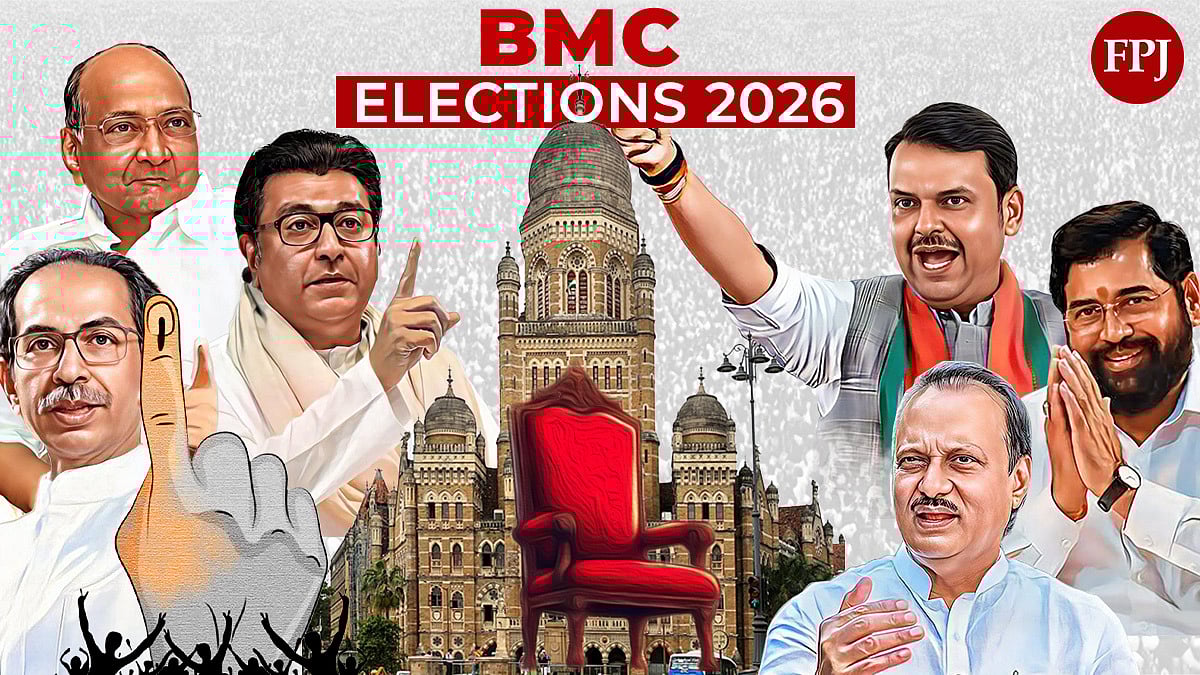
The election to the Brihanmumbai Municipal Corporation (BMC) is just a few days away. The contest among candidates of various political parties has intensified. Amid all this political churn, the common Mumbaikar remains silent—as does this metropolis that provides livelihoods to millions of families every day. Spread over 480 square kilometres, this city deserves to be discussed beyond the lens of politics.
Mumbai contributes 45 to 50 per cent of the state’s total revenue. Additionally, Mumbai’s share in the Gross Domestic Product (GDP) is 6.16%. As India aspires to become a USD 5 trillion economy and Maharashtra seeks to make a substantial contribution to it, Mumbai’s role becomes vital. For that, the city’s governance must be equally strong. Roads, sewage systems, street lighting, healthcare, education, and maintaining the city’s aesthetics must therefore be top priorities for the municipal corporation.
Everything New After Seven Years
The last municipal election was held in 2017. After that, the years 2020, 2021, and 2022 were spent battling COVID-19. During these three years, the corporation’s focus changed completely. Activity in its buildings came to a halt. In March 2022, the elected body of the BMC was dissolved; four years have now passed since then. For seven years—three years of COVID and four thereafter—the corporation functioned without elected councillors. During this period, many officials retired, creating a significant vacuum.
Now, new councillors will come in, and much of the administrative machinery is also relatively new. How they will function will be interesting to watch. Increasing the corporation’s revenue is imperative. Large infrastructure projects have put pressure on the civic treasury. It is said that in the last four years, the corporation has issued work orders worth around ₹2.5 lakh crore. Whether the civic coffers can withstand such strain should have been seriously considered.
The next five years will be extremely challenging for the corporation. Every month, ₹700–800 crore is required just to pay salaries. The corporation cannot be run on emotional politics alone; it requires a practical approach and capable leadership. Around ₹10,000 crore is due to the corporation from various state government departments and authorities.
Not a Single New Building
Even if the corporation currently appears flush with funds, ignoring civic amenities and administration will lead to very serious problems. In recent years, an important business district like the Bandra–Kurla Complex (BKC) has developed. It houses the US Consulate, a bullet train station, a diamond hub, the Mumbai Cricket Association’s indoor stadium, and offices of the central government and leading corporate groups. Yet, there is not a single well-equipped municipal building in this area that could serve as a major center for suburban civic services—no one ever planned for it.
The seating capacity of the assembly hall at the BMC headquarters is 70, yet 270 councillors sit there. During meetings, a large number of officials have to stand. The fact that no one thought of constructing an alternative municipal building after Independence is a stark reality.
The real focus should be on the quality of life and living standards of Mumbai’s citizens. In truth, Mumbai’s infrastructure projects should have begun much earlier. In many major cities around the world, such projects started decades ago—the London Tube, for instance, is about 100 years old.
Large Parts of the City May Submerge
Recent episodes of air pollution underline how essential it is to address Mumbai’s environmental needs. Mangroves along the coastline play a crucial role, yet permissions to cut them are repeatedly sought for infrastructure projects.
While presenting Mumbai’s climate action plan in 2021, then Municipal Commissioner I.S. Chahal stated that 70–80 per cent of Wards A, B, C, and D in South Mumbai would be submerged by 2050 due to rising sea levels. If areas such as Mantralaya, Vidhan Bhavan, Nariman Point, Colaba, Cuffe Parade, and Fort are likely to go underwater, then why are thousands of crores being invested in infrastructure in these zones? No one seems to be discussing this.
Burden of Infrastructure
The corporation’s primary responsibility is to provide civic amenities. Mumbai contributes enormously to both the state and national exchequer—about 30 percent of national income and nearly half of the state’s revenue come from this city. Therefore, large infrastructure projects should ideally be undertaken by the government, while municipal funds should be used for basic civic services. But this is not what is happening.
The Coastal Road was built at a cost of around ₹15,000 crore. Its annual maintenance cost is said to be between ₹800 and ₹1,000 crore. Responsibilities such as resurfacing, signal systems, tunnel maintenance, manpower, and control rooms lie with the corporation. There is no alternative revenue model for this 18 km stretch, which is primarily used by car owners. Traffic inflow has increased after the connectivity of the coastal road was provided to the Sea Link. But, toll is collected on the Sea Link but not on the Coastal Road. A part of that revenue income ideally should go towards the BMC, which is not happening.
Even a platform ticket at a railway station costs ₹10, but the Coastal Road is free. The corporation’s responsibility is not limited to catering to the elite of the western suburbs; it must also address the needs of residents in the eastern suburbs and informal settlements.
Adding to the burden, the responsibility for the Versova–Dahisar stretch of the Coastal Road has fallen on the corporation. The Bandra–Versova section will be handled by the Maharashtra State Road Development Corporation, and there is an expectation that the BMC should take responsibility further north up to Mira–Bhayandar. While such an expensive facility is being created in one specific part of the city, its cost will be borne by all Mumbaikars.
Water Scarcity
Mumbai’s water needs are also being ignored. Not a single dam has been built after the Middle Vaitarna. On the contrary, Mumbai witnesses massive construction activity for skyscrapers, large infrastructure projects—all of which require enormous amounts of water.
Currently, Mumbai faces a shortfall of 400–500 million litres of water per day. Water tariffs have not been increased in the last 2–3 years. People pay ₹20 for a one-litre bottle of packaged water, yet the corporation supplies 1,000 litres of water for just ₹5. This water is brought from 125 km away and treated in municipal purification plants. Still, tariffs are not increased for the sake of popularity.
Mumbai’s sewage system is not 100 per cent complete. In some areas, untreated sewage flows directly into the sea or drains, leading to serious problems that are largely ignored.
Strain on Healthcare
The municipal healthcare system is under tremendous pressure and needs serious attention. Certain hospitals attract heavy patient loads due to better treatment facilities, but they lack sufficient beds. No serious effort has been made to establish a good super-speciality hospital. Land allotted by the state government for a cancer hospital in Marol was given to Seven Hills Hospital, which landed in trouble. The issue is still unresolved. Even today, there is no good hospital in the eastern suburbs.
The announcement of “Zero Prescription”—ensuring citizens would not need to buy medicines from outside—was made three years ago, but it has not been fully implemented.
Provide Quality Services, Not Concessions
To win elections, populist announcements are made. Most of the working class is engaged in the service sector. Even a one-bedroom apartment costs around ₹1 crore. Working citizens want quality roads, railways, and civic amenities, and a better standard of urban life. Instead of focusing on this, announcements are made about concessions in property taxes. Earlier, homes up to 500 sq ft were given concessions; now there is talk of extending this to homes up to 700 sq ft. There is little thought about the real needs of a world-class city versus what is actually being offered.
Mumbai generates around 8,000 metric tonnes of waste every day. Political leaders say that no charges will be levied for waste management. But this waste is not generated only by the city’s 15 million residents; large numbers of people who visit this metropolis for various reasons also contribute. This fact needs to be considered.
Administration Needs a Strong Backbone
Municipal administration was once a strong backbone of the BMC. Many administrators have left their mark on the BMC—S S Tinaikar, Sharad Kale, and Subodh Kumar are among the recent lot. Through the concept of fungible Floor Space Index (FSI), Subodh Kumar created a new source of revenue for the corporation.
The administration, which should be accountable to citizens, has become more accountable to political leadership. Issues raised by political leaders receive more attention than civic problems raised by citizens.
The corporation has 1.4 lakh sanctioned posts, of which around 50,000 are said to be vacant. This affects the delivery of civic services. About half of the workforce operates outside offices, and around 35,000 employees are engaged in solid waste collection and management.
Despite being as large as a state, the BMC still does not have full e-filing or comprehensive e-governance. While about 350 services have been made available online, it cannot be said that citizens are fully satisfied with municipal administration.
Employee-related issues are also not resolved swiftly. Pension payments for retired employees rarely begin within a few months; many have to wait for a year or more.

The practice of giving annual subsidies to the BEST undertaking from the municipal treasury has made its administration complacent. Nobody asks when the BEST will become self-reliant and when the burden on the corporation will reduce. No clear roadmap is sought from BEST. Subsidies are meant to improve service quality for citizens, not just for employees—this is often overlooked.
Mumbai is criticised for flooding, pothole-ridden roads, and deaths caused by people falling into manholes. Parking availability, usage, and roadside parking are serious issues. In many global cities, citizens can check online whether parking is available in a particular area at a specific time and plan accordingly. Mumbai lacks such a system.
There is no clear policy on encroachments and unauthorised constructions. No matter how strict the rules, the problem keeps growing. Around 6.5 million people in this metropolis live in slums. Providing them with facilities is a responsibility—but it is equally important to consider how the corporation raises funds to do so.
To get details on exclusive and budget-friendly property deals in Mumbai & surrounding regions, do visit: https://budgetproperties.in/

