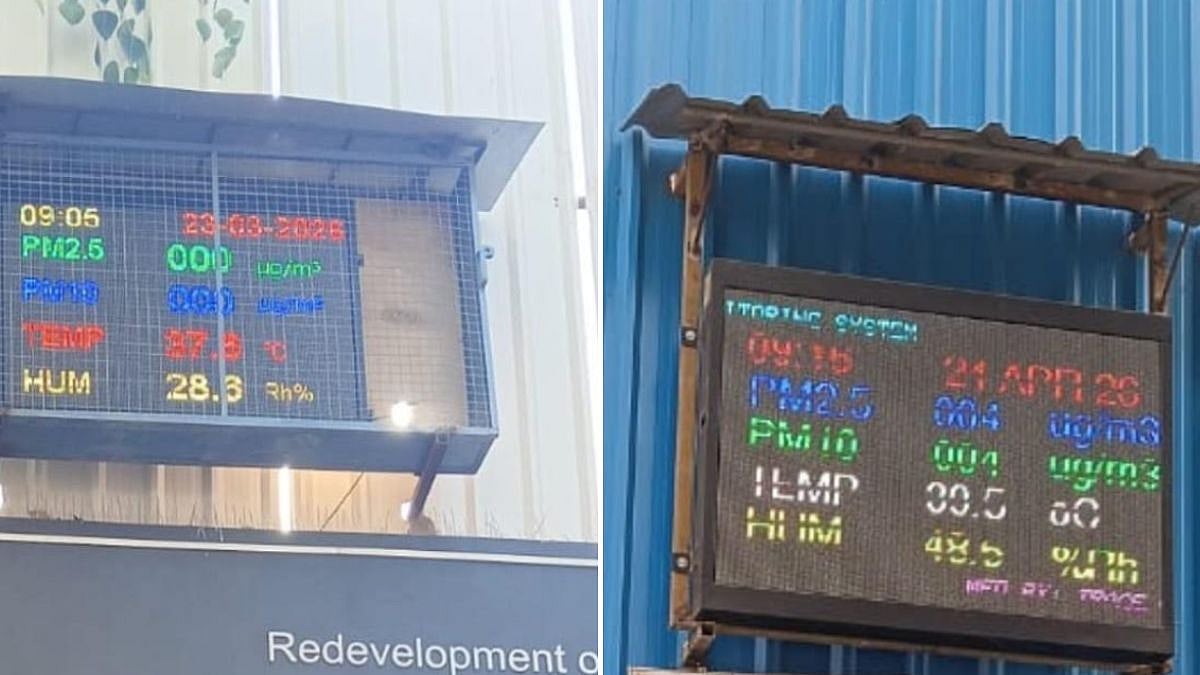
Mumbai: Even as a layer of haze envelops Mumbai, a study by anti-pollution campaign group Awaaz Foundation has raised concerns over the reliability of air-quality displays at construction sites, warning that faulty or misleading readings could give residents a false sense of security.
Foundation Flags Suspicious Readings
In a letter to Chief Minister Devendra Fadnavis and Municipal Commissioner Ashwini Bhide on October 25, the foundation said its study of monitors at construction sites in Bandra and Khar had found several instances of zero or very low readings, raising questions about their accuracy. A Maharashtra Pollution Control Board (MPCB) official said that the organisation will ask their regional officers to confirm Awaaz Foundation's findings.
The foundation photographed air-quality displays 230 times over 38 days during March–May and September–October 2026. For 26 days between March 23 and May 5, it compared readings from construction-site displays with those recorded by the government monitoring stations at Kherwadi and BKC, available on the Central Pollution Control Board’s SAMEER app. These were the geographically closest government stations to the sites surveyed.
Government Stations Record Higher PM10
On eight of the 25 days for which government station data was available, PM10 levels at Kherwadi or BKC reached 100 micrograms per cubic metre (µg/m³) or more. However, the foundation’s comparison did not establish a direct discrepancy between the site monitors and government stations for PM2.5, as corresponding readings for the same particulate measure were not provided.
The foundation found instances of active construction sites displaying zero levels of particulate matter (PM) 2.5 and PM10. At a site off Nargis Dutt Road in Pali Hill, the monitor showed PM2.5 at zero on April 13 and 24. On April 24, both PM2.5 and PM10 readings were zero. On April 13, the same display showed PM2.5 at zero while PM10 stood at 34 µg/m³.
Understanding PM2.5 And PM10
PM2.5 refers to fine particulate matter that can penetrate deep into the lungs and enter the bloodstream, while PM10 includes larger inhalable particles.
On 16 of the 26 days surveyed, at least one monitor recorded PM2.5 levels below 10 µg/m³, with 37 such readings in all. On March 29 and 31, five of six monitors showed readings between zero and 9 µg/m³. On April 7, four of five readable monitors recorded similarly low levels, while on April 3, three of five did so.
The World Health Organization’s recommended 24-hour guideline for PM2.5 is 15 µg/m³. Sumaira Abdulali of Awaaz Foundation questioned the credibility of readings that remained below this level despite construction activity nearby.
“The WHO’s strict 24-hour guideline is 15 µg/m³. These readings sit well under it, beside active construction in central Mumbai,” she said.
The study also found displays that were switched off or unreadable. One monitor was switched off on April 7, 10 and 11. On 10 other days, at least one display showed only a question mark or a dash, leaving its readings unavailable.
The foundation said the Brihanmumbai Municipal Corporation (BMC) had indicated that readings from construction-site monitors would be integrated into its official air-quality findings. While welcoming the move, it said the data should be used only after the monitors had been calibrated. The foundation also called for daily deployment of air-quality monitoring vans of the MPCB and the BMC, arguing that verified readings would provide a more reliable picture of pollution levels across the city.
Its demands include an audit and calibration of every construction-site monitor, publication of real-time, time-stamped PM2.5 data online, and action against sites with faulty, switched-off or misleading displays. The foundation warned that unreliable data could mislead residents making everyday decisions about outdoor activity, particularly those concerning children and the elderly. “A wrong number that looks official is worse than no number at all,” it said.
Mumbai has been witnessing poor air quality post monsoon. On Sunday, the average Air Quality Index at 7.10pm according to aqi.in was 171 which is rated 'unhealthy'. PM2.5 was 84 µg/m³ and PM10 was 114 µg/m³, both in the poor category.
To get details on exclusive and budget-friendly property deals in Mumbai & surrounding regions, do visit: https://budgetproperties.in/

