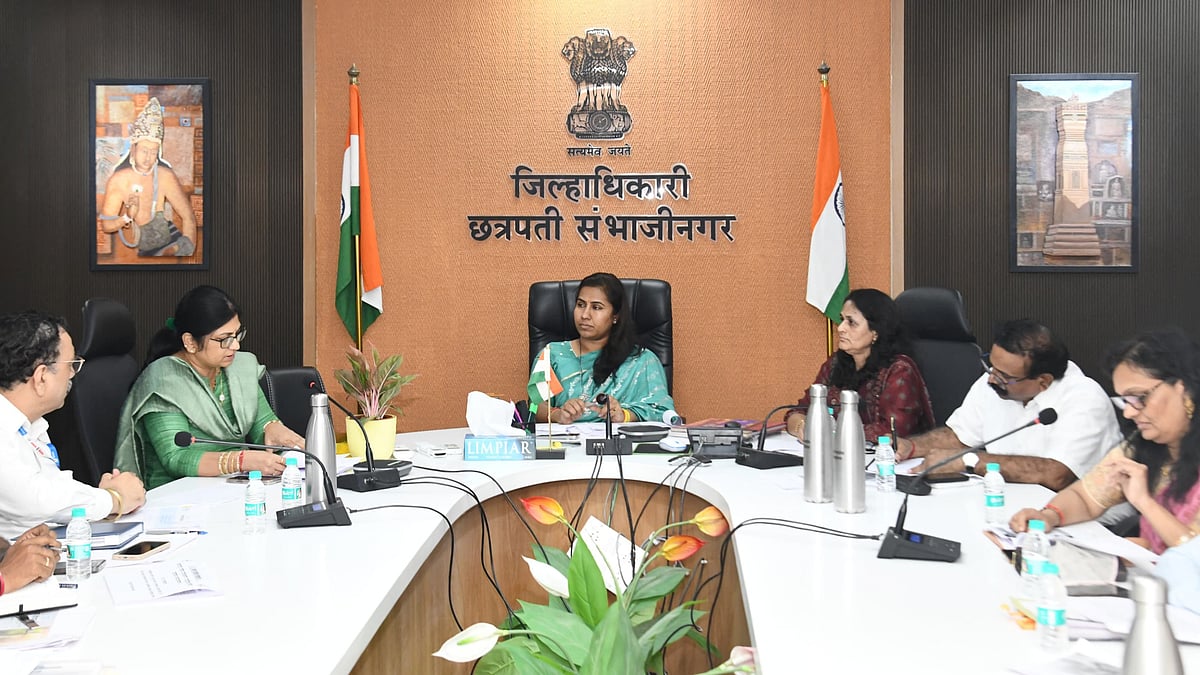
Mumbai: Maharashtra Minister of State for Public Health and Family Welfare, Water Supply and Sanitation, and Energy Meghna Sakore-Bordikar on Monday directed officials to undertake village-wise micro-planning of available water resources to prevent a water shortage in Marathwada, where rainfall has remained below average this year.
She directed officials to take advance measures to ensure regular and uninterrupted drinking water supply to citizens and expedite pending water supply schemes.
Sakore-Bordikar reviewed the prevailing water shortage situation, rainfall, available water storage, the possibility of a water crisis and various water supply schemes in the Marathwada division at the Collector's Office here.
Additional Collector Sambhaji Adkune, Resident Deputy Collector Janardan Vidhate, Additional Divisional Commissioner (Revenue) Rita Maitrewad and Maharashtra Jeevan Pradhikaran Chief Engineer Manisha Palande were among those present.
At the outset, Water Supply and Sanitation Department Joint Secretary Geeta Kulkarni briefed the meeting through video conference on the water shortage action plan and measures to be undertaken in the coming period.
Marathwada rainfall below average
From June to September 2026, Marathwada has received 430.80 mm of rainfall against its annual average of 679.50 mm, amounting to 63.40% of the average annual rainfall. Against the expected rainfall of 629.70 mm during the period, the actual rainfall is 68.41%.
District-wise, Chhatrapati Sambhajinagar has received 422.30 mm (72.60% of average), Jalna 438.50 mm (72.71%), Beed 331.30 mm (58.52%), Latur 351.70 mm (49.82%), Dharashiv 337.90 mm (56.03%), Nanded 587.80 mm (72.18%), Parbhani 420.70 mm (55.26%) and Hingoli 543.40 mm (68.33%).

Fodder stock available currently
The division currently has 5,359,462 livestock, including 650,282 small animals, 2,645,726 large animals and 2,063,455 sheep and goats. The daily fodder requirement is around 20,125 metric tonnes.
Officials informed the meeting that 4,481,136.851 metric tonnes of fodder is currently available and there is no need to establish fodder camps at present.
The available fodder is estimated to last between 89 and 210 days across the districts, with Jalna having the lowest stock, sufficient for around 89 days. Officials were directed to start planning immediately in view of the possibility of a fodder shortage from December 2026.
Also Watch:
Village-level water planning ordered
Sakore-Bordikar directed officials to prepare village-wise action plans for a possible water shortage, give the highest priority to drinking water, manage existing water sources efficiently and keep alternative sources ready wherever necessary.
She also instructed officials to expedite pending water supply projects and ensure prompt resolution of citizens' complaints related to water supply.
She further stressed the need for continuous monitoring of fodder availability for livestock and called for coordination among all concerned agencies to ensure preparedness to tackle any potential water and fodder shortage.
To get details on exclusive and budget-friendly property deals in Mumbai & surrounding regions, do visit: https://budgetproperties.in/

