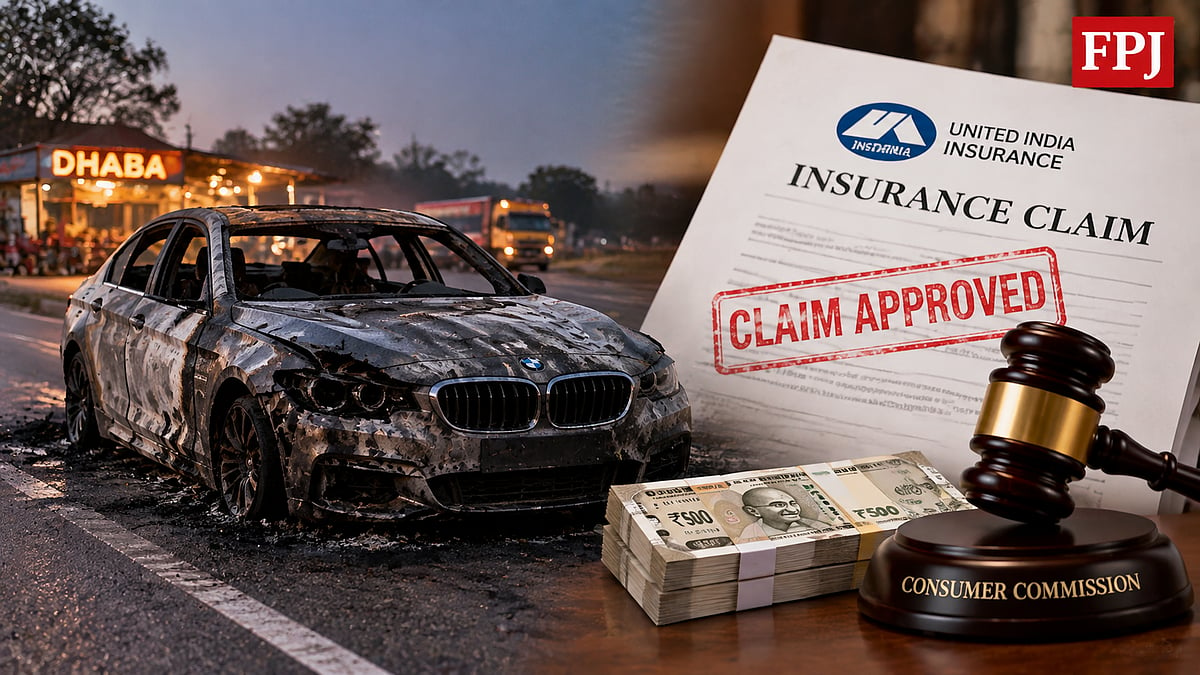
Mumbai: The Maharashtra State Consumer Dispute Redressal Commission has directed United India Insurance Company Ltd to pay ₹70 lakh, the Insured Declared Value (IDV) of a BMW car that was gutted in a fire after it was parked on the roadside following a tyre puncture. The commission held that the insurer could not repudiate the claim merely on the ground that the vehicle was left unattended overnight, particularly when there was no evidence establishing a direct nexus between the alleged breach of the policy condition and the fire.
Insurer Ordered to Pay Interest and Compensation
The insurer has been directed to pay ₹70 lakh with 7% annual interest from November 23, 2012, the date of repudiation, until actual realisation. It has also been directed to pay ₹50,000 towards mental agony and harassment and ₹25,000 towards litigation costs.
The complainant, Ravikant S. Patil of Solapur, had insured his BMW, for an IDV of ₹70 lakh under a policy valid from December 22, 2011 to December 21, 2012. He had paid a premium of ₹1.65 lakh.
BMW Owner Filed Complaint After Fire Incident
As per the complainant, on the night of March 8, 2012, the car suffered a tyre puncture on a highway. “As it was late at night and no repair facility was available, the driver moved the vehicle to the roadside, locked it and returned to Solapur in another vehicle. The following morning, the BMW was found completely burnt,”the complaint reads.
The insurer however repudiated the claim by relying on a condition of the policy, contending that the vehicle had been left unattended without taking proper precautions to prevent further loss. It argued that the complainant or his driver should have remained with the vehicle, changed the tyre or moved the car to a safer location.
Commission Rejects Insurer’s Argument
The commission, however, rejected the contention and observed that the said condition did not impose an absolute prohibition on leaving a broken-down vehicle unattended. It required the insured to take proper precautions, which had to be assessed according to the circumstances of each case.
The commission noted that the BMW had been moved to the side of the road near a Dhaba, its windows were rolled up and it was securely locked. It observed that the puncture had occurred late at night on a state highway, when no tyre repair mechanism or mechanic was available.
The commission further observed that expecting the driver to remain inside a disabled vehicle throughout the night would expose him to the risk of highway collisions and criminal activity.
“It is a well-settled principle of insurance jurisprudence that to repudiate a claim based on a policy breach, there must be a direct nexus between the alleged breach and the cause of the loss,” the commission observed.
It noted that the exact origin of the fire remained undetermined and that the police panchnama and fire brigade report did not establish that the complainant’s absence had caused the vehicle to catch fire. The insurer had also failed to produce forensic evidence establishing such a connection.
The commission also rejected the insurer’s contention that the BMW’s value should be reduced to ₹59 lakh after depreciation. It held that once the IDV is agreed upon and the premium charged accordingly, the IDV becomes the binding value for settlement of a total-loss claim. The insurer could not unilaterally depreciate the value at the time of settlement without a statutory basis.
To get details on exclusive and budget-friendly property deals in Mumbai & surrounding regions, do visit: https://budgetproperties.in/

