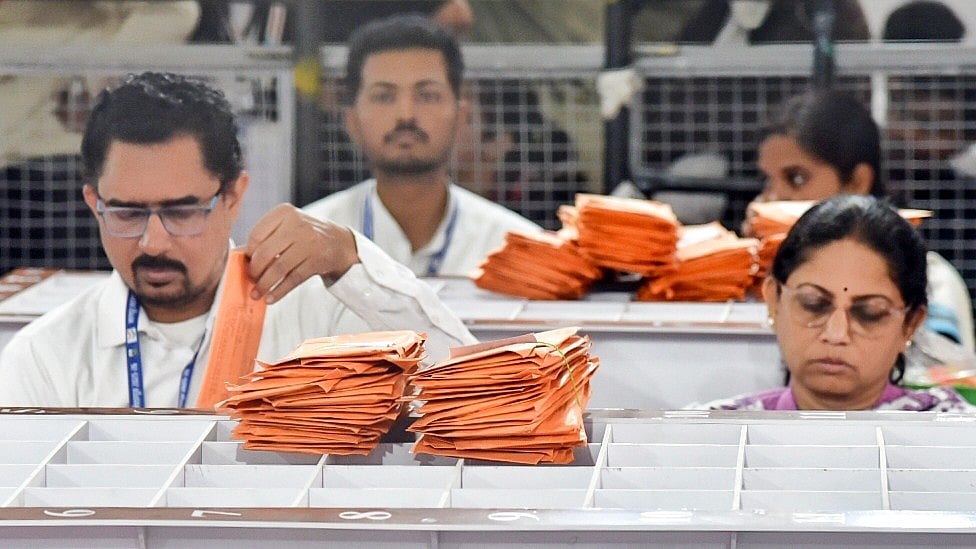
Mumbai: Counting of votes for the Maharashtra Panchayat Samiti and Zilla Parishad elections began on Tuesday across 12 districts, covering 12 Zilla Parishads and 125 Panchayat Samitis. The process is underway amid tight security arrangements.
The elections took place 11 days after Deputy Chief Minister Ajit Pawar died in a plane crash.
BJP Leads
According to trends available and other media reports, The Bharatiya Janata Party (BJP) is leading with 224 seats, followed by the Shiv Sena (Shinde faction) with 160 seats and the Nationalist Congress Party (Ajit Pawar faction) with 170 seats. The ruling Mahayuti alliance has collectively secured 554 seats.
MVA Trails
As per the latest seat tally, Shiv Sena (UBT) has secured 45 seats, Congress party 55, while the Nationalist Congress Party (Sharad Pawar faction) with 20 seats. The Maha Vikas Aghadi (MVA) alliance has emerged strongly with a total of 120 seats. Candidates from other parties and independents have secured 32 seats.
Congress Opens Account in Sangli
While Congress registered its first win in the Sangli Zilla Parishad with a victory in the Palus Panchayat Samiti. Congress candidate Rishikesh Lad emerged victorious from the seat. He is the nephew of Congress MLA Vishwajit Kadam.
The counting process began at 10:00 am sharp, following a high-stakes polling day that saw millions of citizens head to the booths to determine the leadership of their rural and semi-urban administrative bodies. These elections are particularly significant as they represent the first major democratic test since the recent shifts in the state’s political leadership and the unfortunate passing of NCP supremo and Maharashtra Deputy Chief Minister Ajit Pawar last month.
The magnitude of this election is reflected in the vast numbers governing its execution.
Across the 12 districts, which include Pune, Satara, Sangli, Solapur, Kolhapur, Raigad, Ratnagiri, Sindhudurg, Chhatrapati Sambhajinagar, Parbhani, Dharashiv and Latur, a total of 731 Zilla Parishad seats and 1,462 Panchayat Samiti seats were up for grabs.
Scale of the rural mandate
To facilitate this massive democratic undertaking, the State Election Commission of Maharashtra deployed an army of approximately 1.28 lakh personnel and established 25,471 polling stations. The electorate itself was massive, with over 2.08 crore eligible voters. Data reveals a nearly balanced gender participation, with roughly 1.06 crore male voters and 1.01 crore female voters registered, alongside 468 voters from other categories. This high level of engagement shows the deep-rooted importance of local governance in the daily lives of Maharashtra’s rural population.

When the polls concluded on Saturday, February 7, the state recorded a robust final voter turnout of 68.28 percent. However, this average masks significant variations in regional enthusiasm.
Parbhani district emerged as the leader in civic participation, recording a remarkable turnout of 74.89 percent. This was followed closely by the high-engagement zones of Kolhapur and Chhatrapati Sambhajinagar, which recorded 74.45 percent and 72.69 percent respectively.
These figures suggest a highly mobilised electorate in the Marathwada and Western Maharashtra belts.

