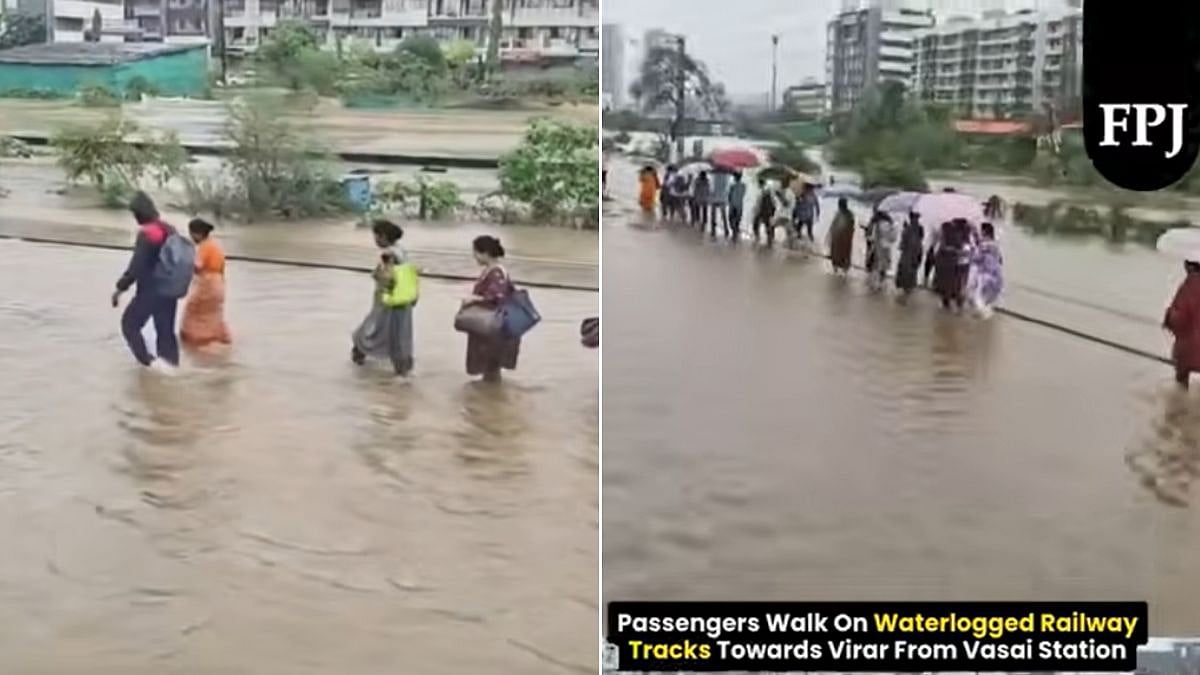
Mumbai, July 7, 2026: The repeated disruption of suburban train services between Vasai Road and Virar is not merely the result of heavy rainfall but also a consequence of the region's geography and long-standing drainage challenges.
For the second consecutive day on Tuesday, Western Railway was forced to suspend local train services between the two stations after water accumulated on tracks near Nallasopara, leaving thousands of commuters stranded during the evening rush hour.
While limited suburban services operated during the morning, most fast locals ran 40 to 50 minutes behind schedule before operations between Vasai Road and Virar were suspended again around 4.30 pm as rising water levels made train movement unsafe.
Train Services Hit Hard
The disruption had a major impact on Western Railway's suburban operations. As of 8 pm on Tuesday, 125 suburban train services had been cancelled, compared with 100 cancellations on Monday, reflecting the worsening impact on the second consecutive day.
While commuters travelling towards Churchgate managed to reach their destinations with delays, the return journey became extremely difficult after services beyond Vasai were suspended.
Hundreds of passengers remained stranded at stations, while several others walked along waterlogged railway tracks to reach nearby stations and look for alternate transport. Long-distance mail and express trains, however, continued to operate on the through lines, ensuring that intercity services remained largely unaffected.
Geography Behind Flooding
According to railway officials, the repeated flooding is linked to the natural topography of the region. Palghar is located at a relatively higher elevation, while Virar, Nallasopara and Vasai lie on a lower gradient.
During spells of heavy rainfall, water naturally flows downhill towards these low-lying areas. However, rapid urbanisation, restricted natural drainage channels and inadequate stormwater outlets prevent the water from draining quickly.
As a result, water accumulates around the railway corridor, particularly near Nallasopara, where the city and the railway station are almost at the same level. Once the water level on the tracks exceeds safe operating limits, suburban train services have to be suspended to ensure passenger safety.
Survey For Permanent Solution
Recognising that the problem requires a permanent solution, Western Railway General Manager Ramashray Pandey inspected the affected Vasai–Virar section on Tuesday. During the visit, he directed officials to conduct a survey to examine the feasibility of raising the level of the railway tracks in the section.
The survey will also ensure that the proposed Mumbai Rail Vikas Corporation (MRVC) fifth and sixth line project is constructed at an appropriate elevation so that future railway infrastructure remains better protected from flooding.
The recurring disruption has once again highlighted the need for long-term engineering and drainage improvements rather than temporary restoration measures after every spell of heavy rainfall.
Also Watch:

With lakhs of commuters depending on the Vasai–Virar corridor every day, railway officials believe that improving track levels, strengthening drainage infrastructure and preserving natural water outlets will be critical to reducing monsoon-related disruptions in the years ahead.
To get details on exclusive and budget-friendly property deals in Mumbai & surrounding regions, do visit: https://budgetproperties.in/

