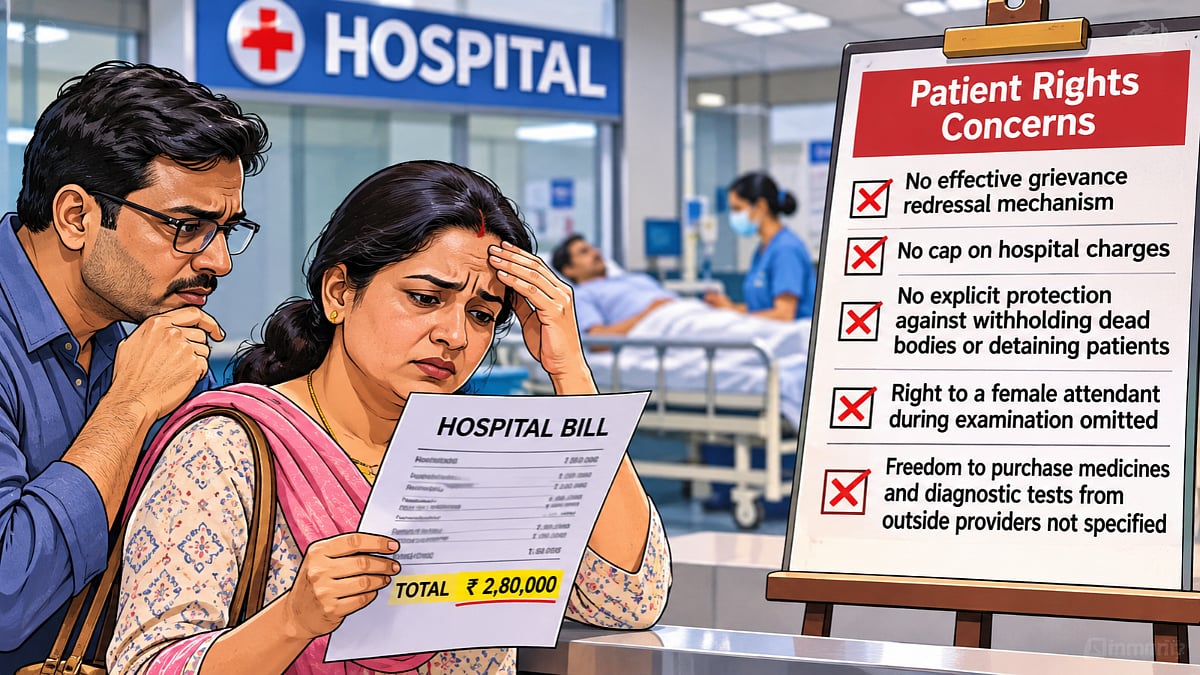
Mumbai, November 27, 2026: The proposed Maharashtra Clinical Establishments (Registration and Regulation) Bill, 2026, may regulate private hospitals but fails to adequately protect patients against excessive billing and violation of their rights, alleged Jan Arogya Abhiyan (JAA) and other patient rights organisations.
A coalition of nearly 80 organisations across Maharashtra has opposed the removal of several existing patient safeguards and approached around 11 MLAs from different parts of the state to raise the issue during the upcoming winter session of the legislature.
The coalition held a Patients' Rights Dialogue in Mumbai on Friday, attended by a large number of health activists and public representatives. Participants discussed the shortcomings of the proposed legislation and chalked out a strategy to oppose the removal of patient protections during the winter session by mobilising elected representatives to raise the concerns in the legislature.
Bill Fails To Empower Patients
Dr Abhay Shukla, public health physician and national co-convenor of Jan Swasthya Abhiyan (JSA), said the need for a new law became evident during the COVID-19 pandemic when the government struggled to control private hospital charges and had to invoke the Disaster Management Act, which was not designed to regulate healthcare services. However, the proposed legislation was introduced only in July 2026, after a delay of nearly five years.
"The fundamental problem is that while the Bill proposes to regulate hospitals, it does not adequately empower patients. Existing protections should be restored rather than diluted. Patients need an independent and time-bound mechanism to seek justice when hospitals violate their rights," said Dr Shukla.
One of the major concerns is the removal of the existing grievance redressal mechanism. Under the 2021 rules, hospitals were required to maintain complaint cells and toll-free helplines, with complaints involving admitted patients to be addressed within 24 hours. The new Bill does not provide a comparable mechanism for patients to seek timely relief.
The proposed legislation requires hospitals to display their charges and issue itemised bills but does not fix standard or maximum rates for treatments, ICU beds, investigations and medical procedures. Patient groups argue that merely displaying rates will not prevent hospitals from charging exorbitant amounts, as hospitals can continue setting their own prices.
Several Patient Safeguards Omitted
The draft also omits several safeguards, including protection against withholding dead bodies over unpaid bills, detaining patients for non-payment, the right of women patients to have a female attendant during medical examinations and the freedom to purchase medicines and undergo diagnostic tests from outside providers.
It also does not specifically mandate displaying doctors' qualifications and registration details or providing comprehensive discharge summaries.
According to JAA, the National Health Accounts report shows that the Maharashtra government accounts for only 29.3% of total healthcare expenditure, while households bear 38.8%.
“Residents of the state spent around Rs 44,712 crore, and a substantial amount went towards private hospitals. In addition, around 81% of patients are visiting private hospitals, the maximum in the country,” said Dr Shukla.
The growing presence of corporate hospitals over the past five years, coupled with weakening patient safeguards, could further increase the financial burden on families, he said.
Groups Demand Independent Regulatory Authority
The groups have demanded an independent regulatory authority, district-level patient grievance committees, standard treatment guidelines to prevent unnecessary tests and surgeries, regulation of hospital charges and representation of patient organisations, nurses, doctors and women's groups in the proposed State Council.
Also Watch:

Five Key Concerns Over The Proposed Bill
1. Grievance redressal: Existing complaint cells and toll-free helplines, including 24-hour response for admitted patients, may be lost.
2. Unpaid bills: No explicit protection against withholding dead bodies or detaining patients over unpaid bills.
3. Hospital charges: Itemised bills and displayed rates are required, but there is no cap on treatment, ICU or procedure charges.
4. Patient freedom: Specific safeguards allowing outside purchase of medicines and diagnostic tests, and a female attendant during examination, are reportedly omitted.
5. Regulatory accountability: No guaranteed patient representation in the State Council or mandatory standard treatment guidelines to prevent unnecessary procedures.
Level up your brain the fun way. Play daily games and quizzes on FPJ Smart!
To get details on exclusive and budget-friendly property deals in Mumbai & surrounding regions, do visit: https://budgetproperties.in/

