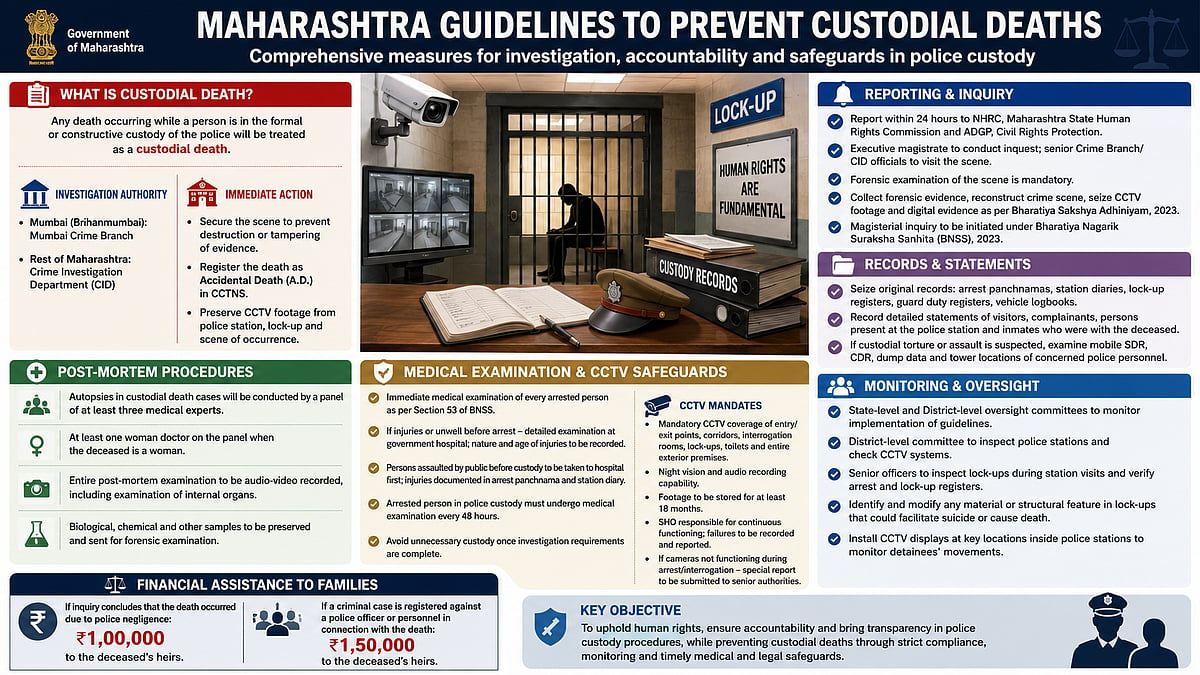
Mumbai: The Maharashtra government has issued comprehensive guidelines for investigating deaths in police custody and preventing such incidents, making it mandatory for police authorities to preserve CCTV and digital evidence, conduct detailed medical examinations and ensure close monitoring of detainees.
The guidelines were issued by the Home Department through a government resolution consolidating various directions issued over the years by the Supreme Court, the National Human Rights Commission (NHRC), the Maharashtra State Human Rights Commission and police authorities.
Crime Branch, CID To Investigate Custodial Deaths
Under the new guidelines, any death occurring while a person is in the formal or constructive custody of the police will be treated as a custodial death. The investigation in such cases will be conducted by the Mumbai Crime Branch if the incident occurs within Brihanmumbai, while the Crime Investigation Department (CID) will investigate cases in other parts of the state.
The police station concerned will have to immediately secure the scene of occurrence to prevent destruction or tampering with evidence. The death will have to be registered as an accidental death (A.D.) in the CCTNS system, while CCTV footage from the police station, lock-up and scene of occurrence will have to be preserved securely.
Mandatory Reporting And Magisterial Inquiry
The incident must also be reported within 24 hours to the NHRC, Maharashtra State Human Rights Commission and the Additional Director General of Police, Civil Rights Protection. An executive magistrate will be deputed to conduct the inquest, while the investigating officer and senior Crime Branch/CID officials will visit the scene.
Forensic Probe And Post-Mortem Protocols Tightened
The guidelines make forensic examination of the scene mandatory. Investigators will have to collect forensic evidence, conduct a crime scene reconstruction and seize CCTV footage and other digital evidence in accordance with the Bharatiya Sakshya Adhiniyam, 2023. A magisterial inquiry will also be initiated under the Bharatiya Nagarik Suraksha Sanhita (BNSS), 2023.
The government has also tightened post-mortem procedures. Autopsies in custodial death cases will have to be conducted by a panel of at least three medical experts, with at least one woman doctor on the panel when the deceased is a woman. The entire post-mortem examination will have to be audio-video recorded, including examination of internal organs. Biological, chemical and other samples will also have to be preserved and sent for forensic examination.
Arrest And Detention Records To Be Examined
Investigators will also be required to seize original records connected with the arrest and detention, including arrest panchnamas, station diaries, lock-up registers, guard duty registers and vehicle logbooks. Statements of visitors, complainants and other persons present at the police station, as well as inmates who were with the deceased, will have to be recorded in detail.
In cases where custodial torture or assault is suspected, investigators will have to examine the mobile Subscriber Detail Records (SDR), Call Detail Records (CDR), dump data and tower locations of the concerned police personnel to establish their presence at or near the scene.
Medical examination and CCTV safeguards
The government has laid particular emphasis on preventing custodial deaths. Under Section 53 of the BNSS, every arrested person must undergo an immediate medical examination. If a suspect has injuries or is unwell before arrest, a detailed examination at a government hospital must be carried out and the nature and age of the injuries recorded.
Persons assaulted by members of the public before being taken into custody must not be placed directly in a police lock-up. They should first be taken to hospital for medical examination and emergency treatment, with their injuries properly documented in the arrest panchnama and station diary.
The government has mandated CCTV coverage of police station entry and exit points, corridors, interrogation rooms, lock-ups and toilets, as well as the entire exterior premises. The systems must have night vision and audio recording capabilities. CCTV footage must be stored for at least 18 months.
Station House Officers will be responsible for ensuring that CCTV systems function continuously. Any technical failure or power outage will have to be recorded in the station diary and immediately reported for repairs. If an arrest or interrogation takes place during a period when cameras are not functioning, a special report will have to be submitted to senior authorities.

The guidelines also provide for State- and district-level oversight committees to monitor implementation. The district-level committee will inspect police stations and check CCTV systems.
Police officers have also been directed to avoid unnecessary custody once investigation requirements are complete. An arrested person in police custody must undergo medical examination every 48 hours. Senior officers will have to inspect lock-ups during police station visits and verify arrest and lock-up registers.
The government has further directed police authorities to identify and modify any material or structural feature in lock-ups that could facilitate suicide or cause death, and to install CCTV displays at key locations inside police stations so that detainees' movements can be monitored.
The resolution also provides for financial assistance to the families of persons who die in police custody. If an inquiry concludes that the death occurred due to police negligence, the deceased's heirs will be eligible for Rs 1 lakh. If a criminal case is registered against a police officer or personnel in connection with the death, the assistance will be Rs 1.5 lakh.
To get details on exclusive and budget-friendly property deals in Mumbai & surrounding regions, do visit: https://budgetproperties.in

