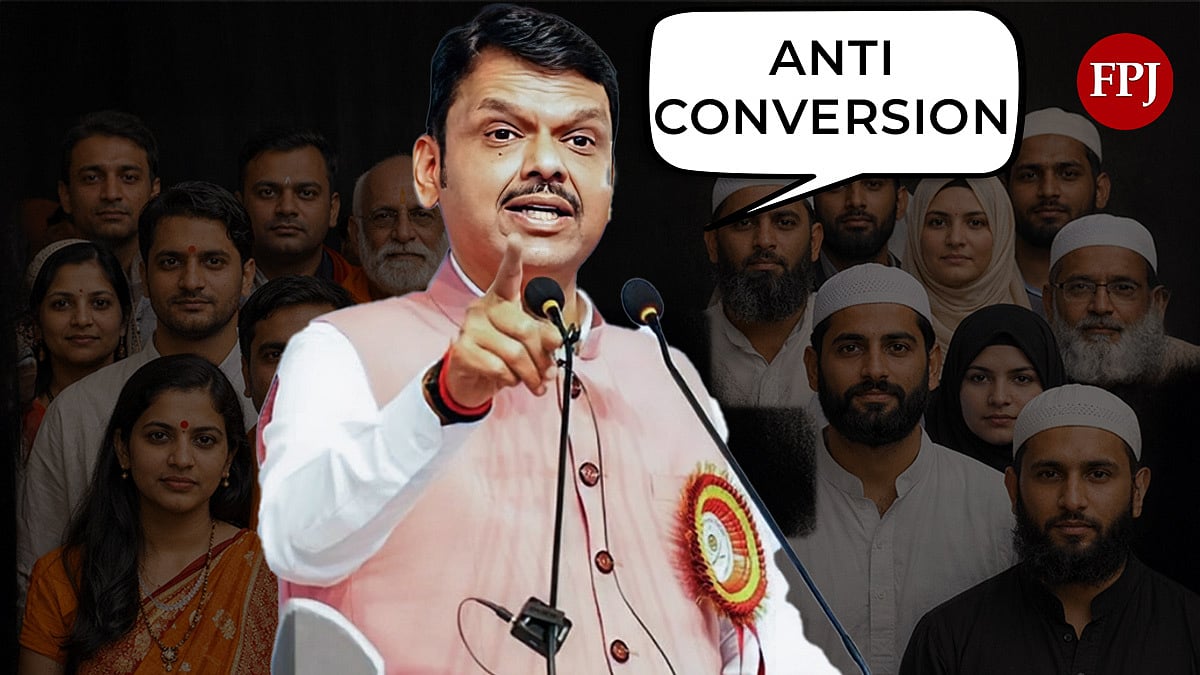
The Maharashtra government on Friday introduced the Maharashtra Freedom of Religion Bill, 2006 in the State Assembly with the objective of curbing unlawful religious conversions in the state. Minister of State for Home (Rural) Pankaj Bhoyar tabled the legislative assembly on friday evening, which includes stringent provisions to regulate religious conversions and penalise those found involved in forced or fraudulent conversions.
Defining Unlawful Conversion
The proposed legislation defines religious conversion carried out through allurement, coercion, fraud, misrepresentation or undue influence as unlawful. According to the provisions of the bill, offering incentives such as money, gifts, employment, free education provided by religious institutions, promises of marriage, better lifestyle, or claims of divine healing in order to induce conversion will be treated as illegal. Portraying one religion as superior to another with the intent to influence conversion has also been included under the ambit of unlawful practices.
Marriage And Child Rights
The bill further states that any marriage solemnised solely for the purpose of unlawful religious conversion will be declared null and void by a competent court. In such cases, the custody of children will remain with the mother. The legislation also specifies that the religion of the child in such circumstances will be that of the mother. The child will retain succession rights and will be able to claim property from both parents in accordance with the respective personal laws applicable to them. The bill also ensures that children are entitled to maintenance from their parents, while victims of unlawful conversion will also be eligible for maintenance, custody of children and rehabilitation support from the state government.
Strict Penalties Proposed
Under the proposed law, offences related to unlawful religious conversion will be cognizable and non-bailable. Individuals found guilty could face imprisonment of up to seven years along with a fine of up to Rs1 lakh. In cases involving repeat offenders, the punishment could extend up to ten years of imprisonment along with a fine of Rs 7 lakh. The government has also proposed provisions to provide rehabilitation assistance to victims of such conversions.
FIR And Police Powers
The bill empowers blood relatives of a converted individual to lodge a First Information Report (FIR) with the police, and it will be mandatory for the police to register such complaints. Additionally, if a police officer believes that a religious conversion has taken place or is being attempted in violation of the provisions of the law, the officer can take suo motu cognisance and initiate action. Investigations under the Act can be conducted by a police officer not below the rank of sub-inspector.
Burden Of Proof
The legislation also provides for punishment for those who abet, facilitate or assist in unlawful conversion. This includes individuals who endorse, execute or attest documents related to such conversions. Importantly, the burden of proof in such cases will lie on the person who has caused or abetted the conversion. All cases registered under the Act will be tried in a sessions court.
Action Against Institutions
Strict action has also been proposed against institutions or organisations involved in illegal conversions. The bill empowers the government to cancel the registration of such institutions and take action against their heads, including imprisonment of up to seven years and a fine of Rs 5 lakh. The government may also stop grants or financial assistance provided to such organisations.
90-Day Prior Notice
The proposed legislation also lays down a detailed procedure for religious conversion. According to the bill, any individual intending to change his or her religion, as well as the organisation planning to conduct the conversion ceremony, must give a prior notice of 90 days to the competent authority, which would be the District Magistrate or an officer authorised by the government. After receiving the notice, the authority will display the information outside its office as well as at the office of the village panchayat or local authority where the individual resides and invite objections within a period of 30 days.
Also Watch:
Objections And Inquiry
If any objection is received, the competent authority may direct the police to conduct an inquiry. If the inquiry finds that the conversion is being carried out in violation of the law, the authority can direct the police to initiate criminal proceedings against the persons involved. If the conversion is carried out in accordance with the law, both the individual converting and the organisation conducting the ceremony must submit a declaration within 21 days to the competent authority detailing the conversion. The authority will then record the declaration and maintain official documentation of the conversion.
Government’s Justification
The statement of objects and reasons of the bill notes that instances of forceful or involuntary religious conversions have been increasing and are often carried out in an organised manner by certain institutions. It states that several cases of mass conversions have come to light where vulnerable individuals were allegedly converted through inducements. Such incidents, the government believes, can disturb public order and affect social harmony in the state.
Protecting Vulnerable Sections
The government has also stated that socially and economically vulnerable individuals and families are particularly susceptible to such unlawful conversions, and therefore require protection from the state. According to the government, existing legal provisions are insufficient to address the challenges posed by such activities.
Similar Laws In States
Several states including Odisha, Madhya Pradesh, Uttar Pradesh, Gujarat, Arunachal Pradesh, Himachal Pradesh, Karnataka, Uttarakhand and Tamil Nadu have already enacted similar Freedom of Religion laws to prohibit forced or fraudulent conversions.
Committee Reviewed Laws
Before introducing the bill, the state government had constituted a special committee comprising the Director General of Police and senior officials from concerned departments to examine legal aspects related to religious conversions. After studying similar laws implemented in other states and deliberating on the issue, the committee recommended the enactment of a dedicated law for Maharashtra to regulate religious conversions and prevent unlawful practices.
Maharashtra Becomes Tenth
With the introduction of the bill in the Assembly, Maharashtra has become the tenth state in the country to move towards enacting a law aimed at regulating religious conversions.
To get details on exclusive and budget-friendly property deals in Mumbai & surrounding regions, do visit: https://budgetproperties.in/

