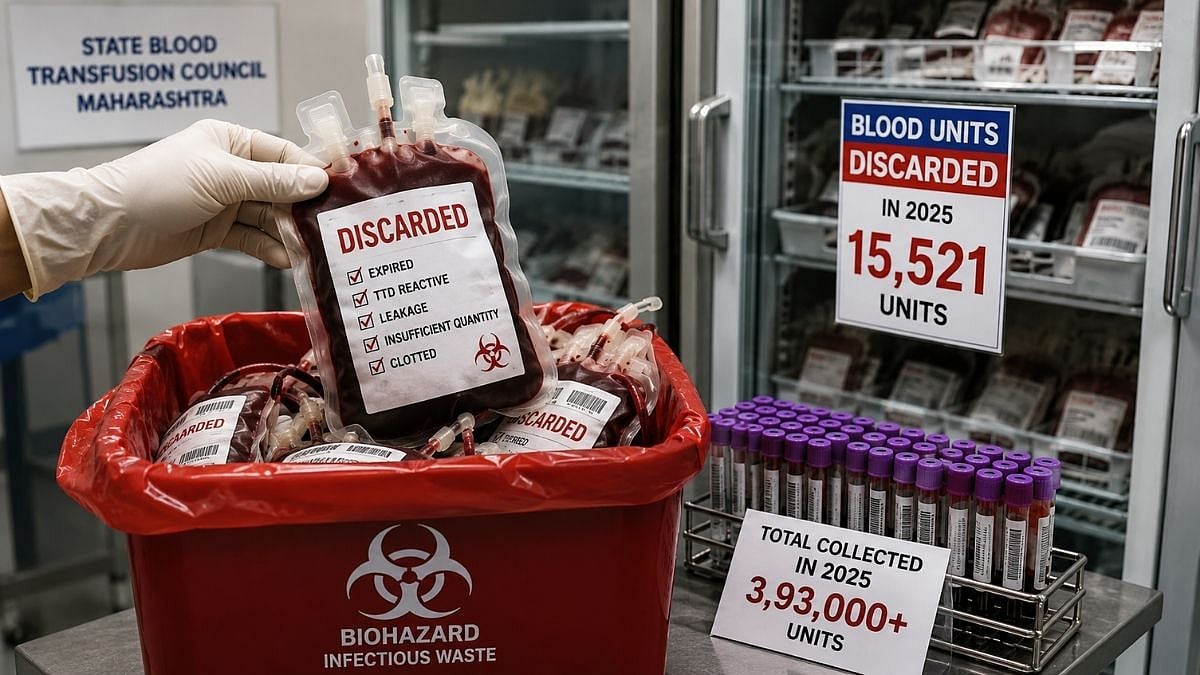
Mumbai, May 6: More than 15,000 units of blood were discarded in 2025 from 77 government-run blood banks across the state due to reasons such as transfusion-transmitted diseases (TTDs), expiry, leakage, insufficient quantity, and clotting.
During the same period, these blood banks collected 3.93 lakh units. Across the state’s 410 blood banks — including private and charitable facilities — total collection exceeded 23 lakh units.
According to data from the State Blood Transfusion Council (SBTC), 15,521 units were discarded. Of these, 4,048 units were rejected due to TTDs, 6,178 had expired, 499 were lost to leakage, and 4,047 were discarded due to insufficient quantity. Additionally, 307 units were haemolysed, 99 were labelled unfit, and 78 were contaminated.
Majority of blood banks run by charitable trusts
Of the 410 blood banks registered with SBTC, 307 are run by charitable trusts, while 77 are government-operated.
The issue of irregular blood stock updates on the e-RaktKosh platform was also raised during a recent review meeting. Officials directed blood banks to address gaps in inventory reporting and adhere strictly to daily stock update protocols.
SBTC issues strict compliance directions
SBTC, which oversees blood bank operations, has issued strict instructions to curb irregularities, including lapses in stock reporting and non-compliance with blood transfer guidelines.
The review meeting was conducted online with Deputy Directors of Health, District Civil Surgeons, and Blood Transfusion Officers from government blood banks. An SBTC official, speaking on condition of anonymity, said such reviews had not been held for several years.
Blood banks are mandated to update daily stock on platforms like e-RaktKosh and Maha SBTC, but compliance has been inconsistent. Irregularities in inter-state bulk blood transfers were also flagged.
Concerns raised over emergency blood access
The central government’s directive requiring installation of blood component separation machines has also not been fully implemented. Authorities have further instructed blood banks to minimise wastage and ensure the establishment of storage centres in every taluka.
SBTC has tasked District Civil Surgeons and Deputy Directors of Health with conducting regular reviews, warning of action against those failing to follow guidelines.
Also Watch:
Officials noted that inadequate stock updates often make it difficult for patients’ families to locate blood during emergencies, particularly in rural areas. Regular updates are expected to improve accessibility and response times.
To get details on exclusive and budget-friendly property deals in Mumbai & surrounding regions, do visit: https://budgetproperties.in/

