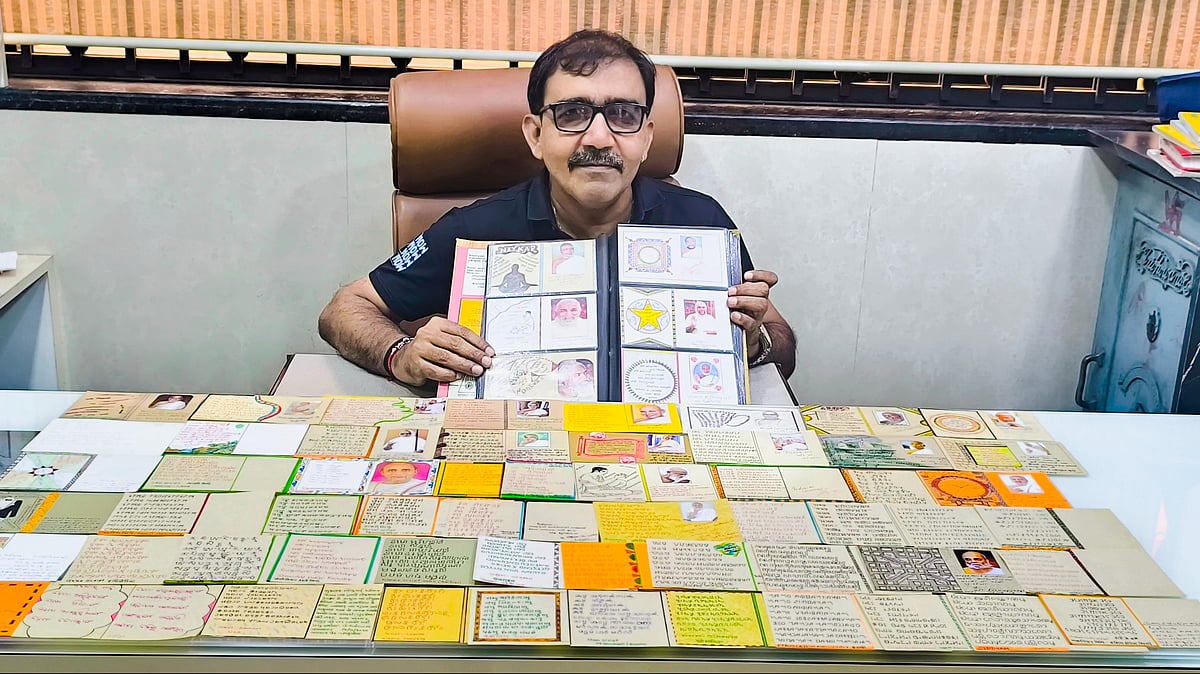
Kalyan: A passion for religion, knowledge and collecting has given Mahendra Mangilal Jain, popularly known as the ‘Crossword King’, a distinctive identity in Kalyan. Originally from Bala, a small village in Rajasthan’s Jalore district, Jain moved to Kalyan around 40 years ago in search of livelihood. Educated up to SSC, he now runs a business in the city’s Bazaar Peth area while pursuing his interests in social and religious activities and an extraordinary collection of the Jain faith’s sacred Navkar Mantra.
For the past 15 years, Jain has been writing the Navkar Mantra on postcard-sized sheets of paper. So far, he has created more than 200 designs of the sacred mantra in over 68 scripts from India and abroad. The collection also features photographs and autographs of prominent Jain Acharyas, making it particularly distinctive. His effort to preserve the mantra in such a wide variety of scripts reflects his sustained dedication to Jain religious heritage.
Five complete Bhaktamar Stotras on one postcard
Jain’s talents extend beyond religious calligraphy. He has won more than 150 prizes in crossword puzzles and general knowledge competitions, earning him the popular title of ‘Crossword King’. His prizes have included a washing machine, television, mixer and several other awards.
He is also skilled in mirror writing, a technique in which text is written in reverse and can be read correctly when viewed in a mirror. In one remarkable feat, Jain wrote the complete Bhaktamar Stotra, comprising 44 verses, five times on a single small postcard using mirror writing. Writing the entire stotra even once on such a limited surface is a challenge, making his achievement particularly noteworthy.
Jain says his desire to do something different dates back to childhood. “The Navkar Mantra is the fundamental and supreme mantra of Jainism. Preserving it in different scripts is the biggest commitment of my life,” he says.
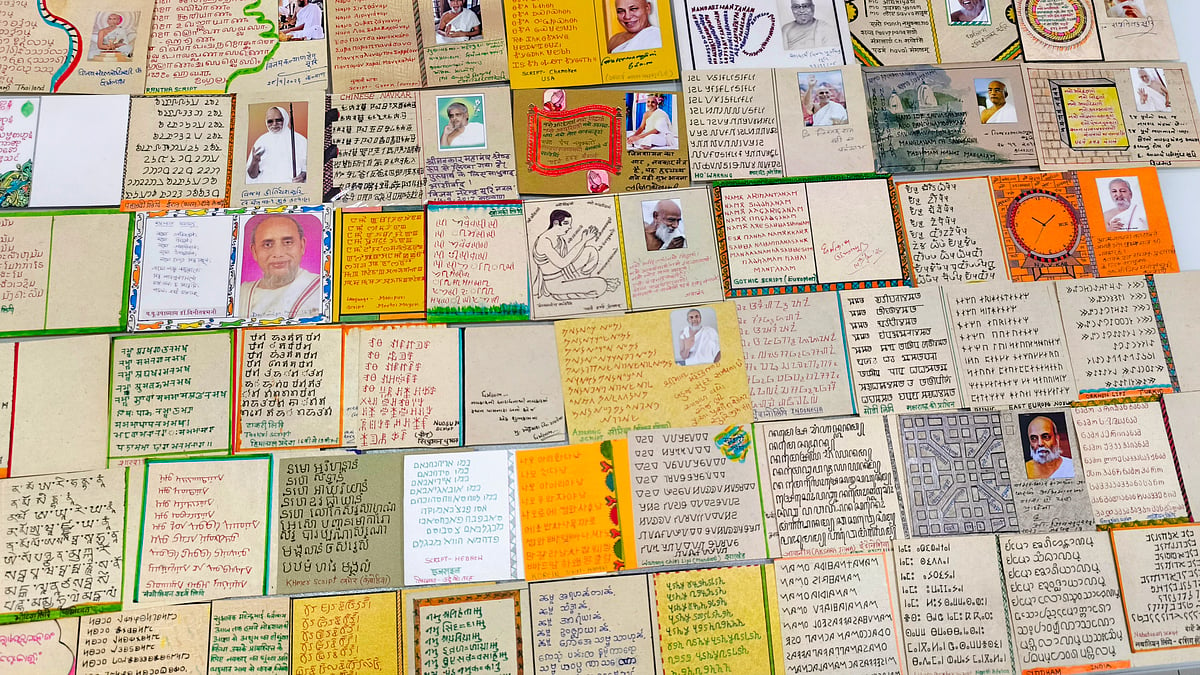
Navkar Mantra transcribed in scores of Indian and foreign languages
From Hindi, Gujarati and Urdu to Japanese, Chinese and Hebrew, the multilingual initiative brings together a diverse range of scripts and languages.
The Navkar Mantra has been presented using an extensive range of Indian and foreign languages, including several regional, classical and international scripts. The list spans languages and scripts from across Asia, Europe and other regions, reflecting the initiative’s wide linguistic diversity.
Also Watch:
The languages and scripts used include Hindi, Gujarati, English, Telugu, Tamil, Kannada, Bengali, Punjabi, Assamese, Urdu, Arabic, Modi, Sharada, Siddham, Malayalam, Manipuri, Nabataean, Shan, Osmania, Kaithi, Georgian, Japanese, Chinese, Lepcha, Khojki, Gothic, Limbu, Runic, Bhotia, Ge’ez, Pahlavi, Lanna, Lao, Burmese, Odia, Ho, Warang, Cherokee, Desert, Mongolian, Mahajani, Javanese, Aksara, Hangul, Hebrew, Khmer, Mundari, Orkhon, Norwegian Runic, Sundanese, Aramaic, Nuosu, Takri, Russian, Greek, Grantha, Ol Chiki, Thai, Kharosthi, Chakma, Sinhala and Phoenician.
The compilation brings together languages and scripts with distinct historical and cultural backgrounds, ranging from Indian regional languages to writing systems associated with East Asia, the Middle East and Europe.
The extensive list highlights the linguistic breadth of the presentation of the Navkar Mantra, incorporating a variety of scripts from different parts of the world.
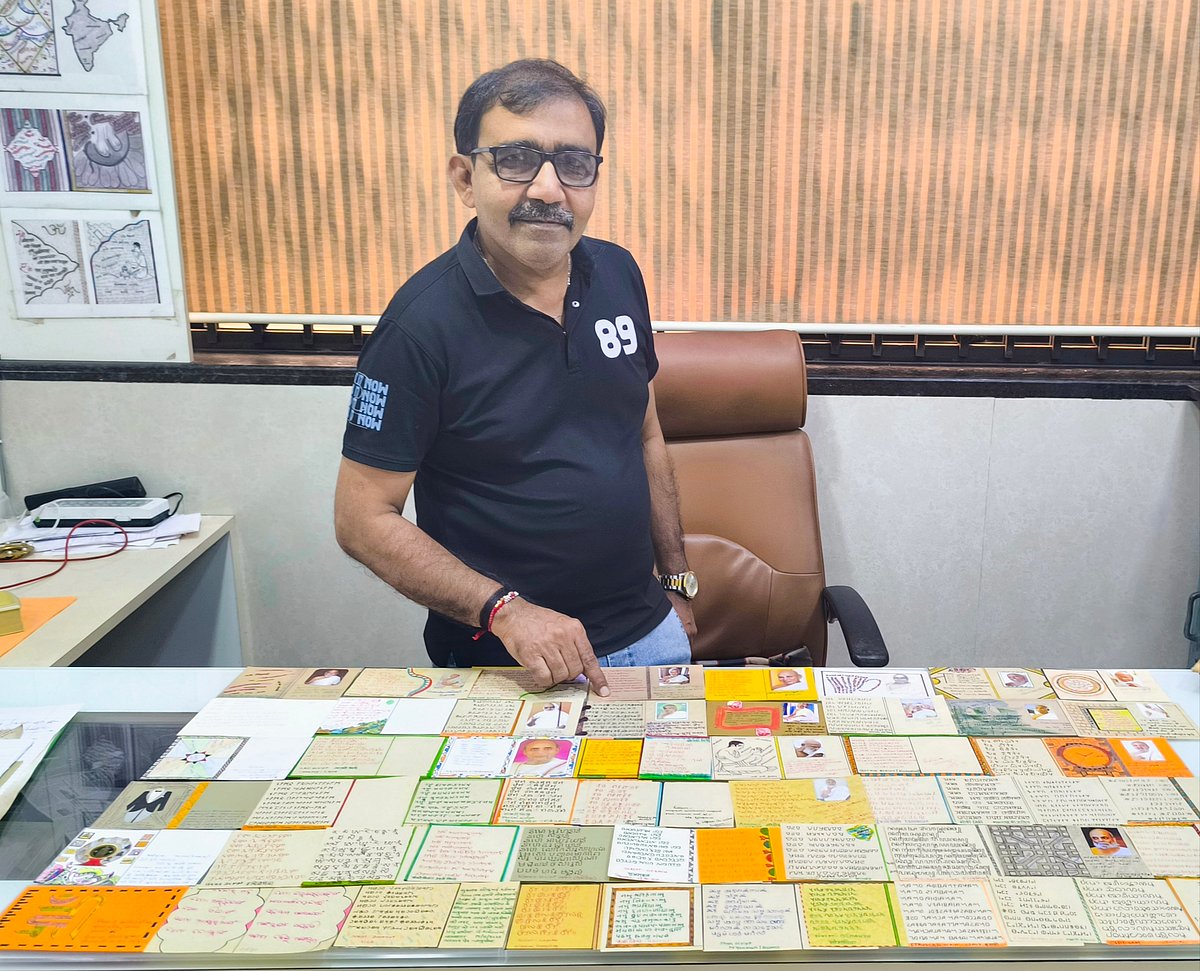
A lifelong passion for collecting
Jain has also collected currency notes, postage stamps and railway tickets from different countries. Yet his Navkar Mantra collection remains a particularly significant expression of his personal interests, combining religious devotion, painstaking effort and an enduring fascination with scripts.
Through 15 years of consistent work, Jain has turned a personal passion into an unusual collection dedicated to preserving the sacred mantra across diverse writing traditions.
To get details on exclusive and budget-friendly property deals in Mumbai & surrounding regions, do visit: https://budgetproperties.in/

