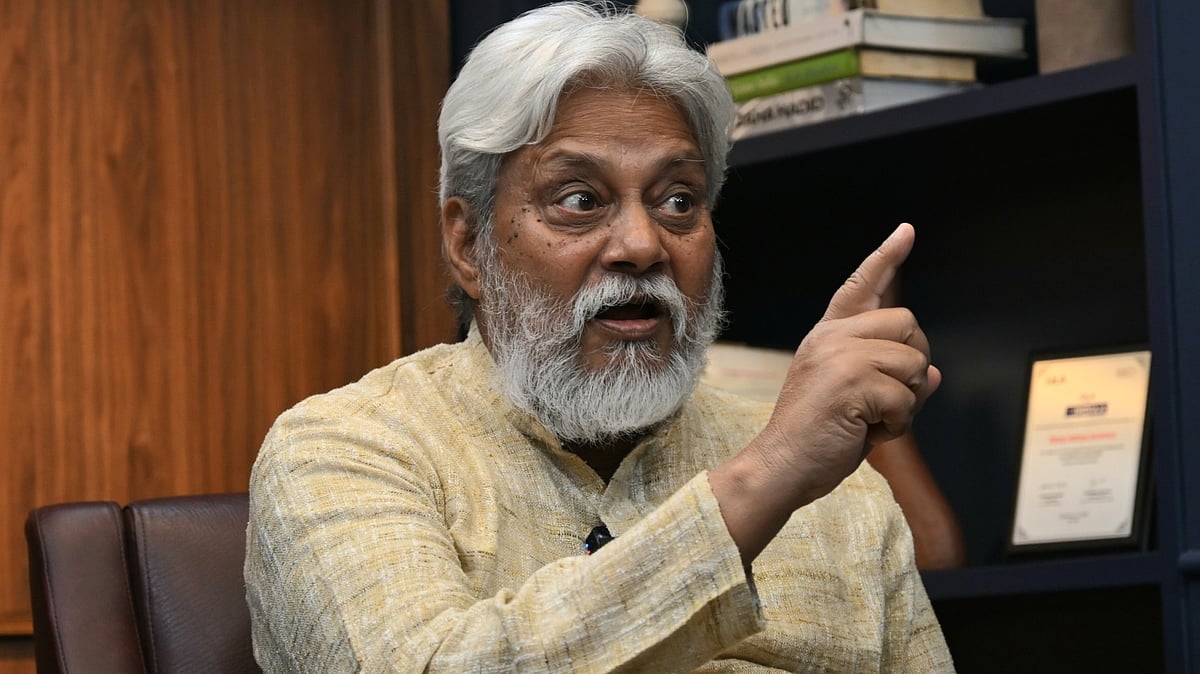
Mumbai: The economy and ecology cannot go hand in hand, and the Indian government’s greed for economic infrastructure has harmed the environment, said environmentalist Rajendra Singh, who has been working to conserve water and the environment in Indian states. Singh (66), a Magsaysay award-winner and known as ‘Waterman of India’, visited the Free Press Journal’s office on Saturday for an interaction on environmental issues in the country.
Excerpts.
You speak about conserving Jal, Jamin, Jungle (Water, Mountains, Forests). What is the overall environmental situation in India currently?
The deterioration of Jal, Jamin and Jungle, which has taken place in recent years, has never happened in the history of India. The reason for environmental degradation is that our governments prioritize economic infrastructure. The economy is the opposite of ecology. However, earlier there were efforts to balance both, and development was considered prakiriti (environment) and sankriti (culture). Nowadays, developmental works start with the destruction and displacement of people, villages and green cover. The greed for economic development has stopped us from thinking about nature.
What have been the effects of the destruction and displacement of nature in India?
The droughts and floods have increased. When India got Independence, there were only three states that witnessed drought- Karnataka, Maharashtra and Rajasthan, but now as many as 17 states. While four states witnessed floods, including Bihar, Odisha and West Bengal, there are now nine states that witness flooding. Maharashtra, which fell under a drought state, now witnesses flooding every year. This is the result of climate change and global warming.
Mumbai had several rivers before its development into a single city, allowing rainwater to flow out naturally. But now the natural stormwater drains have been reclaimed and encroached…
Originally, Mumbai was a city of five rivers. But now all rivers have become nullahs. This status of converting rivers to nullahs tells you where our environment is heading, for which our governments are more responsible than society.
There are several laws in place for environmental conservation, and we have a National Green Tribunal. Despite this, why is environmental conservation becoming more difficult?
It is clear that the Indian government is not following its constitutional duties. We have Article 21, which states that ‘No person shall be deprived of his life’, and Article 48A, which directs the State to protect and improve the environment and safeguard the country's forests and wildlife. But the government has destroyed the administrative definitions. They form committees, which submit reports. If India wants to conserve the environment, we need to realise and utilise our conditional duties. The judgment on Aravali Hills is the latest example.
What is the current status of the Aravali Hills case?
Aravali Hills will be saved. The Supreme Court's job is not to change the definition of the range. The crisis created at Aravali was a constitutional crisis and an insult. But when the government and the Chief Justice of India saw the intensity of public protests to save Aravali, the Supreme Court stayed its decision. We will fulfill our constitutional responsibility. Currently, there is no law to protect the hills, but we have prepared a draft for a new law. People of Aravali won't sit silent, they are prepared for a Satyagraha, and if needed to come on the ground to save Aravali. This case won't be limited till the apex court, but is going to be a ‘lokshakti’.
Also Watch:
Lakhs of trees are proposed to be cut for the Great Nicobar Island project in Andaman & Nicobar. What do you have to say?
I am not against any government. But the fact is that the present government is creating disasters in the name of development. It only wants to bring the economic infrastructure to the forefront and does not care about the loss of green cover, rivers, the sea, mountains, etc.
What message will you give to the youth of India?
I want to urge young citizens that if they want peace in nature, start working towards environmental conservation. Save the environment if you want clean water and air to survive.
To get details on exclusive and budget-friendly property deals in Mumbai & surrounding regions, do visit: https://budgetproperties.in/
