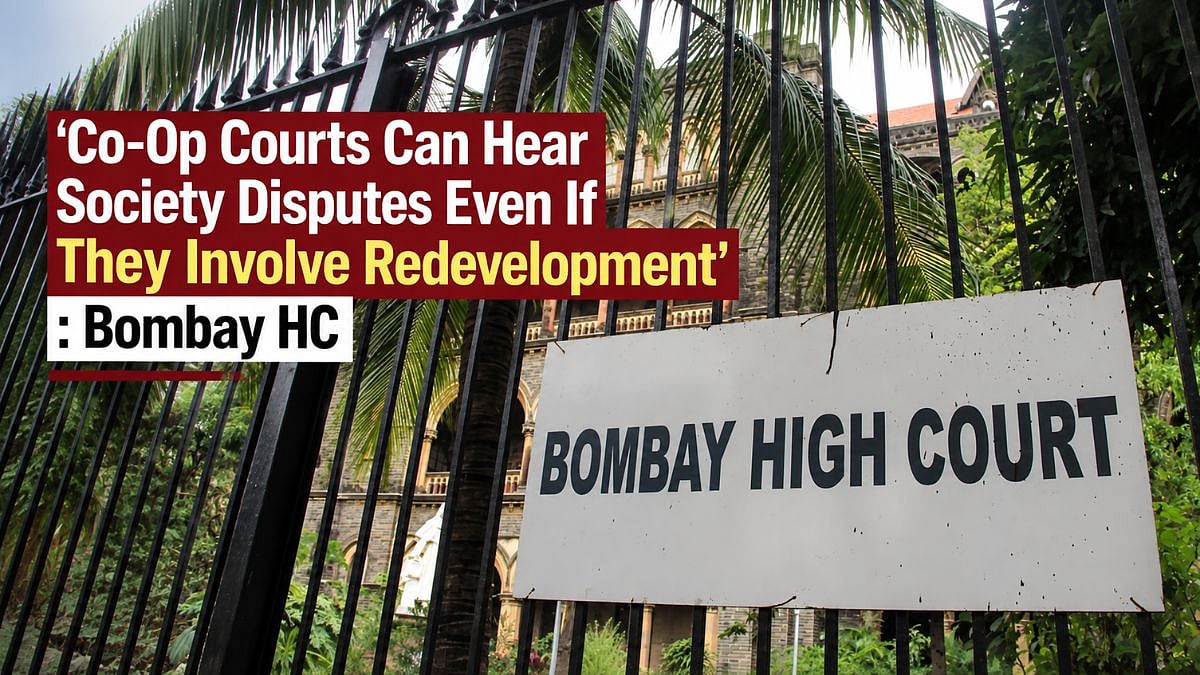
Mumbai, September 19, 2026: In a significant clarification on housing society governance, the Bombay High Court has ruled that Co-operative Courts possess full jurisdiction to hear internal procedural disputes between members and managing committees, even when the underlying meetings involve redevelopment discussions.
The decision comes as a relief to housing society members seeking judicial recourse over internal administrative grievances without being automatically routed to lengthy civil litigation.
Dispute Over Society Meetings
Justice NJ Jamadar passed the order while dismissing a batch of writ petitions filed by office bearers and members of Everard Co-operative Housing Society Ltd in Sion.
The dispute centred around whether challenges to society meeting notices and resolutions could be tried by the Co-operative Court under Section 91 of the Maharashtra Co-operative Societies (MCS) Act, 1960, or if they had to be referred exclusively to a Civil Court.
The conflict in Everard Housing Society, which comprises approximately 230 members, began when dissenting members filed disputes before the Co-operative Court. They challenged the validity of Special General Body Meeting (SGBM) notices and resolutions passed in 2022 and 2024.
The disputants alleged that meetings were convened without proper authority, violated statutory rules and bye-laws, and breached interim status-quo orders previously issued by cooperative authorities.
Co-Operative Court Jurisdiction
The Co-operative Court had initially returned the disputes for presentation before a Civil Court, reasoning that redevelopment falls outside the "business of the society" under established legal precedent. However, the Maharashtra State Co-operative Appellate Court set aside that order and restored the disputes, prompting the subsequent writ petitions before the High Court.
Upholding the Appellate Court's stance, Justice Jamadar observed that the court must steer clear of extreme positions when dealing with such matters.
The bench explicitly noted: "No straitjacket formula of universal application can be laid down. The mere fact that the Resolutions passed by the society pertain to redevelopment, by itself, cannot be the sole determinative factor."
Internal Governance At Core
The court further emphasised that since the primary challenge targeted internal meeting governance and alleged statutory violations – before any development agreement was executed or third-party rights were created – the Co-operative Court was fully competent to adjudicate the matter.
Also Watch:

The High Court concluded that "the learned Member, Appellate Court was justified in interfering with the orders passed by the Co-operative Court and restoring the Disputes to the file of the Co-operative Court."
To get details on exclusive and budget-friendly property deals in Mumbai & surrounding regions, do visit: https://budgetproperties.in/

