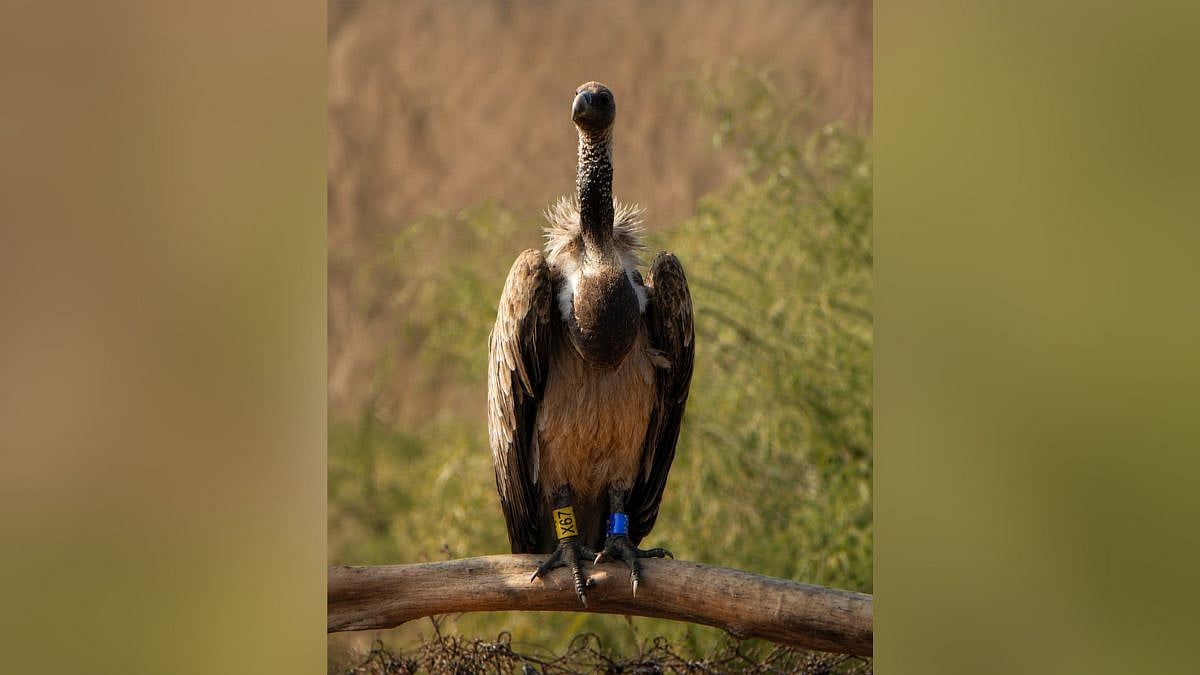
Mumbai: Indian (also called as a Long-billed) Vulture (Gyps indicus) Vulture (X67) released in Melghat in January 2026 covered 3334 Km distance in flight and on Wednesday reached the famous Ranthambhor Tiger Reserve in Rajasthan. Specially, it has also visited the Satpura Tiger Reserve near Pachamarhi and a Kuno National Park in Madhya Pradesh, a new home for Cheetah in India.
Release Background
The vulture is a five-year-old female and was one of 15 captive-bred vultures released on 2 January 2026 from the Somthana Range of the Akot Wildlife Division in Melghat Tiger Reserve. Following the release, the bird remained scavenging in the vicinity of the release site for nearly four months, gradually adapting to natural conditions.
Bhaskar Das, a Senior field biologist of Bombay Natural History Society (BNHS) shared the detailed information of this l remarkable flight. On 28 May, X67 dispersed out from the Melghat Tiger Reserve and embarked on an extensive journey across central India. The bird travelled through Maharashtra, Madhya Pradesh, and Rajasthan, eventually reaching Ranthambore National Park, covering a total distance of 3,334 km, Over a period of 27 days, making temporary roosting stops at Satpura National Park, the Bhopal region, and Kuno National Park before arriving at Ranthambore.
Conservation Significance
Kishor Rithe, Director Bombay Natural History Society (BNHS) further informed that the X67 has survived without any supplementary feeding in the wild, demonstrating the ability of captive-bred vultures to adapt to natural environments, locate food independently, and undertake long-distance movements. “The most important finding is that this route indicates that the vultures prefers the Tiger Reserve and Protected Area network as wild carrions are still available due to good presence of carnivores”, he stated further.

All 15 vultures were fitted with blue-coloured leg rings carrying identification numbers. The blue colour shows that the ringing was done in India, and the letter “M” indicates Maharashtra as the release site. The tags are solar-powered and help scientists track the movement, travel distance, safety, and survival of the vultures after their release into the wild. BNHS field biologists Bhaskar Das and Sooryajith are monitoring the vulture movements under the guidance of Dy.CF Mr.Rahul Tolia (IFS).
This achievement represents a significant milestone for the vulture conservation programme, highlighting the potential of captive-bred vulture release initiatives to contribute in recovering vulture populations in India.
To get details on exclusive and budget-friendly property deals in Mumbai & surrounding regions, do visit: https://budgetproperties.in/

