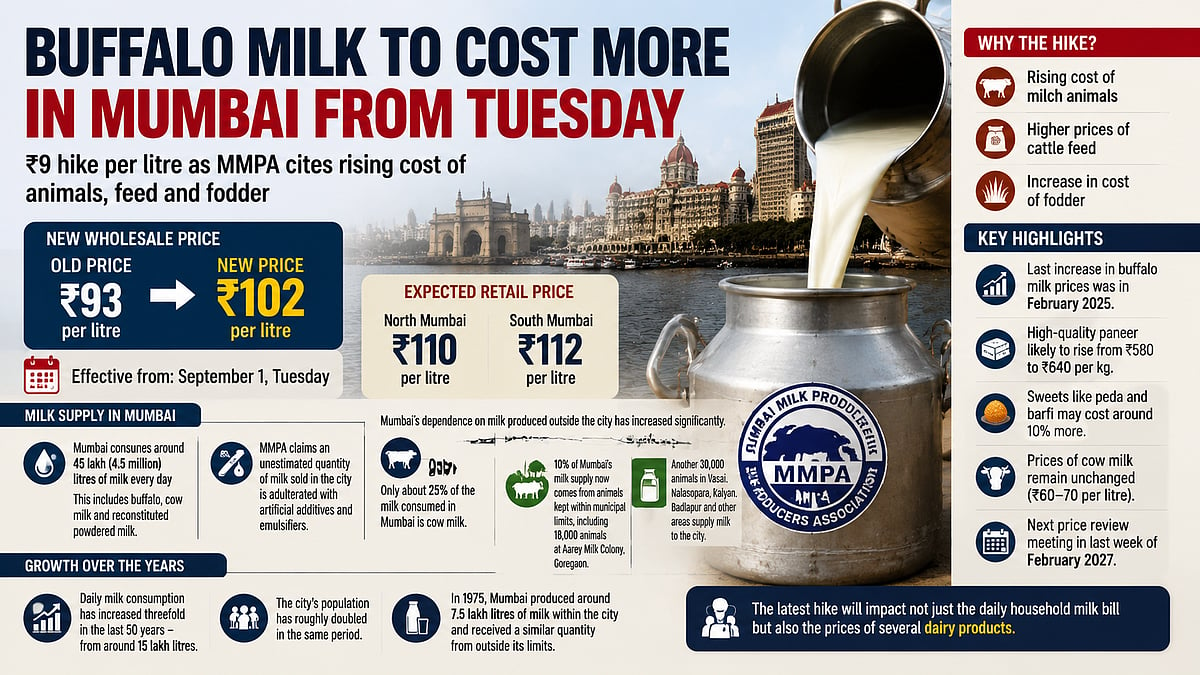
Mumbai: Buffalo milk will cost more in Mumbai from Tuesday, with the Mumbai Milk Producers Association (MMPA) announcing a ₹9-per-litre increase in its wholesale price from September 1. The price will rise from ₹93 to ₹102 per litre.
The increase is expected to push the retail price to around ₹110 per litre in North Mumbai and ₹112 in the southern parts of the city.
Rising Cost Of Milch Animals And Fodder Behind Price Increase
MMPA president Chandra Kumar Singh said the hike was necessitated by the rising cost of milch animals, cattle feed and fodder.
The last increase in buffalo milk prices was announced in February this year.
Milk-Based Products Like Paneer And Sweets Likely To Become Costlier
The higher milk prices are also expected to have a cascading effect on milk-based products, including paneer, ghee and traditional sweets. Singh said high-quality paneer could see its price rise from around ₹580 to ₹640 per kg.
Deepak Agarwal, a sweet retailer in Ghatkopar, said prices of popular sweets such as peda and barfi could increase by around 10%.
"While the cost of ingredients will go up, wholesalers and semi-wholesalers are expected to absorb most of the increased cost. End users will not be much affected," he said.
Mumbai Consumes Around 45 Lakh Litres Of Milk Daily
According to the MMPA, Mumbai consumes around 45 lakh (4.5 million) litres of milk every day. This includes buffalo and cow milk as well as reconstituted powdered milk. The association also claimed that an unestimated quantity of milk sold in the city is adulterated with artificial additives and emulsifiers.
Buffalo milk prices vary according to fat content, which generally ranges from 5.5% to 7% or more. The MMPA's standard is 7% fat. Cow milk, which has an average fat content of 3.5%, is sold at around ₹60-70 per litre.
Only about a quarter of the milk consumed in Mumbai is cow milk, according to the association.
Mumbai Increasingly Depends On Milk Supply From Outside City Limits
Singh said Mumbai's dependence on milk produced outside the city had increased substantially over the decades. Only around 10% of the city's milk supply now comes from animals kept within municipal limits.
This includes around 18,000 animals at Aarey Milk Colony in Goregaon. Another 30,000 animals kept in Vasai, Nalasopara, Kalyan, Badlapur and other areas supply milk to the city, Singh said.
"In 1949, the state government set up the Aarey Milk Colony and closed down private cattle sheds in Oshiwara, Goregaon, Kurla, Mulund and other parts of the city. So, these sources of milk supply stopped," he said.

The association said Mumbai's daily milk consumption has increased threefold over the past 50 years, from around 15 lakh litres, while the city's population has roughly doubled. Singh attributed the increase partly to rising incomes and greater consumption.
In 1975, Mumbai produced around 7.5 lakh litres of milk within the city and received a similar quantity from outside its limits, he said.
The latest hike is therefore likely to be felt not only in the daily household milk bill but also in the prices of several commonly consumed dairy products.
Prices of cow milk remain unchanged. MMPA said it will meet in the last week of February 2027 to review prices again.
To get details on exclusive and budget-friendly property deals in Mumbai & surrounding regions, do visit: https://budgetproperties.in/

