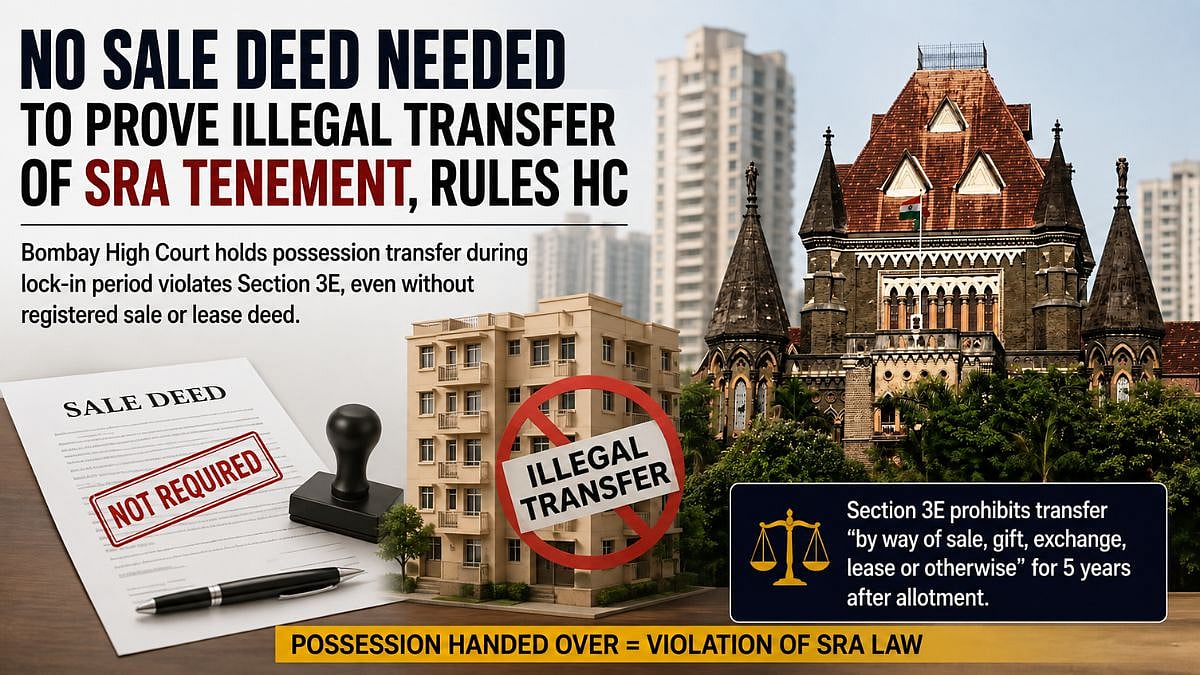
Mumbai, August 1, 2026: The Bombay High Court has held that an allottee of a slum rehabilitation tenement can be found to have illegally transferred the flat even without executing a registered sale deed or lease deed if the person has handed over possession to someone else during the statutory lock-in period.
Justice Amit Borkar observed that Section 3E of the Maharashtra Slum Areas (Improvement, Clearance and Redevelopment) Act, 1971, prohibits the transfer of rehabilitation tenements "by way of sale, gift, exchange, lease or otherwise" for the first five years after allotment.
The court said the words "or otherwise" must be interpreted broadly to include indirect methods of transfer and not just formal registered transactions.
It held that if an allottee parts with actual possession of the rehabilitation flat during the prohibited period, such an arrangement may attract the statutory bar even in the absence of a registered conveyance.
Court Upholds Eviction
The observations came while dismissing a petition filed by one Chhaya Shinde, who had challenged orders passed by the competent authority and the appellate authority directing eviction from a rehabilitation flat allotted under the Slum Rehabilitation Scheme.
According to the case records, Shinde was allotted a rehabilitation flat in 2008. The authorities later received complaints alleging that the flat had been transferred in violation of Section 3E.
During an inspection in 2015, officials found another woman occupying the flat. The inspection report recorded her statement that she was staying there as a tenant.
Dispute Over Allotment
As per the records, one Vithabai Shivram Ruke was the original occupant and photopass holder. After her death, the same was passed on to her grandson, Sushant Ruke, respondent No. 4 in the petition.
Ruke's advocate, Vinod Sangvikar, alleged that the petitioner fraudulently got her name included in Annexure II to secure allotment of the rehabilitation flat.
However, the High Court said those allegations were outside the scope of the present proceedings. Justice Borkar clarified that the case arose from action under Section 3E and was limited to examining whether the rehabilitation tenement had been transferred in breach of the statutory restriction.
Questions relating to eligibility for allotment or alleged fraud in preparing Annexure II could be examined in separate proceedings but could not determine the outcome of the present case.
Possession Key To Transfer
Shinde's advocate, Mahesh Tiwari, argued that there was no registered document showing any sale, gift, exchange or lease and, therefore, Section 3E could not be invoked. She also relied on the housing society's reply stating that the flat had not been sold.
Also Watch:

The court accepted that no registered sale or lease deed had been produced but said that alone was not enough. It noted that the petitioner had executed a power of attorney in favour of another person, Hiteshi Tank, who was allowed to remain in possession, and that the inspection later found a tenant residing in the flat.
Reading these circumstances together, the court held that there was sufficient material to conclude that possession had been parted with in violation of Section 3E and upheld the eviction order while dismissing the petition.
To get details on exclusive and budget-friendly property deals in Mumbai & surrounding regions, do visit: https://budgetproperties.in/

