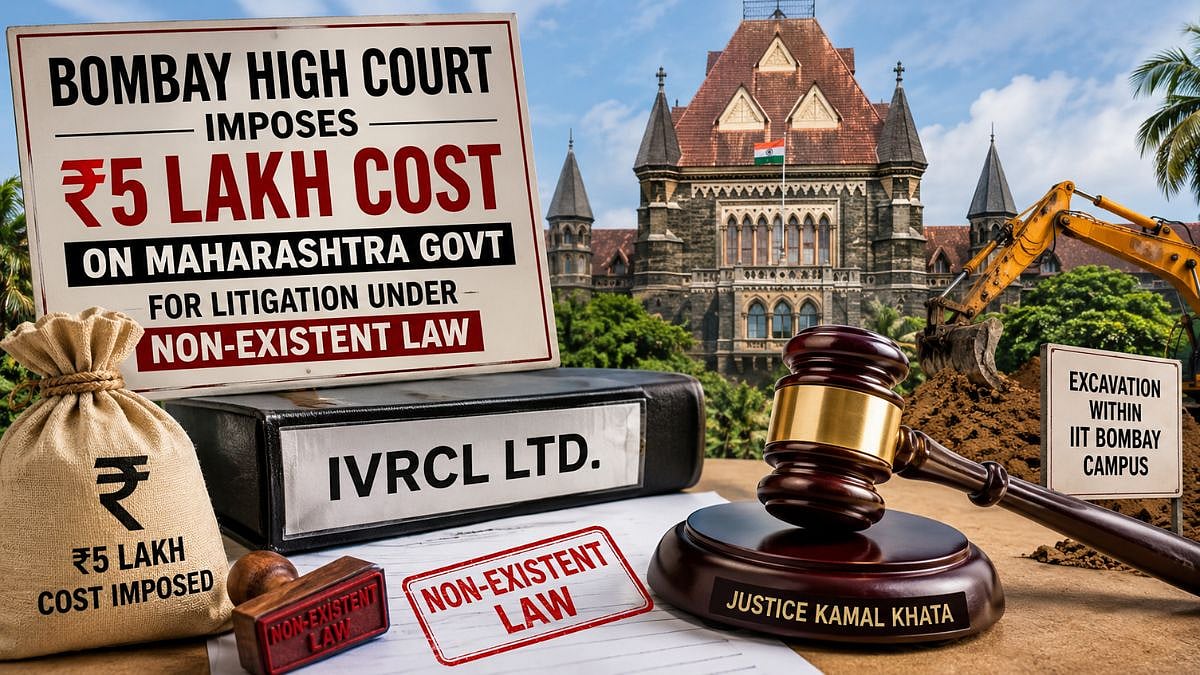
Mumbai, June 23: The Bombay High Court has imposed costs of Rs 5 lakh on the Maharashtra government for forcing infrastructure company IVRCL Ltd. into nearly a decade of unnecessary litigation by issuing a notice under a law and statutory provision that did not exist.
Justice Kamal Khata held that the State had acted without application of mind while issuing a show-cause notice over excavation work carried out within the IIT Bombay campus.
Dispute Over Excavation Work
The dispute arose from a contract awarded by the Department of Atomic Energy to IVRCL for constructing a computer centre complex at IIT Powai. As per the work order, surplus excavated earth was to be dumped at designated locations within the campus. The contractor accordingly used the excavated material to level low-lying areas inside IIT, a fact certified by the senior project engineer.
However, in 2010, a sub-divisional officer issued a show-cause notice alleging unauthorised excavation of minor minerals and later imposed a penalty of Rs 54.08 lakh. The authorities treated the movement of excavated earth between two survey numbers within the same campus as unlawful extraction and disposal.
Court Finds Notice Legally Flawed
The High Court found a fundamental flaw in the notice. It had invoked Section 29(4) of the Mumbai Minor Minerals Act, 1955. During the hearing, the State admitted that no such Act or provision exists.
“The impugned show-cause notice was thus issued by invoking a non-existing enactment and a non-existent statutory provision,” Justice Khata observed, describing the case as one of complete non-application of mind.
The Court further noted that despite the writ petition being admitted in 2015, the State failed to file a reply for more than eight years.
“Having regard to the fact that IVRCL Ltd was compelled to pursue this litigation for nearly a decade... costs quantified at Rs 5 lakh are imposed upon the State,” the judge said.
State Directed To Take Corrective Measures
Justice Khata also held that Section 48(7) of the Maharashtra Land Revenue Code had been wrongly invoked. Since the excavated earth was neither taken outside the IIT campus nor commercially exploited, it could not be treated as a “minor mineral” attracting royalty or penalty.
Also Watch:
Criticising the government's approach, the Court reiterated that the State should not engage in avoidable litigation. Quoting Supreme Court precedents, it observed that government litigation policy must be “conciliatory rather than combative or adversarial”.
The Court quashed the notice, directed the State to pay Rs 5 lakh within four weeks, and sought an affidavit detailing systemic corrective measures by August 24.
To get details on exclusive and budget-friendly property deals in Mumbai & surrounding regions, do visit: https://budgetproperties.in/

