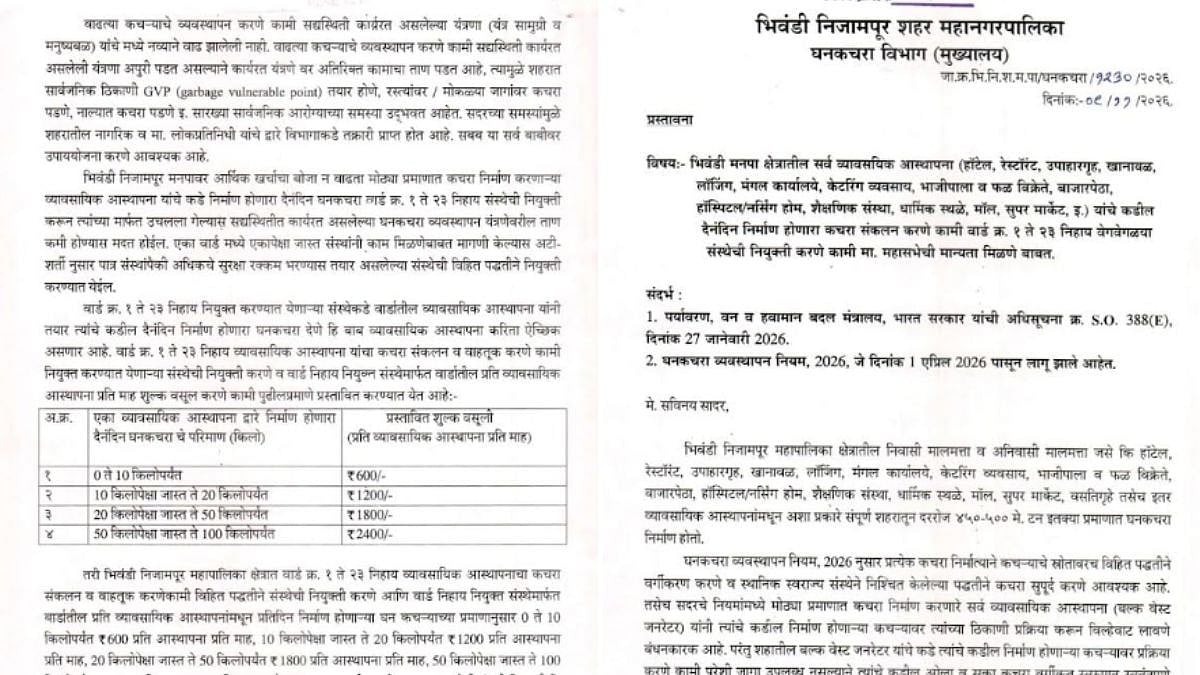
Bhiwandi: At a time when Bhiwandi continues to grapple with questions over its garbage collection and waste management system, the Bhiwandi-Nizampur City Municipal Corporation (BNCMC) is planning to impose an additional monthly charge on commercial establishments in the name of waste management. Under a proposed arrangement, private agencies would be appointed across all municipal wards to collect waste from hotels, restaurants, roadside eateries, hospitals, nursing homes, educational institutions, marriage halls, malls, supermarkets and other commercial establishments. Depending on the quantity of waste generated, these establishments could be charged between Rs 600 and Rs 2,400 per month.
The proposed charges would translate into an additional annual expenditure of Rs 7,200 to Rs 28,800 for individual establishments. The move has raised questions over the basis for calculating the fees, the legal approval required for their implementation and, more importantly, the services that businesses would receive in return.
According to the proposal prepared under Municipal Commissioner Anmol Sagar Bhiwandi generates approximately 450 to 500 metric tonnes of garbage every day. The civic body plans to appoint private agencies across all its wards for waste collection, transportation and disposal.
Under the proposed fee structure, establishments generating up to 10 kg of waste daily would be charged Rs 600 per month. Those generating 10 to 20 kg would have to pay Rs 1,200, while establishments producing 20 to 50 kg would be charged Rs 1,800. The highest proposed slab of Rs 2,400 per month would apply to establishments generating 50 to 100 kg of waste daily.
No clarity on bulk waste generators
However, the proposal does not clearly specify the fee structure or collection mechanism for establishments generating more than 100 kg of waste every day. Such establishments fall under the category of bulk waste generators under solid waste management regulations and may be required to segregate waste and process biodegradable waste within their premises, subject to applicable rules.
Hospitals and nursing homes also require special attention, as ordinary municipal waste and biomedical waste must be handled separately. Biomedical waste is governed by separate regulations and cannot be mixed with general municipal garbage. The civic body will therefore need to clarify how the proposed private agencies will distinguish between different categories of waste and ensure compliance with the relevant rules.
Accountability remains a major concern
Even if waste collection is outsourced, the overall responsibility for municipal sanitation, waste transportation and scientific disposal will continue to rest with the civic body. Before introducing an additional fee, the corporation needs to clarify the existing waste management expenditure, available vehicles, manpower, collection infrastructure and waste-processing capacity.
There are also questions over accountability. If an establishment pays the proposed monthly charge but its garbage is not collected regularly, who will be responsible for addressing complaints? Will there be a monitoring mechanism, service standards and penalties for private agencies failing to deliver the promised services?
Social Activist Parameshwar Ambure strongly opposed the proposal, alleging that the civic administration was gradually transferring various municipal functions into private hands.
He questioned the rationale behind imposing an additional financial burden on traders when sanitation and garbage collection are among the basic responsibilities of the municipal corporation. He alleged that the civic administration was increasingly focusing on commercial arrangements rather than public services and demanded that the proposal be withdrawn.
Congress corporator Shakeel Ansari Alia Papa also opposed the proposed charges arguing that the corporation was already collecting money for waste management through existing arrangements.

He pointed out that the garbage management contract had already been awarded under the Zero Garbage Project, while households were also being charged for domestic waste collection through property tax. Commercial and industrial establishments, he added, were already paying various taxes and charges, including mal-labhkar and jal-labhkar.
Imposing another monthly fee for garbage management, he argued, would amount to an additional or potentially duplicate recovery from businesses. He said he would oppose the proposal during the General Body meeting and demand its withdrawal.
With the proposal facing opposition, the key question before the civic administration is whether outsourcing waste collection will actually improve sanitation in Bhiwandi or simply add another financial burden on the city's already burdened business community.
To get details on exclusive and budget-friendly property deals in Mumbai & surrounding regions, do visit: https://budgetproperties.in/

