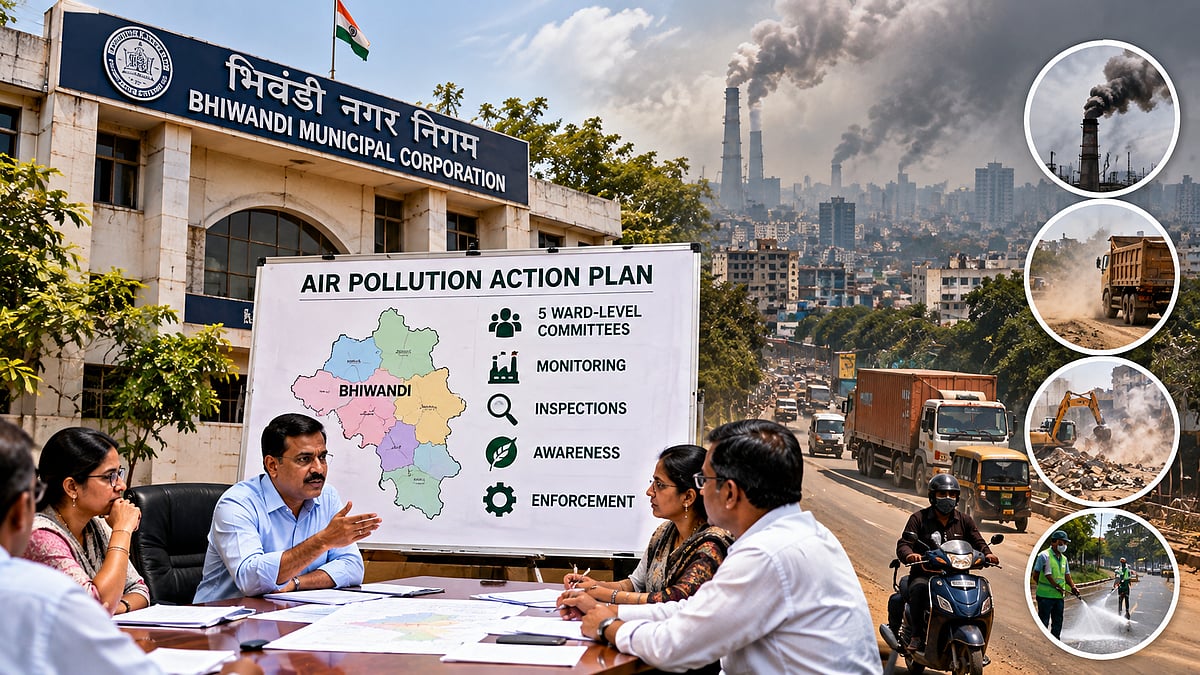
Bhiwandi: In a concerted effort to tackle rising air pollution and dust levels, the Bhiwandi-Nizampur City Municipal Corporation (BNCMC) will constitute ward-level committees across its five prabhag areas, with a city-level review committee headed by the municipal commissioner overseeing their functioning. The move follows recommendations of a high-level committee in connection with a suo motu public interest litigation initiated by the High Court.
The measures aim to improve air quality, control dust generated at construction sites, curb vehicular emissions and ensure effective implementation of the winter action plan. Rapid urbanisation, construction activities, industrial operations and vehicular emissions have contributed to the growing air pollution problem across the Mumbai Metropolitan Region (MMR), prompting directions for immediate intervention by local civic bodies.
Ward-level panels to include multiple departments
The committees in all five prabhag areas will be chaired by the respective prabhag officers. The Deputy Regional Officer of the Maharashtra Pollution Control Board (MPCB), Kalyan, or the concerned regional representative will serve as the convener.
Representatives from the traffic police, Bhiwandi city police, the Regional Transport Office, ward health inspection staff, sanitation, town planning, construction and roads departments, beat inspectors and the encroachment removal department will also be part of the committees.
Weekly meetings, action within eight days
The ward-level committees will meet every week to review pollution levels and identify vulnerable locations. A list of dust-prone and pollution-sensitive sites will be prepared, covering unpaved roads, unauthorised construction activities, construction and demolition sites, bakeries, furnaces, cremation grounds, open plots, traffic congestion points and locations where waste is dumped or burned in the open.
The authorities have been directed to initiate strict action at identified locations within eight days. Regular public awareness campaigns will also be undertaken to promote proper waste disposal, segregation of wet and dry waste, and measures to prevent air pollution.
The city-level review committee, chaired by the municipal commissioner, will include regional and deputy regional officers of the MPCB as conveners. Other members will include the Deputy Commissioner of Traffic Police, Regional Transport Officer, municipal city engineer, town planning officials, deputy commissioners overseeing environment and solid waste management, chief garden superintendent, district mining officer and the head of the environment department.
Sensor-based monitoring at construction sites
All recognised construction sites will be required to install sensor-based air pollution monitoring equipment. The data generated by these devices will be reviewed daily, while a control room at the municipal headquarters will facilitate real-time monitoring and record-keeping.
Any abnormal pollution levels detected at a site will require immediate action and submission of a report. Construction and demolition sites, particularly those involving excavation and demolition work, will be subject to special inspections.
Measures will also include covering waste and debris that cannot be removed immediately, stabilising soil, installing biological fencing and developing green belts.
Road cleaning, pothole repairs and green cover
Road-sweeping machines will be fitted with cameras to facilitate monitoring and record-keeping. The civic body has also been directed to complete post-monsoon road patchwork and pothole repairs on a war footing to prevent dust from rising from damaged road surfaces.
Also Watch:
The city-level committee will promote plantation of native tree species and the development of green belts to help control dust. Pollution-control measures will be implemented in short-, medium- and long-term phases, with priority given to construction dust, waste management, road dust and vehicular emissions.
The municipal deputy commissioner in charge of environment will be appointed as the nodal officer to coordinate and monitor the implementation of these measures.
The effectiveness of the initiative will ultimately depend on timely enforcement, inter-departmental coordination and regular monitoring of pollution hotspots across Bhiwandi.
To get details on exclusive and budget-friendly property deals in Mumbai & surrounding regions, do visit: https://budgetproperties.in/

