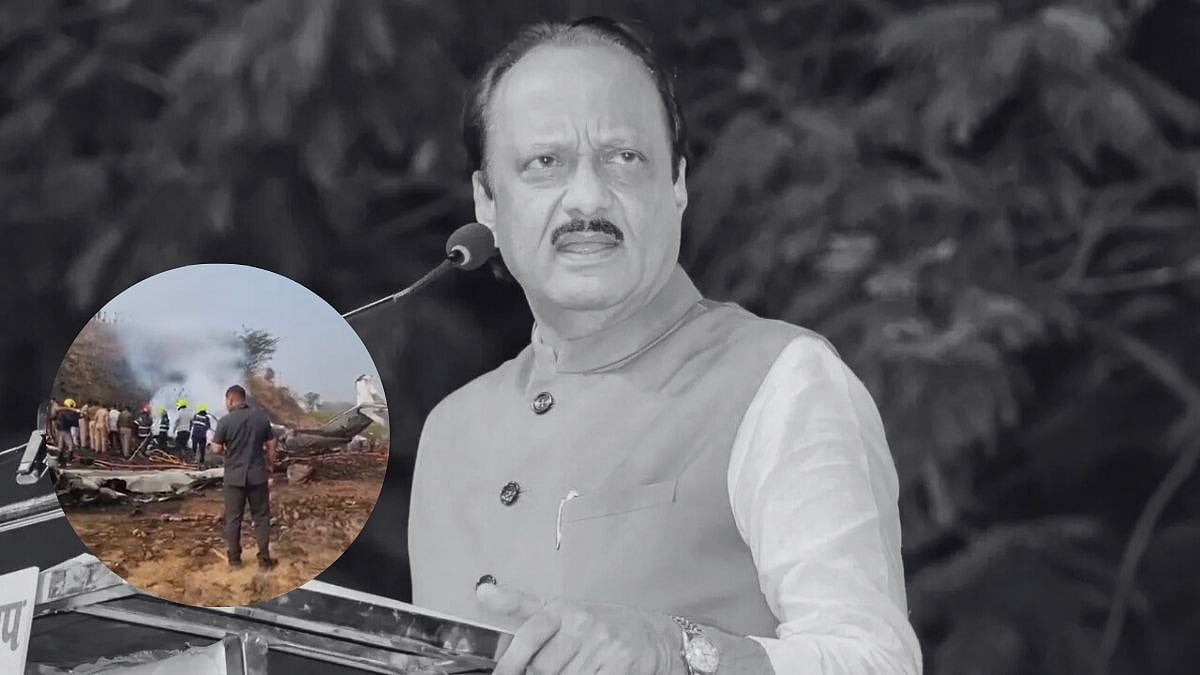
Mumbai: A preliminary investigation report by the Aircraft Accident Investigation Bureau (AAIB) into the fatal crash of a Learjet 45XR in Baramati, that killed Maharashtra Deputy Chief Minister Ajit Pawar, has revealed that the aircraft attempted to land in weather conditions significantly below safety requirements. The report also ended all the speculations about the flight’s captain being in inebriated condition as it revealed that the breath analyser test of both the crew members were found to be negative before the flight.
The Incident: Five Lives Lost on January 28
The January 28 crash claimed the lives of all five people on board, including Pawar. The report, released on Saturday, provides the first official technical timeline of the accident involving aircraft VT-SSK, operated by VSR Ventures Pvt. Ltd.
According to the AAIB findings, the visibility at Baramati airfield at the time of the accident was reported to be approximately 3,000 meters. Under Visual Flight Rules (VFR), which govern landings at uncontrolled airfields like Baramati that lack advanced navigational aids, a minimum visibility of 5,000 meters is legally required. It also highlighted that while the meteorological aerodrome report of Pune showed lowest visibility of 2,000 mtr during that time, satellite imagery showed presence of very shallow fog in patches over Baramati.
The report highlighted a critical lapse that the airfield lacks a formal Meteorological (MET) facility. Instead, visibility was estimated by a ground instructor from a local flying training organisation (FTO) who was manning the temporary Air Traffic Control (ATC) tower. The instructor reportedly used a hand-drawn chart of local landmarks to guess the visibility distance.
The Final Moments
Despite the 3,000-meter estimate being relayed to the pilots, the crew proceeded with the approach. The communication between Baramati tower and aircraft highlighted that the crew enquired about Runway 11 but asked landing permission for Runway 29 even after ATC stated that winds were calm for Runway 11. However, the crew again asked clearance for Runway 11 after the ATC asked to descend at pilot's discretion.
After an initial failed attempt and a go-around, the pilots reported the field was in sight during their second attempt. Around 18 seconds later, the aircraft transmitted a final, distressed exclamation – "Oh s**t Oh s**t" before it crash landed 50 mtr to the left of Runway 11. CCTV footage from nearby villages showed that the aircraft banked towards right, then struck the trees before hitting the ground, which is at a lower elevation than the runway surface.
Pilots Cleared of Substance Use
In a significant finding regarding the crew, the AAIB confirmed that both the pilot-in-command Sumit Kapur (61) and the first officer Sambhavi Pathak (25) had tested negative in their pre-flight breath analyser (BA) tests. Kapur was a highly experienced aviator with over 18,000 flying hours. However, details about his past record of positive BA test had sparked speculations related to his condition while flying. This detail effectively rules out alcohol impairment as a contributing factor, shifting the investigative focus toward environmental conditions and operational procedures.
The report noted that both the pilots had flown to Baramati earlier and were aware of the topography of the airfield. As per the records available with the company, the PIC and FO had prior experience of operating a number of VIP flights and other flights to uncontrolled airfields including Baramati. Pathak also had a flying experience of almost 2,500 hours. AAIB added that the post mortem report highlighted the cause of death of both the crew members due to multiple injuries associated with burn injuries.
Last Flight Before The Crash
AAIB noted that the last flight operated on VT-SSK before the accident flight was on January 26 Mumbai-Surat-Mumbai. The flight had landed back at Mumbai at around 12.20am the next day. The operating crew of that flight did not find any abnormality in the aircraft during the entire flight and the technician, who inspected the flight post arrival at Mumbai, stated that no abnormality was observed in the aircraft.
Safety Recommendations Issued For Uncontrolled Airfields And Private Operators
Through the preliminary report, the AAIB issued interim safety recommendations aimed at the Directorate General of Civil Aviation (DGCA) and chartered operators. It recommended DGCA to direct all operators using VFR flights to uncontrolled airfields to strictly adhere to the standard operating procedures. It also suggested DGCA to direct the aerodrome operators and organisations handling the aerodrome services at such uncontrolled airfields to ensure that the flying operations are allowed only when the prevailing meteorological conditions are within the criteria laid down in DGCA regulations.
AAIB highlighted that there is an increase in the number of private operations in uncontrolled airfields and recommended DGCA to direct all stakeholders, managing and maintaining the uncontrolled airfields, to ensure that required safety standards are maintained at the airport and compliance should be checked during audit or surveillance. It also suggested the aviation regulator enhance the landing aids along with basic meteorological facilities at these airports to cater for the large number of chartered flying and recommended DGCA to check the feasibility of licensing these aerodromes for conducting safe and regulated flying operations.
The AAIB is continuing its probe and is yet to download data from the cockpit voice recorder (CVR), which suffered thermal damage. While the data from the flight data recorder was successfully downloaded, the investigation body has sought assistance from United States’ National Transportation Safety Board for specialised data retrieval.
AAIB Investigation Highlights Infrastructural Lapses At Baramati Airport
AAIB’s inspection of Baramati Airfield after the Learjet Crash highlighted various infrastructural lapses at the airport, which is operated by Maharashtra Airport Development Company (MADC) since August 2025. The onsite investigation revealed that the airport does not have any navigational aids other than wind socks. While two windsocks have been installed at the aerodrome towards Runway 29, no wind sock is available towards Runway 11.
It flagged that the runway has not been re-carpeted after March 2016 leading to fading of all the runway markings and presence of loose gravels on the runway surface. The airport does not have an inhouse aircraft rescue and fire fighting (ARFF) unit and emergency services are provided by Baramati Municipal Corporation based on request from non-scheduled operators. AAIB also highlighted that there is no boundary wall around the aerodrome and the available fencing is not adequate and does not cover the entire aerodrome.
To get details on exclusive and budget-friendly property deals in Mumbai & surrounding regions, do visit: https://budgetproperties.in/

