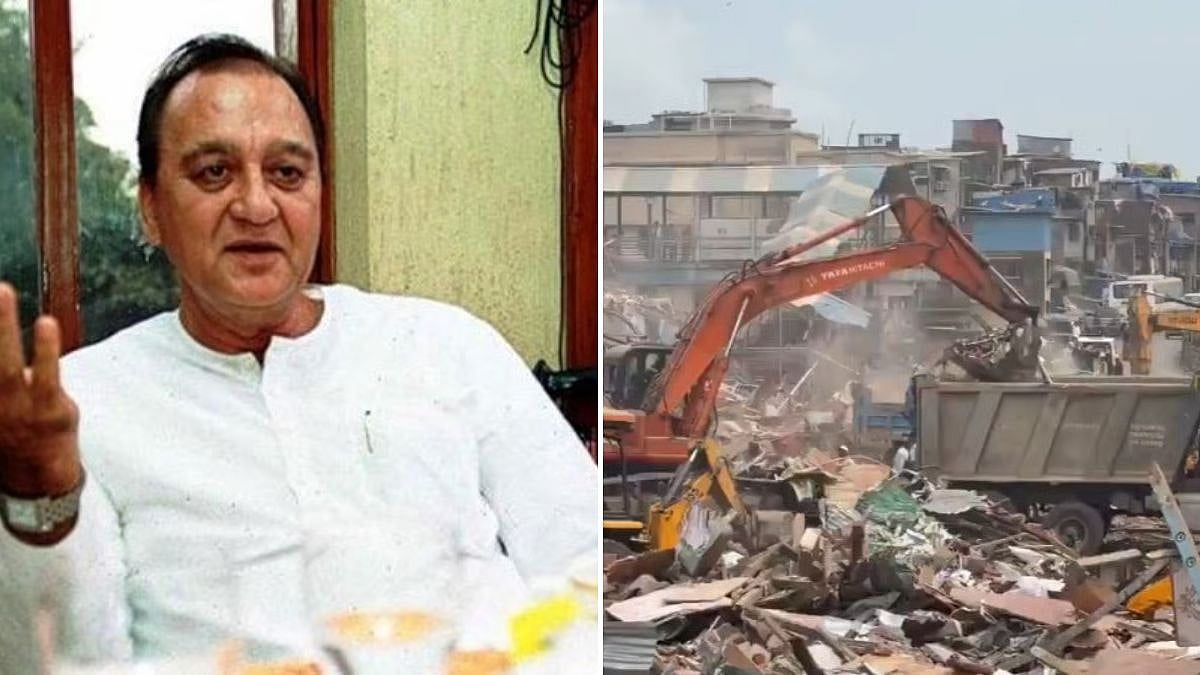
Mumbai: When around 500 illegal hutments in Bandra East were demolished last week in one of the city's largest recent anti-encroachment operations, one name frequently resurfaced in social media posts: actor and former Congress Member of Parliament for the area, the late Sunil Dutt.
Online commentary on demolition
As bulldozers tore through the illegal multi-storey slum houses outside Bandra railway station, online commentators described the demolition as the destruction of Dutt’s life's work. One comment, insinuating that Dutt had actively encouraged the growth of the slums, alleged that he had brought in illegal immigrants to secure a captive vote bank.
Priya Dutt, daughter of the late MP and herself a former parliamentarian for the constituency, noted that she had read some of the commentary. "I find these messages completely silly because nobody can simply bring people to the city. The slums came up in front of everybody’s eyes," she said. "During my father’s time as an MP, he did stop bulldozers because he felt a responsibility towards the citizens. He did not oppose the demolitions outright, but he insisted that the residents be rehabilitated first."
Priya Dutt on her father's approach to demolitions
Dutt recalled that the scale of the slums was far smaller during her father's tenure. "The number has increased significantly, even though my father has been gone for more than 20 years," she said. She added that when a slum in the area was named Nargis Dutt Nagar after her mother—the m actor and Rajya Sabha MP—her father actually wanted to take legal action to stop the use of the name. "Everyone mistakenly thought that the slum belonged to my mother."
Longtime residents of Bandra have witnessed the massive proliferation of informal housing in a locality traditionally referred to as the 'Queen of Mumbai’s suburbs'. Sanjeev D'Souza, whose family has lived in the suburb for over a century, said the landscape had shifted dramatically by the time he returned to India around 2005, after spending 25 years in the United States.
Nargis Dutt Nagar controversy
"I remembered just a few slums in Kasaiwada near the station. Beyond that, there was mostly vacant space. When I returned, the entire area was covered by slums. If you looked out from Hotel Rang Sharda, all you could see was a sea of shanties," said D’Souza. However, he dismissed the idea that Dutt maliciously created them. "He was a benevolent man, and he simply helped the people who lived there."
Many locals feel that responsibility for the expansion lies more with Dutt’s juniors in the Congress party. "Now, people look back and think the slum residents were brought in as a vote bank because almost all of them belong to one community. However, at that time, voting did not happen along communal lines, and people didn't view them as religious vote banks," D’Souza explained.
Sanjeev D'Souza's recollection of change
Asif Zakaria, a former corporator from Bandra, argued that if Congress leaders had systematically engineered these slums for votes, the party's local political fortunes would look very different. "It is unfair to say the slums were created solely as a vote bank. If every Congress leader had encouraged them, the party would still be comfortably in power here. The reality is that slums are a city-wide phenomenon," Zakaria said.
Priya Dutt emphasised that Bandra reflects some of the sharpest income inequalities in Mumbai. "We cannot ignore the half of our population that is poor. People often fail to see the value of human life," she added.
D’Souza, who also serves as the H-West ward coordinator for the civic activist group Agni, concluded that the growth of Bandra’s slums was not a calculated political plot, but rather a natural urban evolution. "The suburb desperately needed labour," he said. "It became a win-win situation for everybody: Bandra got cheap labour, the politicians got voters, and the poor got a roof over their heads."
To get details on exclusive and budget-friendly property deals in Mumbai & surrounding regions, do visit: https://budgetproperties.in/

