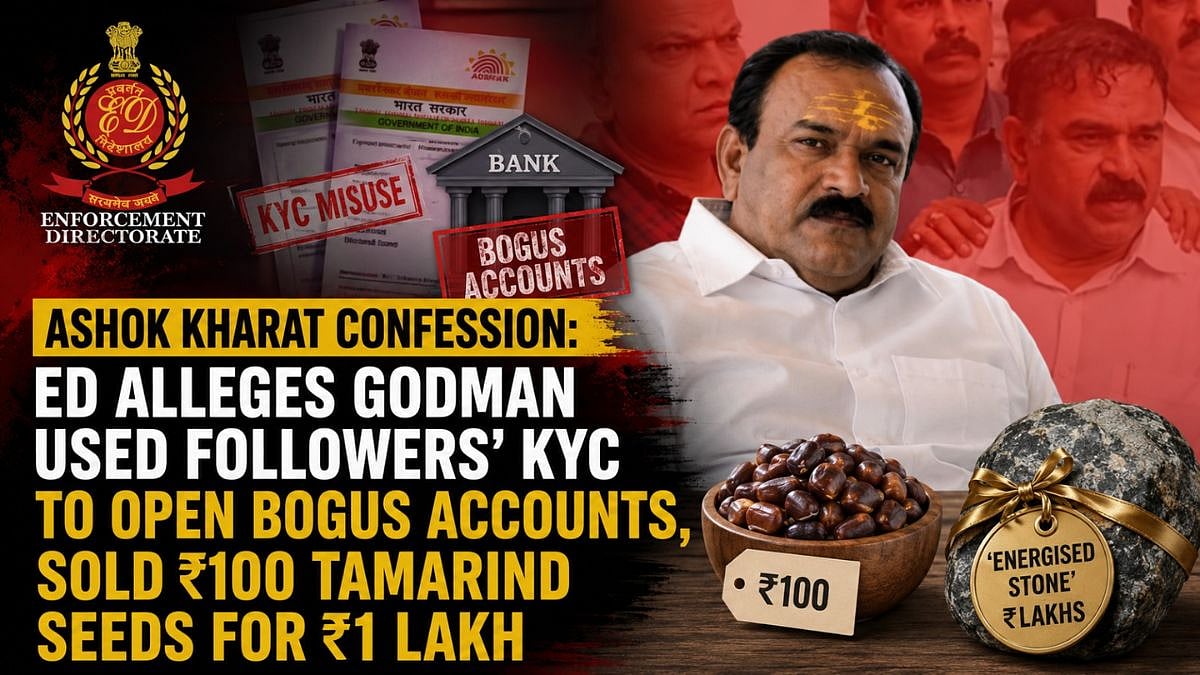
Mumbai, July 22: Self-styled godman Ashokkumar Eknath Kharat alias "Captain", arrested in the Enforcement Directorate's (ED) alleged Rs 42.88-crore money laundering case, reportedly admitted during questioning that he collected Know Your Customer (KYC) documents of his followers on the pretext of arranging pilgrimage bookings and used them to open dozens of bank accounts without their knowledge, according to his statement recorded by the agency.
Alleged KYC Misuse Detailed
The statement, which forms part of the ED's prosecution complaint, also records Kharat admitting that he controlled several of these accounts, while repeatedly claiming he could not produce documentary proof regarding the source of large cash deposits, investments and donations received through entities linked to him.
According to his statement, Kharat told investigators that followers were asked to submit their Aadhaar and PAN cards on the pretext that the documents were required for booking pilgrimage tickets or organising religious rituals. Instead, the KYC documents were allegedly used to open around 60 bogus bank accounts and 48 special savings accounts at Samata Nagari Sahakari Patsanstha, in Rahata, and 34 fixed deposit and current accounts at Jagdamba Mata Gramin Bigarsheti Sahakari Patsanstha Maryadit in Sinnar. Of the 34 accounts, 32 were allegedly benami and opened without the knowledge or consent of the account holders. In some cases, the prosecution complaint alleged, followers' signatures were forged to facilitate the opening of the accounts.
ED Details Alleged Modus Operandi
According to the prosecution complaint, the alleged extortion, cheating and money laundering operation revolved around what the agency described as a carefully cultivated religious persona. Investigators alleged that Kharat projected himself as an incarnation of Lord Shiva, adopted the title "Captain" and claimed supernatural powers to instil fear of death, black magic and divine wrath among devotees.
The complaint also refers to allegations forming part of the predicate offence investigation that Kharat administered sedative-laced "prasad" or drinks to female devotees before sexually assaulting them while they were unconscious or semi-conscious. The ED said in the complaint that the allegations are relevant to its money laundering probe as they indicate that fear and psychological dependence created through such acts were later used to extract money from followers over several years. Kharat has denied wrongdoing.
Investigators further alleged that devotees were persuaded to buy ordinary products falsely projected as possessing divine and curative powers. These included tamarind seeds, gemstones, Vastu Yantras, Suvarna Bhasma, specially "energised" rings and "sacred honey", which were allegedly sold at exorbitant prices after being claimed to possess supernatural properties capable of curing illnesses, removing misfortune, warding off evil spirits and improving prosperity.
Witnesses Describe Alleged Sales
The prosecution complaint relies on the statement of Kharat's former office assistant, recorded under Section 50 of the PMLA on June 22, who allegedly told investigators that ordinary tamarind seeds purchased from local Ayurvedic stores for around Rs 100 per kg were marketed as spiritually energised divine seeds and sold to devotees for amounts ranging from Rs 10,000 to Rs 1 lakh. The witness alleged that the price was fixed by Kharat after assessing the financial capacity of each devotee rather than the value of the product.
The same witness claimed that gemstones marketed as possessing extraordinary astrological powers were procured at ordinary market prices and resold for several lakh rupees after purported "energisation". He further alleged that plastic snakes and artificial tiger figures purchased from local markets were placed at the Ishaneshwar Temple and other locations during rituals to create an illusion of divine manifestation, leading devotees to believe they were under the influence of supernatural forces and that only Kharat could remove curses or evil influences in return for money.
The complaint also cites the statement of a pharmaceutical company director, who alleged that he was persuaded to purchase what was described as rare "cave honey" with exceptional medicinal and spiritual properties for around Rs 7 lakh per litre. Upon verification, he allegedly found it to be ordinary honey available in the market for a few hundred rupees per litre.
Also Watch:
Kharat Denies Wrongdoing
Kharat denied allegations that the funds represented proceeds of extortion, claiming that the money was received as voluntary donations from devotees and not through coercion. He told investigators that he never charged a fee for spiritual consultations and that followers contributed out of faith. Kharat further stated that funds received through Shree Shivnika Sansthan were meant for religious and charitable activities. However, according to the ED, he failed to produce donor records, year-wise details or any documentary evidence to substantiate the source of the donations. The agency further alleged that he could not explain how the funds received as donations were diverted and utilised for his personal expenses and acquisition of assets.
To get details on exclusive and budget-friendly property deals in Mumbai & surrounding regions, do visit: https://budgetproperties.in/

