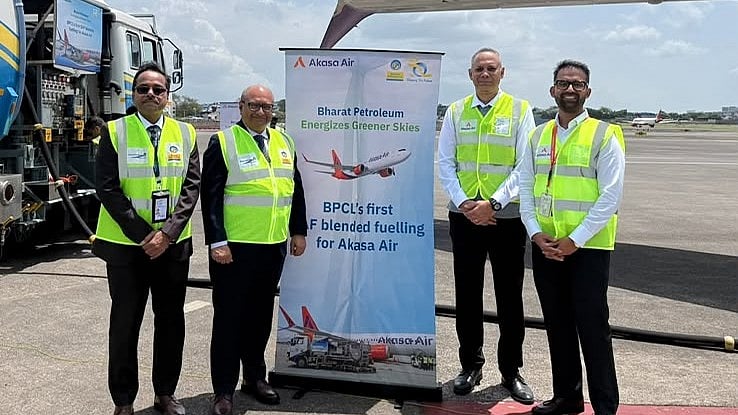
Mumbai: Low-cost carrier Akasa Air operated a commercial flight utilising conventional aviation turbine fuel (ATF) blended with 1% sustainable aviation fuel (SAF). The eco-blend, supplied by state-run energy giant Bharat Petroleum Corporation Limited (BPCL), powered a flight operating from Mumbai to Goa.
Flight Collects Fuel Performance Data For Future SAF Expansion
The aircraft departed Mumbai’s Chhatrapati Shivaji Maharaj International Airport at 1.05pm and touched down at Goa’s Manohar International Airport in Mopa at 2.30pm, collecting crucial operational data and fuel-performance metrics for both organizations. The sector flight supports India’s national ambition to achieve a 5% mandatory SAF blend by 2030, while aligning with the International Air Transport Association’s (IATA) commitment to achieve net-zero carbon emissions across global commercial aviation by 2050.
This was the first operational milestone following a memorandum of understanding (MoU) signed between Akasa Air and BPCL in July 2026. Under the agreement, both entities aim to test, scale and establish a commercial framework for SAF distribution across primary Indian hubs.
SAF Trials Help Build Supply Chain And Regulatory Framework
While a 1% blend represents an incremental ratio, industry experts view operational flights as essential proof-of-concept demonstrations needed to refine supply chains, handling procedures, and regulatory frameworks.
Akasa Air’s chief financial officer, Ankur Goel, stated that operationalising the fuel blend translates strategic intent into practical progress. "Sustainability is one of Akasa Air's core values and shapes how we are building the airline for the long term. This flight with BPCL translates our partnership into tangible action. Scaling SAF in India will require coordinated action across the ecosystem, supported by domestic supply, enabling policy and commercial viability,” he said.

According to industry experts, indigenous SAF production offers dual benefits of lower emissions and stronger national energy security for a country like India, which relies heavily on crude oil imports. However, supply chain fragmentation and complex feedstock aggregation continue to hinder scaling.
BPCL’s director of marketing, Subhankar Sen, acknowledged these hurdles while emphasising the strategic need for renewable fuel development. "The transition from conventional fuels to sustainable alternatives is both an environmental imperative and a strategic necessity for India. While feedstock availability and aggregation have historically posed challenges due to fragmented supply chains, sustained efforts across the value chain have helped create the foundation for a viable SAF ecosystem,” he added.
To get details on exclusive and budget-friendly property deals in Mumbai & surrounding regions, do visit: https://budgetproperties.in/

