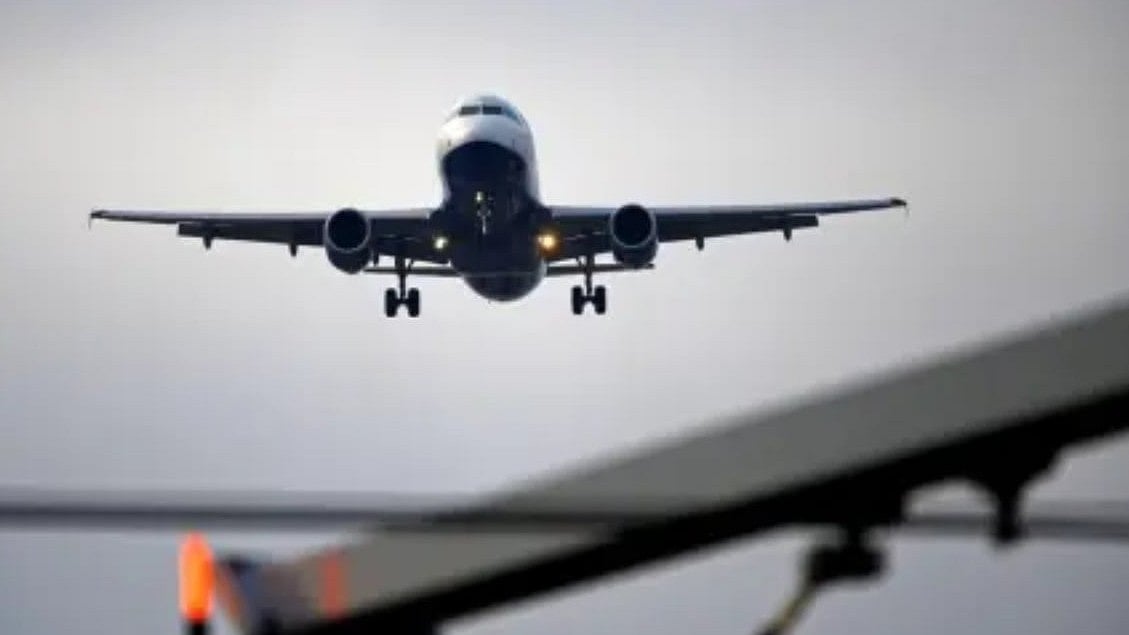
Mumbai: India’s Aircraft Accident Investigation Bureau (AAIB) has strongly recommended the establishment of a formal framework for institutional collaboration between itself, the Directorate General of Civil Aviation (DGCA), and national defence authorities. The systemic gaps in dual-user airspace management were highlighted following a serious incident at Port Blair airport, in which an Air India commercial flight and an Indian Navy helicopter came dangerously close.
The significant policy recommendation is part of the AAIB's final investigation report on a serious airprox incident in February 2024 at Port Blair’s Veer Savarkar International Airport – a strategic airfield operated by the Indian Navy, where both civilian and military flights share the runway and local airspace.
According to the AAIB, Air India flight AI-788, an Airbus A319 bound for Kolkata, was cleared for take-off from the runway and an Indian Navy's ALH Mk III Dhruv helicopter was executing a training mission simultaneously. As the Air India jet surged down the runway and entered its take-off path, the proximity between the two aircraft decreased sharply, triggering a critical traffic advisory on the defence helicopter.
The disaster was averted only after the helicopter pilot executed a sharp right turn to steer clear of the commercial airliner's ascending flight path. Following the evasive maneuver, the Air India flight proceeded to its destination, while the Navy helicopter discontinued its approach and safely returned to base. Subsequently, the Air India flight's crew had to carry out a forced descent at a very high speed of 245 knots, triggering an overspeed warning.
Classifying the event as a serious incident, the AAIB probe pinned the primary responsibility on local air traffic control management. "The probable cause of the incident was inadequate assessment of the traffic situation by the approach controller, which resulted in reduced separation and close proximity between the departing aircraft and the overflying helicopter," the final investigation report concluded.
Crucially, the bureau pointed out a secondary operational lapse by the civilian airliner's crew. The AAIB noted that the pilot-in-command of the Air India flight engaged in "undue conversation with the controller" during a critical phase of the flight, momentarily choking the communication channels.
The core finding of the report points toward a deeper, structural problem in Indian aviation about the absolute lack of a formal, standardised channel for sharing critical flight safety and accident data between civilian regulators and the armed forces. The AAIB explicitly noted that no formalised mechanism for the exchange of safety-related information currently exists between the AAIB or DGCA and the three wings of the military.
Also Watch:
Alarmingly, the bureau revealed that this is not the first time such an operational void has been highlighted and the earlier recommendations are yet to be highlighted. The AAIB had previously issued urgent recommendations urging seamless coordination with defense authorities following two separate air accidents, including the crash of a state government aircraft at Gwalior Airport in May 2021 and a training aircraft crash at Umari in January 2023.
To mitigate the risk of catastrophic mid-air collisions at a shared enclave such as Port Blair, the AAIB suggested that the Indian Navy consider integrating a secondary surveillance radar system to significantly enhance air traffic tracking capabilities. While the investigative body urged the civil aviation and the defence ministries to implement previous recommendations on a priority basis, it also advised Air India to heavily sensitise its flight crews regarding the strict adherence to radio telephony (RT) discipline.
To get details on exclusive and budget-friendly property deals in Mumbai & surrounding regions, do visit: https://budgetproperties.in/

