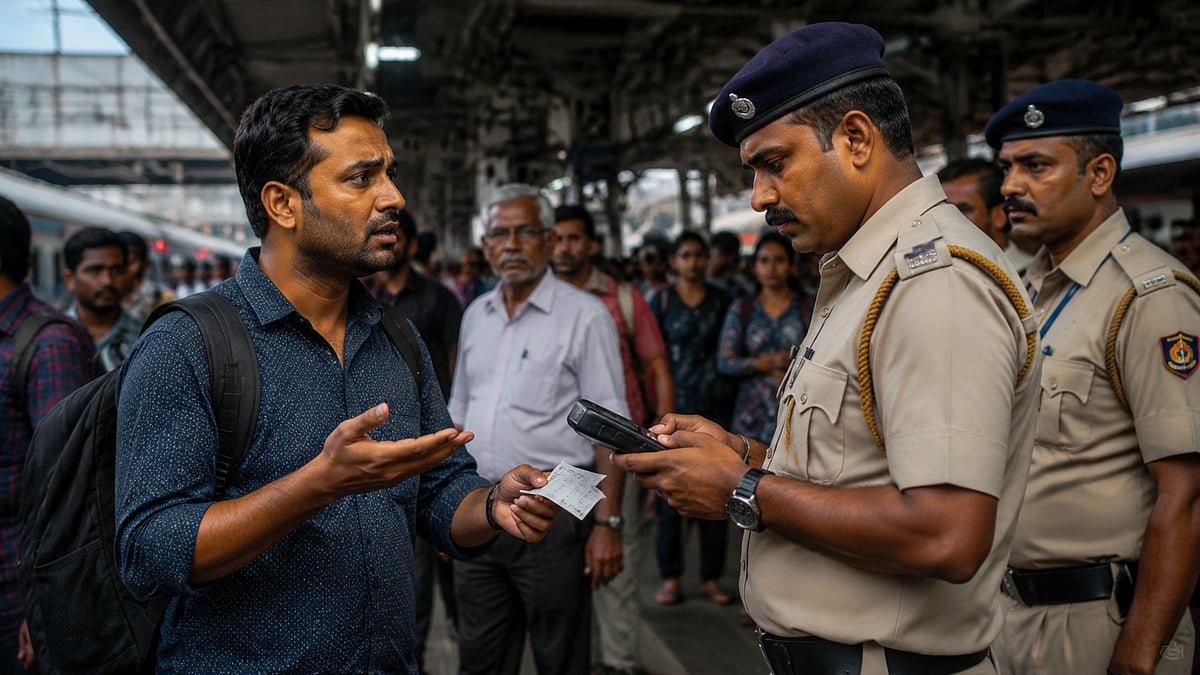
Mumbai: A ₹500 fine imposed on a man at Kalyan railway station after he waited several hours for a delayed train has triggered a debate over whether railway regulations adequately account for ground realities faced by passengers and their families.
What Happened
The incident occurred on Thursday when the man purchased a platform ticket to accompany family members boarding a long-distance train. According to the passenger, the train, originally scheduled to arrive around noon, was repeatedly delayed. He remained on the platform with his family until the train eventually arrived later in the evening.
However, while exiting the station after seeing them off, he was stopped by ticket-checking staff and fined for remaining on the platform beyond the validity period of his platform ticket.
Railway’s Stance
Railway officials maintain that the penalty was imposed strictly in accordance with existing rules. A senior Central Railway official said the action had no connection with the train delay itself and was solely based on the expiry of the platform ticket's validity.
Under current railway regulations, a platform ticket is generally valid for two hours from the time of issue. The validity period does not automatically extend if a train is delayed.
Official’s Clarification
"The fine was imposed because the individual stayed on the platform beyond the prescribed validity period of the ticket. The delay of the train was not the basis for the penalty," an official said.
Yet the incident has brought into focus a practical dilemma frequently faced by passengers. Family members often accompany elderly travellers, women travelling alone, children or first-time passengers and may be required to wait for extended periods when trains are running late.
Larger Question
The Kalyan case raises a larger question: should a person holding a valid platform ticket be penalised for remaining on the platform when the delay is caused by the railway system itself?
Passenger rights activists argue that while the rule may be legally enforceable, its implementation in such situations appears disconnected from passenger convenience.
Zaveri’s Statement
Railway activist Sameer Zaveri said the incident exposed a gap between regulation and reality. "If a train is delayed by several hours due to the railway's own operational reasons, passengers and their family members should not be penalised for overstaying on a platform ticket. A platform ticket holder cannot be expected to leave the station and purchase a fresh ticket every two hours while waiting for a delayed train. The Railway Board should review this provision and consider a mechanism for extending validity in cases where delays are caused by the railways," he said.

The controversy has also renewed questions about public awareness of platform ticket regulations. While the two-hour validity rule exists, many passengers remain unaware that the validity period continues to run regardless of train delays.
For the railways, the matter may be a straightforward case of rule enforcement. For passengers, however, the Kalyan incident highlights a broader issue — whether regulations framed for normal operations remain fair when circumstances are far from normal.
As railway authorities increasingly emphasise strict ticket checking and revenue protection, the episode serves as a reminder that passenger convenience and operational fairness must evolve alongside enforcement.
To get details on exclusive and budget-friendly property deals in Mumbai & surrounding regions, do visit: https://budgetproperties.in/

