
I am a bit of a military history nerd. My home library has hundreds of titles on military history (both physical and digital versions combined), ranging from academic tomes by historians, campaign histories, memoirs by generals and other officers, and biographies of military leaders. Probal Dasgupta’s General Brasstacks: The Sundarji Story is a welcome addition.
Dasgupta has had a very interesting career. He served in the Indian Army with the Gorkha Rifles. He is an alumnus of Columbia University and, in addition to being a historian, he is the founder of a firm that advises businesses on investment risks, governance, and reputation.
Having read his earlier book, Watershed 1967: India’s Forgotten Victory over China, an excellently researched narrative history of a seminal battle fought at over 16,000 ft in the Himalayas, I was keenly looking forward to reading his latest offering. And Dasgupta doesn’t disappoint.
General Krishnaswamy Sundarji is universally acclaimed as India’s most cerebral military thinker. As chief, Sundarji was responsible for ensuring that the Indian Army shed its defensive mindset inherited from the British and adopt manoeuvre, mechanisation, offensive action, and the infusion of technology into its tactical and operational philosophy.
Through extensive research, interviews with several of Sundarji’s colleagues and family, and the general’s own memoirs, Dasputa brings to life Sundarji’s 43-year career in the army, his successes and failures. The book is rich with interesting and often funny anecdotes.
Sundarji qualified for the British Indian Army in 1945 and, after training, joined the Mahar Regiment in 1946. The Second World War had ended in 1945, and his aspirations to travel and fight around the world remained unfulfilled. At the time of Independence, his unit was posted in Baluchistan, and Sundarji hoisted the Pakistani flag on August 14 and the Indian flag on August 15.
Dasgupta describes the role played Sundarji’s battalion in safely escorting over a thousand Hindu and Sikh refugees as the unit returned to India. A few months later, the young 2nd lieutenant was to reprise this role in the reverse as his unit was deployed to provide security to Muslim refugees on the way to Pakistan.
The future army chief played a minor role in the 1948 Kashmir conflict with Pakistan, and when the war with China broke out in 1962, he was posted to the Congo as a Brigade Major of UN Peacekeeping forces, where he played an important role in suppressing the Katanga rebellion. As Lt. Col. Sundarji was part of the early skirmishes in Bhuj during the 1965 war, he later served as a Brigadier on the staff of the Eastern Front during the 1971 Bangladesh Liberation War.
But the book is far more than just a recounting of the general’s career. Dasgupta deserves credit for placing it at the intersections of military modernisation, civil-military decision-making, regional conflict, and political upheaval. Sundarji comes across not simply a decorated general, but a figure who mirrors the anxieties, ambitions, and contradictions of 1980s India. As a result, the book is at once a biography, a military history, and a study of power.
Sundarji is a fascinating subject because he defies easy classification. He was intellectually restless, operationally bold, technologically forward-looking, and often politically contentious.
His handling of the Sumdorong Chu crisis with China was masterful. His decision to airlift heavy artillery and supplies to the icebound areas above Tawang made the dragon blink and reconsider its aggressive intentions.
Operation Brasstacks was an ambitious all-arms coercive exercise and perhaps the last opportunity for India to permanently eviscerate Pakistan before it acquired nuclear weapons.
But his impatience and sense of hubris were also responsible for two of his biggest blunders – Operation Blue Star and Operation Pawan. Blue Star was the controversial assault on the Golden Temple. (Sundarji was the commander of the Army’s Western Command and the operational brain behind the action). Pawan was the introduction of the Indian Peacekeeping Forces in Sri Lanka. To Dasgupta’s credit, he doesn’t shy away from discussing both in detail.

The book’s central achievement lies in its ability to place Sundarji within the broader transformation of the Indian Army. Dasgupta is especially persuasive when he shows Sundarji as a visionary of mechanisation, computer-assisted war-gaming, and technology-driven military planning.
Sundarji’s work on nuclear deterrence was his other seminal contribution to India’s strategic thinking. India’s current doctrine of ‘No First Use,’ ‘Credible Minimum Deterrence’ and ‘Massive Retaliation’ owes a lot to his work.
Four years of the Ukraine conflict have permanently changed warfare. By its innovative use of drones and targeting technology, Ukraine has bled a much larger and more powerful adversary dry. It would have been an interesting intellectual exercise to wonder what Sundarji’s thoughts would have been on this. That the book doesn’t do it is perhaps its only limitation.
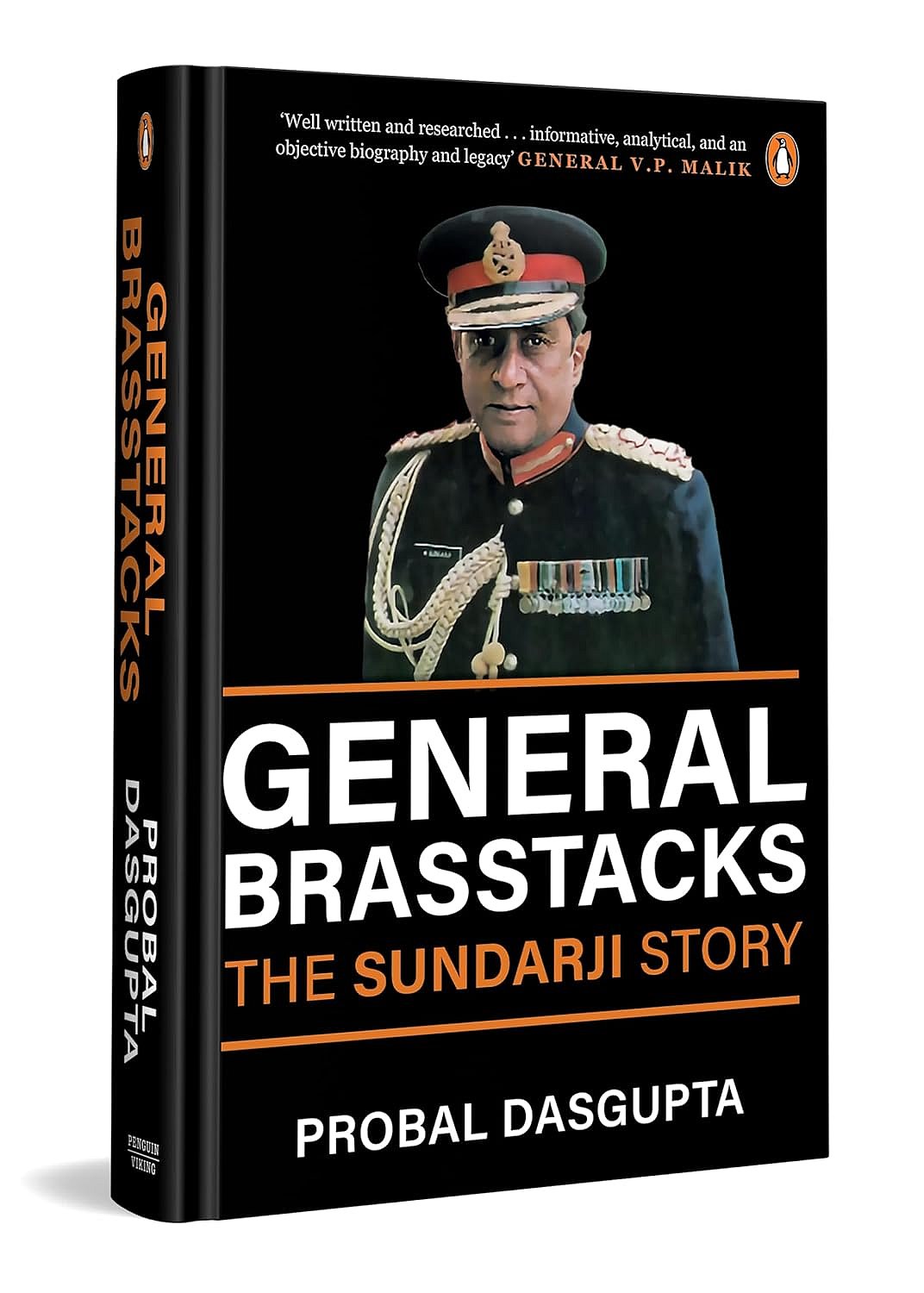
Book: General Brasstacks: The Sundarji Story
Author: Probal Dasupta
Publisher: Penguin Viking
Pages: 336
Price: Rs 999

