
Fair warning! Reading this book will take a long time. Not because it is badly written, in fact, it is quite superb writing. The reason it takes much longer to read, especially if you are a cinema buff like I am, is that you keep putting the book aside to watch the movies these great film-makers created.
During my reading of the book, I ended up re-watching The Godfather and Apocalypse Now by Francis Ford Coppola, Star Wars by George Lucas, and many, many films by Steven Spielberg, including Jaws, Close Encounters of the Third Kind, E.T., and Schindler’s List.
In the 1970s, the Hollywood studio system was broken and no longer wielded the influence and power it had in its heyday. In walked three young upstarts who wanted to make “personal” cinema, movies that were not governed by the studio bosses’ wishes but by what the filmmaker wanted to say.
George Lucas was a young film school graduate on a Warner Bros. scholarship, and, just by chance, he was assigned to assist another up-and-coming director, Francis Ford Coppola. Around the same time, a twenty-year-old Steven Spielberg had begun his apprenticeship with Universal Studios.
The trio were soon to become friends and, over the next two decades, revolutionise filmmaking. Francis and George, wanting to break from the studio system, moved from Los Angeles to San Francisco and started their company, American Zoetrope. But with Coppola’s overspending and micro-management, Zoetrope was soon in trouble. That’s when Lucas convinced Francis to take up the assignment of scripting (along with Mario Puzo) and directing The Godfather, an assignment that he had rejected earlier. Coppola and Puzo’s script transformed a trashy crime novel into a family saga and a metaphor for American capitalism.
Francis faced severe hurdles from the Paramount Studio bosses in making The Godfather, including his insistence on casting Marlin Brando as Vito Corleone and Al Pacino as his son Michael. Coppola prevailed, and the rest, as they say, is history. The movie was released on May 24, 1972 and went on to gross over $250 million at the box office. At that time, it was the highest-grossing movie of all time. Incidentally, this record was to be traded between Coppola’s two other friends, Lucas and Spielberg. Steven Spielberg’s Jaws snatched the record in 1975, George Lucas’ Star Wars in 1977, and back to Spielberg with E.T. in 1982.
Incidentally, just like Coppola, both Lucas and Spielberg had several run-ins with studio bosses.
George Lucas’ science fiction film THX 1138 (produced under the Zoetrope banner) had been a box-office dud. Coppola then advised him to ‘humanise’ his films. George then wrote and directed American Graffiti, the first film under the Lucasfilm banner. Studio executives at Universal Pictures, which had agreed to distribute the film, wanted cuts, which Lucas refused. As a way of showing his confidence in his friend’s work, Coppola, fresh from the success of The Godfather, offered to buy out the distribution rights from the studio. Later, not expecting much success, Universal wanted to release the film only on television. Coppola again stepped in, attaching his name as executive producer. American Graffiti grossed over $200 million at the box office and from home rentals. Considering it was made on a budget of just $750,000, it is still regarded as among the most profitable films ever.
Spielberg’s Jaws was the first film to be entirely shot on the open ocean and, from the outset, faced problems. The mechanical shark, which, of course, was to be the centrepiece of the movie, severely malfunctioned. The shoot was grossly delayed and overshot the budget. Universal Pictures threatened to pull the plug. To overcome the difficulties posed by the malfunctioning shark, Steven shot several sequences with cameras close to the water’s surface as if he were depicting the shark’s point of view. Combined with composer John Williams’ music, this created an ominous and suspenseful effect. Released in over 450 cinemas, Jaws launched the summer blockbuster trend in Hollywood.
While detailing these struggles and successes, Fischer also recounts the friendships and fights among the three friends and other ensemble cast members, such as Martin Scorsese and Brian De Palma.
The book is also full of memorable anecdotes. Here is one. Harrison Ford, before he found success, did carpentry jobs in Hollywood (at which he was hopeless) and peddled grass, which he also smoked copiously. When Star Wars was released, one of his celebrity customers sitting in the audience jumped up and shouted aloud, “That’s my dope dealer!”
Then there are the affairs. For example, Fischer discusses Coppola’s long extramarital affair with Mellisa Mathison, who entered his life as a nanny for his children. Mathison later wrote the scripts for The Black Stallion and Spielberg’s E.T.

The three friends followed different paths. Coppola stayed truest to the principle with which Zoetrope was founded. He found enormous success, yet astonishing failures that led to bankruptcies. In fact, he agreed to direct The Godfather III only because he was deeply in debt.
Lucas, who had retained the rights to the Star Wars IP went on to establish an empire that he eventually sold off to Disney for an estimated $4 billion. Spielberg, after working long for studios, founded his own company, DreamWorks.
All this is summed up in the words of Walter Murch, the award-winning editor and sound designer who also came up in that era. Fischer quotes him as saying, “It’s the trajectory of every revolution, you know. As Eric Hoffer said, every great idea starts as a movement, becomes a business, and winds up as a racket.”
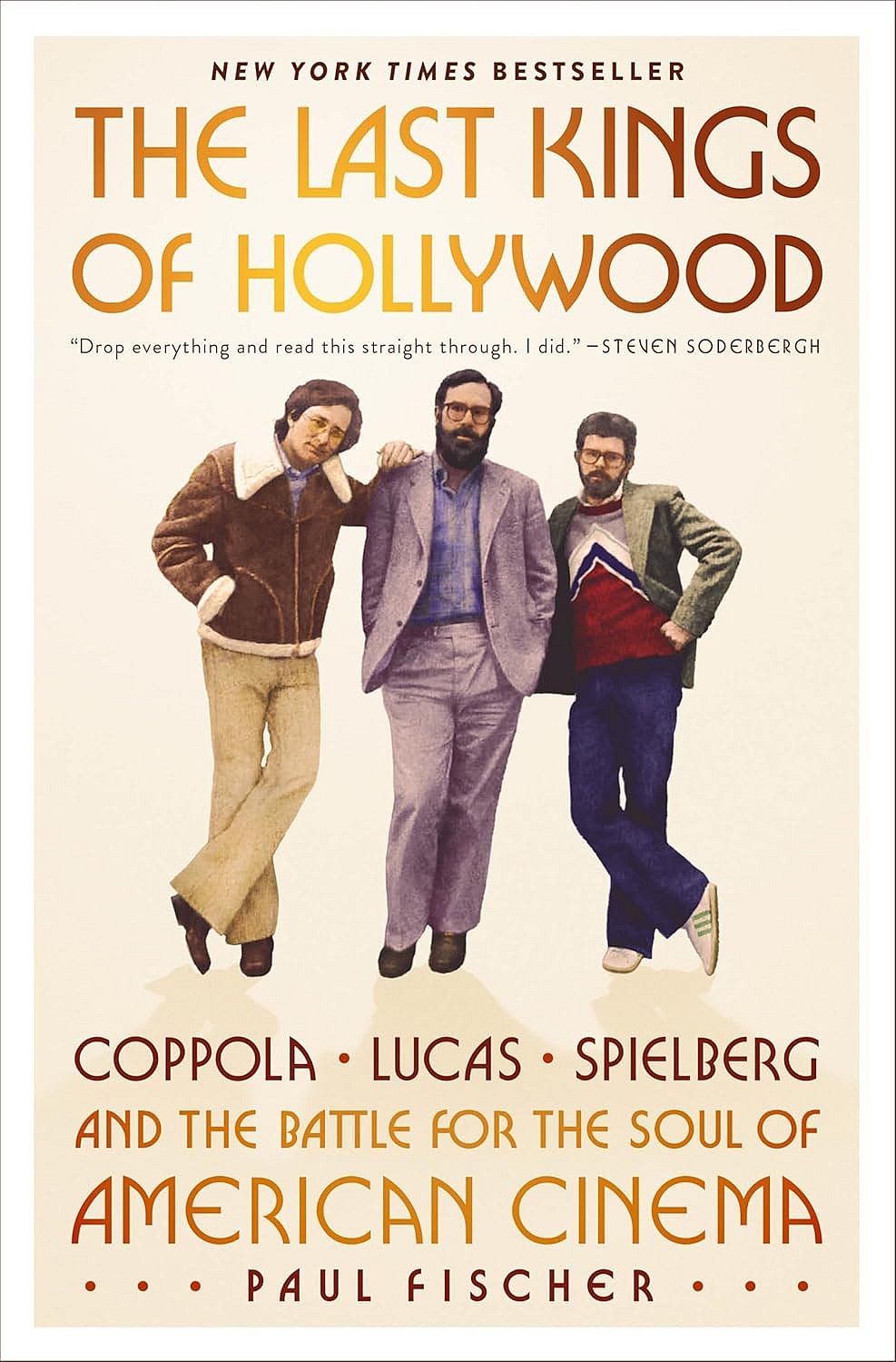
Book: The Last Kings of Hollywood: Coppola, Lucas, Spielberg and the Battle for the Soul of American Cinema
Author: Paul Fischer
Publisher: Celadon Books
Price: Rs 3108
Pages: 432

