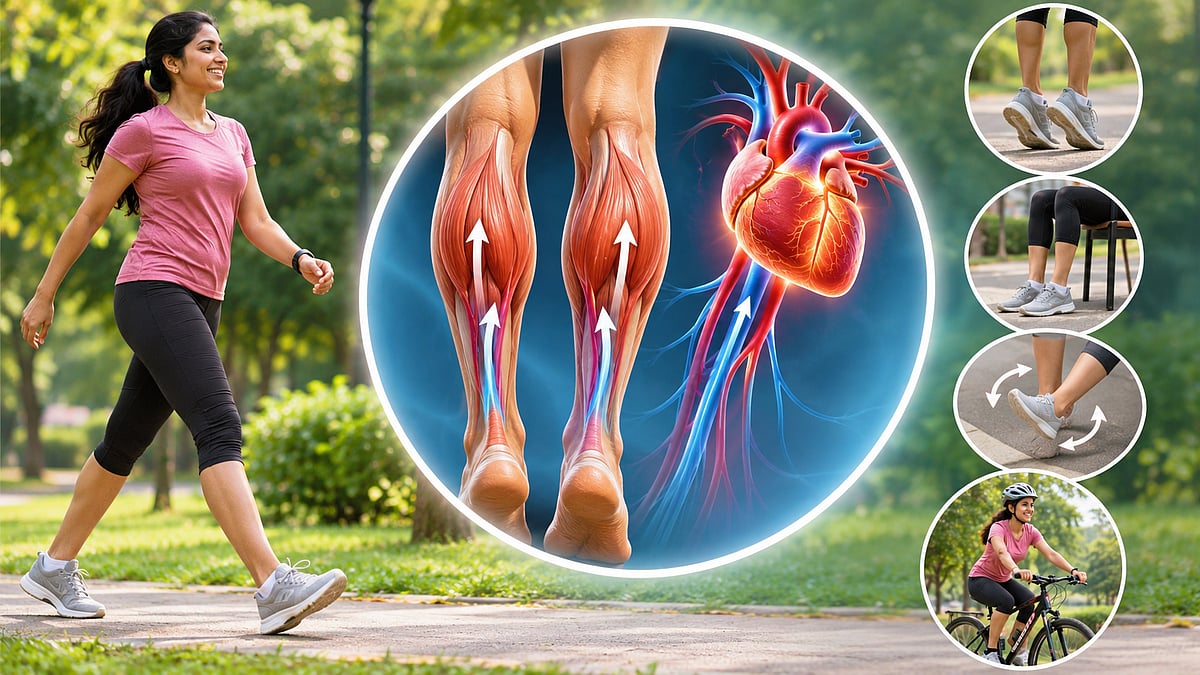
Ever wondered why the calf muscles are commonly nicknamed as the human body’s ‘second heart’? The answer is purely technical. The muscles play a pivotal role in this. They function as a mechanical pump to force the flow of deoxygenated blood back up from the hind limbs towards the heart with an anti-gravity motion.
Scientifically termed triceps surae, the calf muscles denote a cluster of tissues formed precisely at the back of the lower leg behind the shin bone. Comprising three chief muscles, namely Gastrocnemius, Soleus and Plantaris, the calves join and connect to the heels through the Achilles tendon.
Reflection of heart
The heart of the matter is that the calf apes the heart’s vital activity. The calf muscles are often described as the second heart because they are instrumental in helping the blood return from the lower limbs or legs to the heart.
“Unlike the heart, which actively propels blood throughout the body, the calf muscles assist circulation via repeated contraction and relaxation. Every time we walk, climb stairs or move our ankles, these muscles aid in pushing the blood upwards against gravity. This makes them an important part of the body’s entire circulatory system,” explains Dr. Ashish Phadnis, director of orthopaedics, Jupiter Hospital in Thane.
Dr Dheeraj Batheja, senior consultant (ortho-spine surgery) at Artemis Hospital in Gurugram informs that “gravity enables blood to travel downwards. But the blood that wants to ascend from the lower legs back to the heart has to overcome this gravitational pull to get where it needs to reach.”
Good news is that the gastrocnemius and soleus muscles of the calves solve this problem. Each leg movement constricts the deep veins and prevents blood from accumulating in the lower legs and helps return it to the heart. The calves allow smooth circulation of blood throughout the body, thus curbing the weight on the circulatory system and fostering distribution of healthy blood.
Pumping power
Walking us through the pumping action of the second heart in detail, Dr. Phadnis confirms that the calf muscle magic works through a simple but an effective mechanism, which is mainly achieved through the coordination of muscles, veins and one-way valves.
“The deep veins in our legs carry blood back towards the heart and the calves surround and support these blood vessels. When we contract our calf muscles, particularly while walking, they squeeze the veins to drive blood in the upward direction. Incidentally, small one-way valves inside the veins impede blood from flowing backwards,” said the doctor.
Later when the muscles relax, the veins restore blood from the lower extremities, ready for the next contraction. “This repeat cycle of compression, northward flow and restocking of the blood continues with every footstep taken, ankles flexed and the calves raised. That is why, regular movement is so essential for maintaining a healthy circulation,” he notes.
Lifting the heart
It is significant to note how calf muscles help increase heart efficiency to pump blood without overburdening itself.
The calf muscle pumping method defends the heart by improving venous return, which determines the safe passage of blood back to the heart. “When this mechanism is executed efficiently, it deters blood from getting stagnated in the lower limbs for prolonged periods. This, in turn, drives effective circulation and promotes the heart’s normal pumping cycle,” assures Dr. Phadnis.
However, he reminds us all to understand that “calf muscles do not replace the heart’s primary function or independently reduce its workload. They lend a hand in the overall circulatory process, thus highlighting flexible mobility as a key contributor to cardiovascular health.”
The calf muscles shrivel and funnel the blood to the heart above. Furthermore, this helps checking blood collection in the southern zones of the body, especially while sitting or standing at length.
Keeper of health
Calf muscles have the capacity to benefit overall health. Strong calf muscles offer advantages beyond just circulation. They elevate balance, stability and mobility, making everyday activities such as walking, running and climbing stairs way easier. Their pumping action also helps lessen blood pooling in the legs, particularly during standing or sitting for hours.
Also, regular calf motion boosts better venous circulation and decreases the risk of complications associated with persistent dormancy. Moreover, simple tasks like brisk walking, ankle rotations, heel raises and cycling can keep these muscles agile and in good shape. Ultimately, a pair of solid and active calves enhances our physical well-being on the whole.
Calf muscles are indispensable for helping us walk, run and scale a flight of stairs. They are like assets that curtail your chances of falling and getting hurt. The calves also increase ankle stability, mobility and proprioception — the ability to judge body position, motion and sense of balance in space.
Calf muscle atrophy
The general query is whether calf muscles wear and tear, and weaken over time due to a sedentary lifestyle in today’s times.
“Extensive sitting and limited physical labour can gradually erode calf muscle potency and steadiness. When muscles are not used frequently, they tend to waste away as well as lose much of their stamina and eventually, some muscle volume and mass. This could impact circulation plus equilibrium and kinesis,” warns Dr Batheja.
Fitness expert Sumit Dubey echoes: “Lack of physical exercises may dwindle muscle endurance and affect blood circulation.”
“Routine pacing, calf raises as well as stretching and taking occasional breaks in between work to regain energy could help retain your muscle might and dynamism,” he claims.

Strengthening calf muscle
Fitness expert Sumit Dubey says one must do “a set of exercises to avert calf-muscle degeneration and keep blood circulation normal. Always remember that robust and vigorous calf muscles support better mobility, balance and a healthy venous circulation”.
To experience the best outcomes, try the following. Here, consistency matters more than intensity:
Standing calf raises: 3 sets × 15–20 reps.
Seated calf raises: 3 sets × 15–20 reps.
Brisk walking: 20–30 minutes daily.
Ankle pumps and rotations: 20–30 reps, especially during prolonged sitting.

