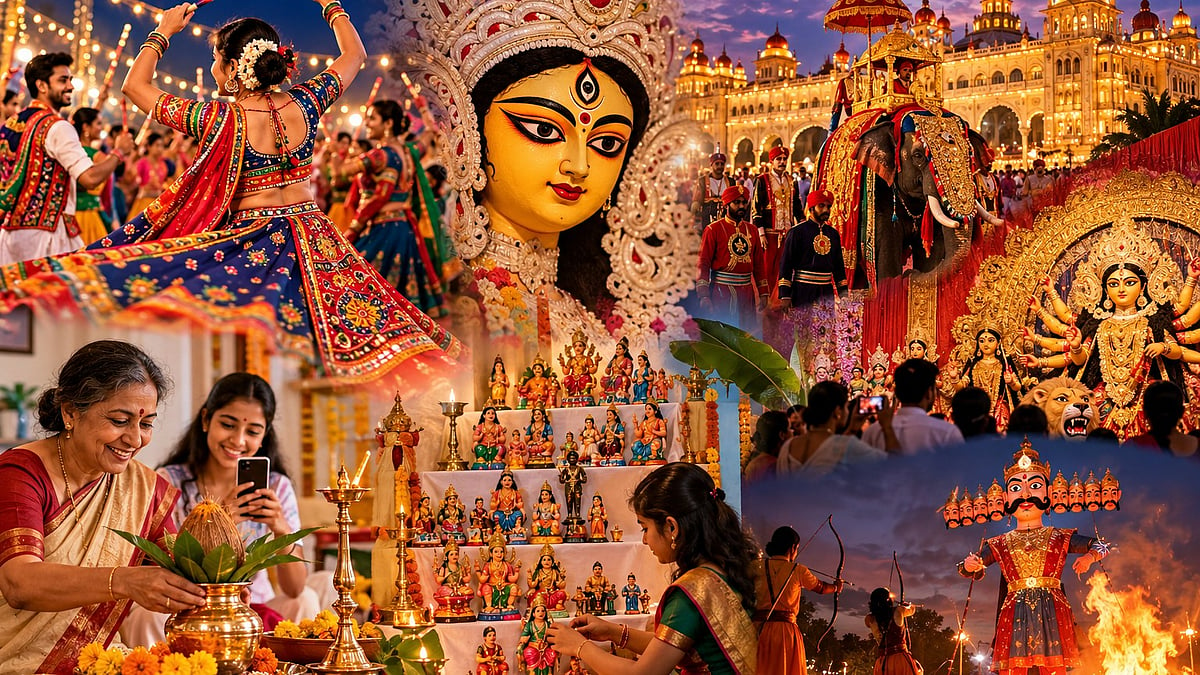
Somewhere in Gujarat right now, a woman is adjusting her chaniya choli before stepping into a Garba circle that will spin past midnight. In a lane in Kolkata, someone is arguing over which pandal has the best Durga idol this year. In Karnataka, Mysore Dasara festival is happening at the palace ground. A goddess is about to ride a golden howdah atop an elephant. In Tamil Nadu, Bommai Golu festival is going on where families are arranging dolls on stepped shelves to retell stories from the scriptures. And in a Maharashtra home, a grandmother is placing a kalash with water and mango leaves, while her granddaughter films it for Instagram.
Same nine days. Same country. Not even remotely the same festival.
One name, many celebrations
Navratri literally means nine nights where 'nav’ for nine, 'ratri' for nights. The festival honours the goddess in her many forms. In practice, it splinters into dozens of celebrations so different from each other that someone from Kolkata could walk into a Navratri event in Ahmedabad and genuinely wonder if it's the same occasion.
In the North, these are the nights of Ram Leela, dramatic retellings of Lord Ram's victory over Ravan, building to the towering Dussehra bonfires. In Gujarat, it's the hypnotic, foot-blistering energy of Garba and Dandiya around the garbo, a lit earthen pot symbolising shakti. In Himachal Pradesh, the fun actually begins on the tenth day, when Kullu Dussehra kicks off a festival that stretches for weeks, drawing many visitors to a valley of processions and music. Down south in Andhra Pradesh, women build gorgeous flower stacks called Bathukamma to worship Goddess Gauri, then immerse them in rivers. And in Kerala, children place their books before Saraswati's idol, hoping the goddess of learning will do what two months of tuition could not.
In Bengal and the East, the last five days are what matter most, Durga Puja, when Maa Durga arrives like a married daughter visiting her parents' home, and an entire civilisation rearranges itself to welcome her back.
When Maa comes home
Perhaps nowhere is this beautiful overlap of traditions more visible than in South Mumbai, where the Bombay Durga Bari Samiti (BDBS) has been hosting Durga Puja since 1930. This year marks their 97th Sharodotsav of a Bengali tradition thriving in a city that speaks a dozen languages at once.
For Bengali’s this puja carries a weight that goes beyond ritual. "This is a connect as a cultural anchor to our heritage, to our family pujas. It is an opportunity to convey to our city folks that Maa Durga is the creator, and an opportunity to bow down to her and seek her blessings," says Partha Sen, President of BDBS.
Mitali Poddar, Chairperson of the Social and Cultural Committee at BDBS, puts it more intimately. "We experience it as Maa's homecoming, our daughter returning to her parents' home, bringing the whole family together."
Over the decades, what started as a community gathering at Tejpal Hall has quietly opened its arms wider. "People from different communities come for darshan, share bhog and enjoy our cultural programmes. We believe Maa is visiting her parents' home, and a home celebrating such a joyful occasion should have its doors open to all,” says Mitali.
And then there's the part every Bengali will defend to the end, the adda. The informal conversations, the laughter over plates of bhog, the friendships renewed once a year over luchi and alur dom. Partha calls it "recreating community spirit, a gathering of buddies informally, sharing the spirit of holistic energies through bhog." No app can replicate it. No reel can capture it.
Meanwhile, in Maharashtra
A few kilometres from Tejpal Hall, an entirely different Navratri hums along. Ghatasthapana marks the beginning in Maharashtrian homes, the sacred kalash is placed, and some families sow wheat or moong seeds in a small tray beside it, a quiet symbol of new beginnings.
Then there's Bhondla, a beautiful, fading tradition where women gather each evening, place an elephant figure at the centre, the carrier of Goddess Parvati and sing playful folk songs while circling it. The songs tease mothers-in-law, poke fun at married life, and end with sweets called khirapat.
"There was a time when we had Bhondla on all nine days. Women sang traditional songs, danced around the elephant. Not many do that anymore, says Maharashtrian Ritika Patil, a lecturer, with a trace of nostalgia.
Nobody owns the prayer
So whose festival is it, really? The Gujarati twirling in a Garba circle at 1 am? The Bengali weeping at Dashami immersion? The Maharashtrian lighting a diya beside a kalash? The Tamil family rearranging their Golu dolls?
Ritika doesn't hesitate. "It doesn't belong to anyone. It's an Indian festival. Each community, each state celebrates it in their own way. And that's how it should be, unity in diversity."
Mitali agrees, gently. "Each tradition deserves to retain its own identity, while giving us an opportunity to understand and celebrate one another. A festival can belong deeply to a community and still welcome everyone."
And perhaps that's the real genius of these nine nights. The goddess doesn't check which state you're from before she blesses you. She doesn't ask whether you came for the Garba, the pandal, the Bhondla or the Ram Leela. She just asks you to show up.

