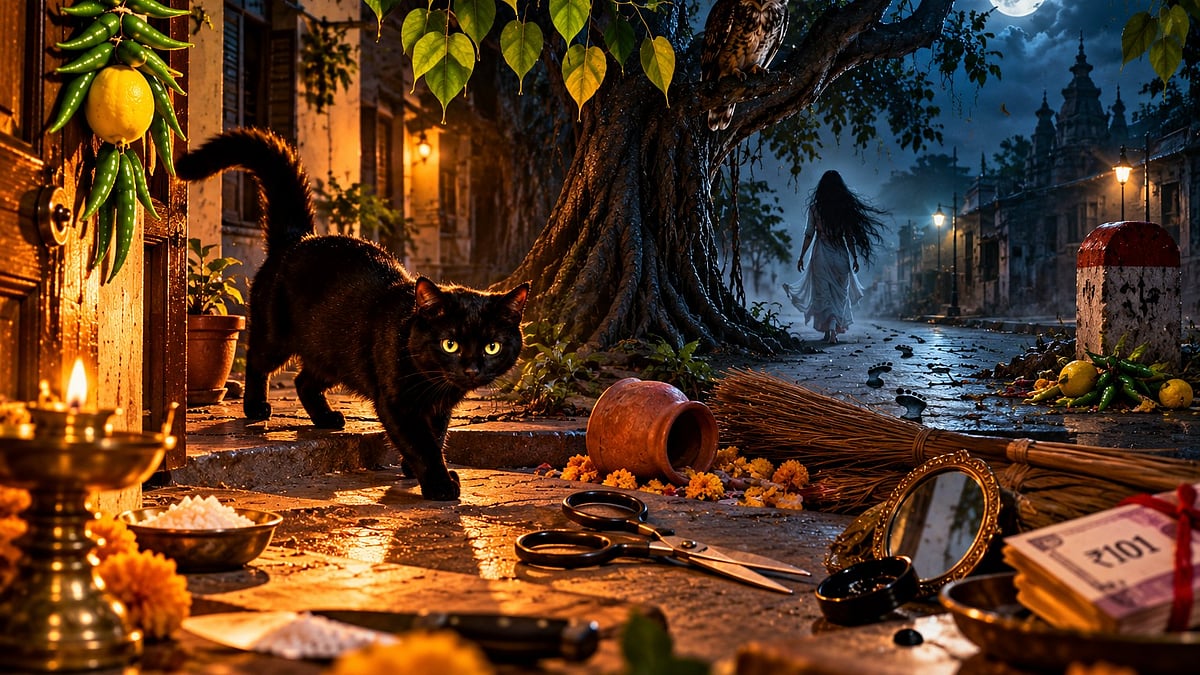
You don't believe in ghosts. You are a rational, educated, tax-paying adult who has read enough science to know that a black cat is just a cat with dark fur and a bad PR problem. And yet, when your mother calls to say ‘don't cut your nails after sunset,’ something in you quietly obeys. Not because you believe it. But because what if.
That ‘what if’ is the engine that powers every superstition in India. And as Halloween rolls around with its carved pumpkins and candy-fuelled frights, it's worth asking, do we really need an imported holiday to feel spooked? We've been scaring ourselves for centuries with no costume required.
Everyday arsenal
Let's start with the nimbu mirchi, that string of one lemon and seven green chillies you've seen dangling from shop shutters, auto rickshaws, and the occasional cars. It's meant to ward off Alakshmi, the goddess of misfortune, who is believed to be drawn to sour and pungent things. The logic, if you can call it that, is that she'll stop at the lemon and chillies and leave the premises alone. Every Saturday, the old string gets tossed at a crossroads, carrying the week's bad luck with it.
Then there's the kaala teeka, the small black dot dabbed on a baby's cheek or behind the ear. The idea is to introduce an intentional flaw on something too beautiful, so that the evil eye, the nazar, passes it by. Mothers do this instinctively. Grandmothers insist on it. And somewhere in this chain of love and fear, a smudge of kajal becomes a shield.
Don't sweep the house after dark, you'll sweep out Lakshmi. Don't wash your hair on Thursdays or Saturdays. Don't hand someone a knife directly, place it down first. Don't call out to someone who's leaving the house, it'll jinx their trip. And if someone sneezes just as you're about to step out? Sit back down. Wait a minute. Then try again.
These aren't fringe beliefs. They're the background noise of daily life across most Indian households.
Ones that actually chill you
But if the everyday superstitions are the warm-up act, the folklore is where India gets properly terrifying.
Take the churel, a figure found across North Indian, Gujarati, and Bengali folklore. She is said to be the ghost of a woman who died during childbirth, pregnancy, or from mistreatment by her family. Her most unsettling feature? Her feet face backwards. According to Persian-origin versions of the legend, a traveller who spots her reversed footprints and runs the other way is led straight back to her. In parts of rural India, families historically buried women who died in childbirth with thorns and heavy stones, not to disrespect the dead, but out of genuine fear that she might return.
Then there's the peepal tree after dark. Across much of rural India, resting under a peepal tree at night is considered an invitation to spirits. The rational explanation is that trees release carbon dioxide after sunset and absorb oxygen, making the air around them slightly heavier. But the folklore version? Spirits live in the branches, and they don't like company.
And owls. In many parts of India, the hoot of an owl near your house isn't a nature moment, it's a death omen. The bird is associated with Lakshmi in some traditions, but in folk belief, its cry after dark is considered deeply inauspicious.
Why do we still flinch?
Rithika Krishnan, Clinical Psychologist at Sir H. N. Reliance Foundation Hospital, Mumbai, says a lot of this comes down to how our brains are wired. "The human brain is wired to look for danger, even when it isn't sure. The amygdala is a brain region that's involved in processing fear and emotional significance, and helps us respond to potential dangers. When a story or experience gets repeated enough times and links something with bad luck, it can make people worried even without any real proof for it. Our feelings can sometimes outpace our logic, and we can feel uncomfortable before we have logically considered the belief."
She also points to something subtler, the way we confuse coincidence with cause. "Sometimes people think that a black cat is something bad. But there is no proof that the cat caused the bad thing. If a feared consequence follows an event, the association is remembered. If nothing happens, the person may simply forget. In this way, such selective attention and confirmation bias can help to reinforce superstitious beliefs over time."
And childhood, she says, is where the roots go deepest. "If parents, grandparents or other trusted adults frequently associate certain actions, objects or circumstances with bad luck, children may pick up on these associations. A child warned against the street at night for fear of spirits may feel uncomfortable in the dark even after he has rejected the literal explanation."
Fright is the point
India doesn't need Halloween to do fear. We've been doing it longer, weirder, and with far better stories. The nimbu mirchi is our jack-o'-lantern. The churel is our ghost with better backstory. And the "what if" that makes you pause before cutting your nails tonight? That's not superstition winning. That's just centuries of storytelling doing what storytelling does best, getting under your skin and staying there.
Now go check if your nimbu mirchi needs replacing. Happy Halloween!
Popular Indian Superstitions
Nimbu Mirchi: One lemon, seven chillies, hung at entrances every Saturday to keep Alakshmi away
Kaala Teeka: Black dot on a baby's face to deflect the evil eye (nazar)
No sweeping after dark: Believed to sweep Lakshmi (prosperity) out of the house
Black cat crossing your path: Signals bad luck; many still stop and wait before continuing
Peepal tree at night: Spirits are said to inhabit the branches after sunset
Owl hooting near the house: A death omen in folk belief across much of India
Sneezing before leaving: Considered a sign to pause and delay your departure
Sleeping with head facing north: Believed to disrupt health; families insist on south-facing sleep
Adding ₹1 to money gifts: ₹101, ₹501, the extra rupee ensures the amount doesn't "return to zero"
Clicking scissors in the air: Said to invite quarrels into the household

