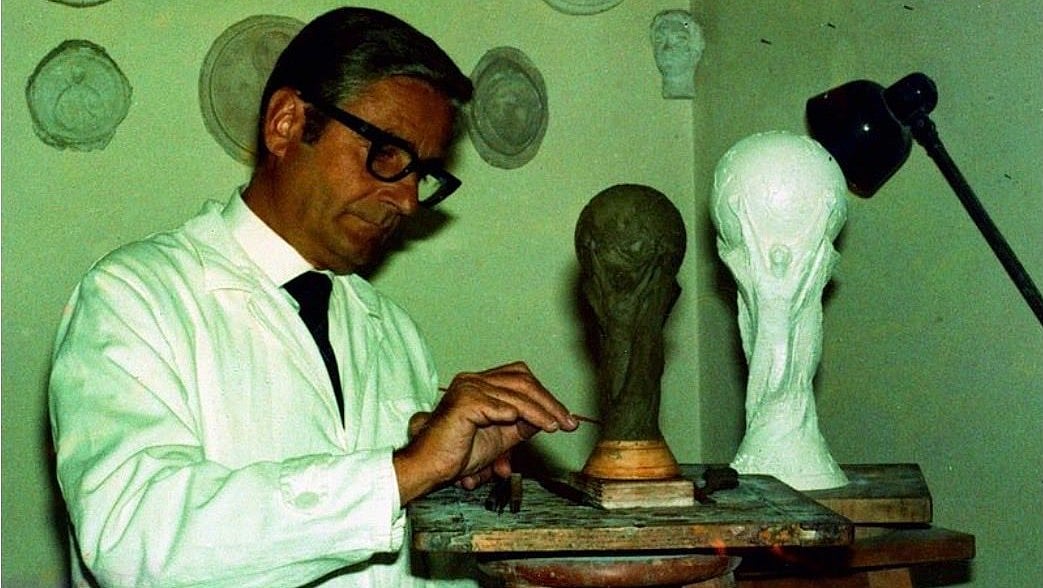
As US President Donald Trump prepares to present the FIFA World Cup trophy to the champions of the 2026 tournament on Sunday, many football fans are curious about the story behind one of the most iconic prizes in sport. President Trump is set to present the World Cup trophy to the winner of Sunday's final between Argentina and Spain. But have you ever wondered who designed the iconic trophy? The famous prize was created by Italian sculptor Silvio Gazzaniga, whose masterpiece has become a global symbol of footballing excellence. Ahead of an action-packed World Cup weekend, here's what to know about football's most coveted trophy.
Who was Silvio Gazzaniga?
Silvio Gazzaniga was born in Milan, Italy, in 1921. He was a renowned sculptor and medal designer. Following FIFA's decision to replace the Jules Rimet Trophy after Brazil permanently retained it in 1970, an international design competition was held in 1971. More than 50 artists from several countries submitted their concepts, and Gazzaniga's design was chosen as the winner.
The story behind the FIFA World Cup Trophy
The current FIFA World Cup Trophy was officially introduced in 1974. Standing 36.8 centimetres (14.5 inches) tall and weighing approximately 6.2 kilograms, it is made of 18-carat gold and features a base decorated with two bands of malachite, a green semi-precious stone.
When he started designing the trophy, he sketched a large number of drawings before developing the idea of representing the world with two forms resembling DNA spirals moving upwards. He ultimately created the trophy in the form of two human figures holding the Earth above their heads.
Gazzaniga's design depicts two human figures lifting the Earth, symbolising the joy, unity, and triumph that football brings to people across the globe. Speaking about his creation in the past, the sculptor said he wanted the trophy to represent "the athlete, the victory and the world."
What's different from the Jules Rimet Trophy?
The first World Cup trophy was introduced for the inaugural tournament in 1930. It depicted Nike, the Greek goddess of victory, and later became known as the Jules Rimet Trophy after the FIFA president who founded the competition. It was designed by French sculptor Abel Lafleur, made of gold-plated sterling silver, and stood on a lapis lazuli base.
According to FIFA, the Jules Rimet Trophy was stolen twice. The first theft occurred in 1966 while it was on public display in England. A dog named Pickles discovered it beneath a hedge in south London.
It was stolen again from the Brazilian Football Confederation headquarters in 1983. It has never been recovered and is widely believed to have been melted down.

Unlike the original Jules Rimet Trophy, the current FIFA World Cup Trophy is not permanently awarded to the winning nation. Champions receive the trophy during the presentation ceremony before it is returned to FIFA. The winning team is instead presented with a gold-plated replica to keep.

