The Indus Valley Civilisation (Indus-Saraswati Civilization) was one of the world's three earliest great societies, the other two include The Roman Empire and Ancient China civilisation. Talking about the Indus-Saraswati Civilisation (also known as the Harappan or Indus Valley Civilisation), it flourished from roughly 3300 to 1300 BCE.
It was the largest of the ancient Near Eastern civilisations, covering a vast expanse of modern-day Pakistan, northwest India and northeast Afghanistan. But do you know about the Indus-Saraswati inscription, also called the World's oldest inscription, and how it is related to Indus Valley Civilisation? Found it interesting! Then keep on reading to know more about this inscription and more about the Indus Valley Civilisation.
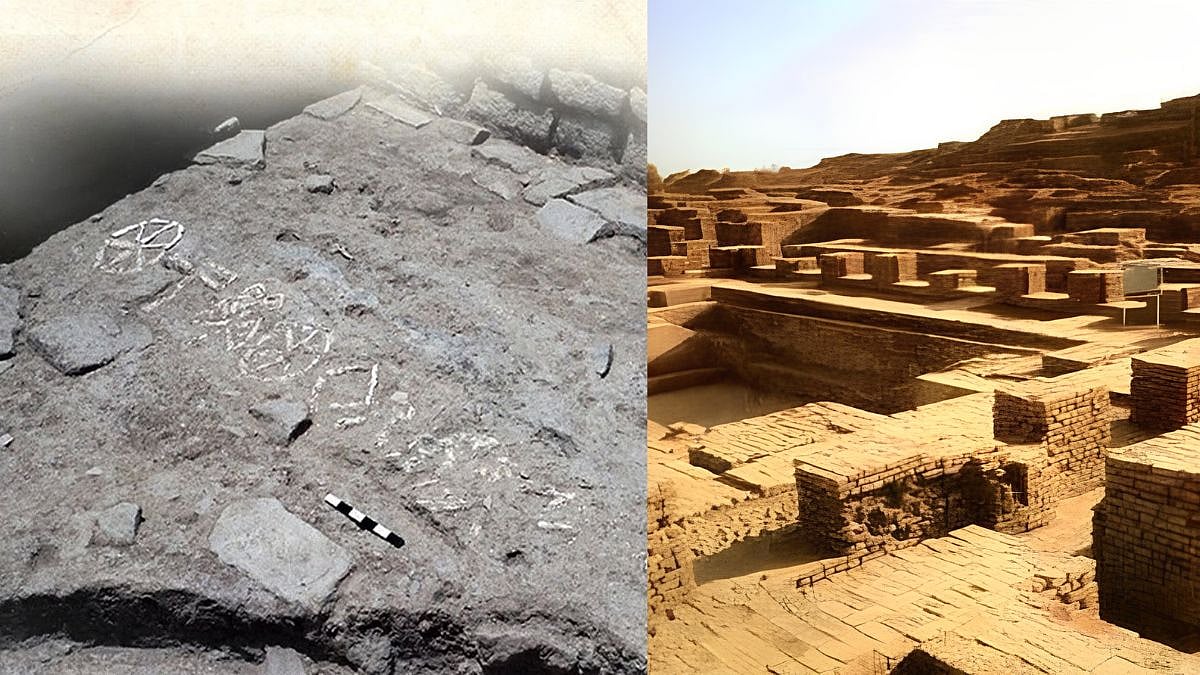
Recently, Ministry of Culture has shared the picture of the Indus-Saraswati inscription on Instagram of Dholavira Signboard. The Dholavira Signboard is one of the most remarkable discoveries from the Indus Valley Civilisation and is believed to be the world's oldest known public signboard. It was unearthed at the UNESCO World Heritage Site of Dholavira in Gujarat's Kutch district, and the inscription dates back around 4,000 years.
A unique discovery from Dholavira, Gujarat
Archaeologists discovered the signboard above the northern gateway of Dholavira, one of the largest and best-preserved Harappan cities between 1990 and 1991. The board originally displayed 10 large symbols (each sign being appx. 36 cm tall) from the still-undeciphered Indus script and the entire inscription stretching nearly 3 metres in length. The characters, crafted from white gypsum and mounted on a wooden board, were large enough to be seen from a distance, suggesting they were intended for public viewing. It is located on the arid island of Khadir in Gujarat. Experts believe this may have served as a city entrance sign, the name of an important building, or an administrative marker.
Why is it significant?
The Dholavira Signboard is significant because it is the largest known inscription in the Indus script found in its original context. Unlike the small inscriptions commonly seen on seals and pottery, the oversized symbols indicate that writing was also used in public spaces.
Despite decades of research, the Indus script remains undeciphered. Scholars continue to debate whether the symbols represent a language, names, titles, or administrative information. This mystery has made the signboard one of the most fascinating archaeological artefacts from ancient India.
A symbol of Harappan brilliance
Dholavira itself is renowned for its advanced water management systems, reservoirs, town planning, and engineering skills. The discovery of the signboard further highlights the intellectual and organisational achievements of the Harappan people.
Today, the reconstructed Dholavira Signboard stands as a powerful reminder of an ancient civilisation whose writing system still challenges modern scholars. From advanced water engineering to public inscriptions, Dholavira continues to reveal the remarkable capabilities of the Indus-Saraswati people, a legacy deeply rooted in the cultural and civilisational heritage of India, keeping alive the mystery of one of humanity's earliest urban cultures.

