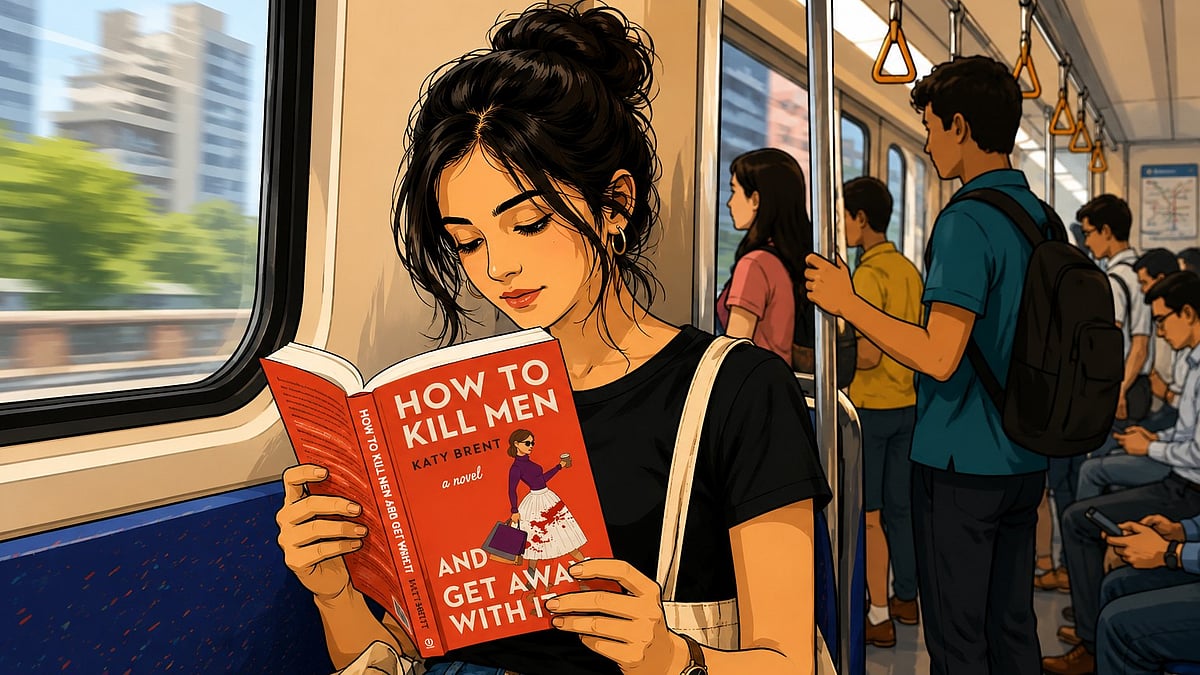
A young woman travelling on an Indian public transport recently got caught in an online storm—not because of anything she said or did, but because of the book she was reading. The title, How to Kill Men and Get Away With It by Katy Brent, was enough to cause outrage after a fellow commuter filmed her without her consent and shared the video online. As the clip went viral, many criticised the reader without knowing the book's contents or context. The reason being the recent highly publicised murder case of a young man by his fiancee.
The incident has sparked a deeper discourse online. Are people beginning to police what others read? Does a provocative title justify public scrutiny? And in the age of social media, is the freedom to read giving way to the fear of being judged?
Don't judge a reader by a book cover
The controversy reminds one of the old saying—don't judge a book by its cover. And that's exactly what happened.
For author K. Hari Kumar, reading fiction is a private act. "Reading fiction is a private engagement between an author's imagination and a reader's mind. A book title is a creative prompt or a genre signifier, not a manifesto. Crime fiction and dark psychological thrillers have always been staples of commercial reading. You cannot judge a book by its cover, nor can you judge a reader by the book they hold."
Harshil Shah, Founder of Books Barista and Co-Founder of Pen N Paper Awards, believes reading should remain one of the few freedoms untouched by public opinion. "Reading is a personal affair and ideally shouldn't be determined by anyone else. Reading gives you freedom over anything else, and that shouldn't be snatched from anyone. Reading gives freedom of thoughts, words and worlds, which should be your very own and not be decided by anyone."
Content writer Divya Sonigra calls reading "one of the most intimate and personal acts of intellectual freedom." "No one should ever be forced to publicly justify their choice of book. Books are sacred vessels for exploration, empathy, and the courageous confrontation of uncomfortable truths. Demanding justification transforms a private journey of the mind into a public performance, where curiosity is policed, and intellectual autonomy is undermined."
For content creator Parul Gupta, the debate also exposes a gendered reality. Speaking from experience, she adds: "As a woman, I feel that women are more scrutinised for their choices. We live in a world where the mindset that 'a woman in public is public property' is still exercised, and women feel uncomfortable. I personally have had instances where I hid the cover of the book while travelling on the metro because I feared being judged."
When public outrage shapes reading habits
Beyond the viral moment, many worry about what such reactions could mean for readers.
Sonigra believes online outrage can have consequences far beyond social media. "Public outrage can cast a long and freezing shadow over literary freedom. When certain titles are relentlessly attacked and weaponized on social media, even casual readers, students on trains, and commuters with headphones begin to hesitate. The fear of being misunderstood, labelled, or attacked leads to quiet self-censorship."
Hari Kumar agrees that the greater threat today may not be official censorship but fear itself. "While formal censorship remains a structural issue, the fear of public condemnation is far more insidious because it leads to self-censorship. Public shaming creates an invisible boundary that authors, publishers, and readers become hesitant to cross. This stifles creativity before the words even reach the page."
Shah, however, believes readers should not allow temporary outrage to dictate their choices. "This is just a fad, and this too shall pass. Since when have readers started deciding what to read or not on the parameters of public judgement? Like a good author would never write what the reader wants to read—it is his/her deep inner feelings which take shape through their writing—similarly, it is the reader who decides what to read or not and not anyone else."
Gupta is equally dismissive of the backlash. "I believe this type of public outrage is baseless, and it should not stop a person from picking a book of his or her choice. This outrage does confirm the saying, 'Never judge a book by its cover.' One should never draw conclusions about the reader's next move just because they like certain genres."
Interestingly, she says many women responding to her social media posts have embraced the title rather than avoided it. "Based on the comments I am getting on my reel, I can confirm that women are more likely to buy this book, and most of them are already reading or have read it. Some are even willing to carry books with titles that scare men for their safety."
The consent debate
While the discussion has largely centred on the book's provocative title, many believe the more important question is whether a stranger should have been filmed and turned into viral content in the first place. The incident has raised uncomfortable questions about consent, privacy and the ethics of content creation.
Hari Kumar believes the incident crossed a line long before it became a literary debate. "In my opinion, taking photos or videos of individuals in public places without consent is a significant invasion of privacy, and social media has made it far too easy to exploit people who just happen to be in the frame."
Girish Mallya, Editor, T3 India, says the race for viral content has gone too far. "Harmless content generation is going out of hand. People are waiting for something wrong to happen. I know a lot of creators who milk every negative thing that happens or they see. I'm firmly against anybody shooting anything without the consent of the person. And even if they want to share the video on social media platforms or otherwise, to make a point, faces visible in the video should be smudged or hidden. So there is no way something can go viral with the person's face being seen. Also, we need stronger laws to penalize such people. If they post videos on social media without the consent of the person or people being filmed, they should be given a warning, asked to take down the video, or have their account suspended. We need rules in place to discourage people from doing something like this."
An avid reader Neha S. believes consent should be at the heart of the conversation. "Consent should matter. You are recording someone with the intention of putting the video on social media. It is basic decency to ask. There should be stricter laws for this. Sometimes, I also feel, what if someone recorded me in public without my consent? We are failing every day with basic human etiquette. Content creation should be for you, but recording someone without their knowledge is an invasion of privacy. We should ban these kinds of videos that use people's faces just to gain views and engagement."
From privacy to public shaming
The incident has also revived the debate around public shaming and whether online outrage is becoming a form of censorship.
For Sonigra, the problem extends beyond one viral clip. "Public shaming has emerged as one of the most effective modern forms of soft censorship. Though it lacks the force of law, it wields the sharp sword of social punishment. By creating real-world consequences for simply holding or reading certain books, it intimidates readers and writers alike."
Gupta sees public shaming through the lens of gender. "Public shaming has always been a form of censorship and suppression. The whole patriarchy thrives on shaming women, mostly publicly. If a woman walks with confidence, holding her head and chest high, she is most likely to be stared at and told to hide her face and chest with a dupatta to become publicly appropriate."
Shah offers a different perspective, saying he does not necessarily see this as censorship but rather a symptom of social media culture. "Ideally not, as we are more open, more comfortable in our own skin than ever before, so I don't think this is any form of censorship. This could be just a fad and one of its instances."
Literature in the age of social media
What everyone agrees on, however, is that social media has fundamentally changed how people interact with books.
Hari Kumar believes nuance is disappearing. "It reveals that social media has trained us to view the world through a lens of instant outrage rather than nuance, eroding our capacity for critical judgement. Frankly, there are far scarier things broadcast daily on our television screens than what is found on a book cover."
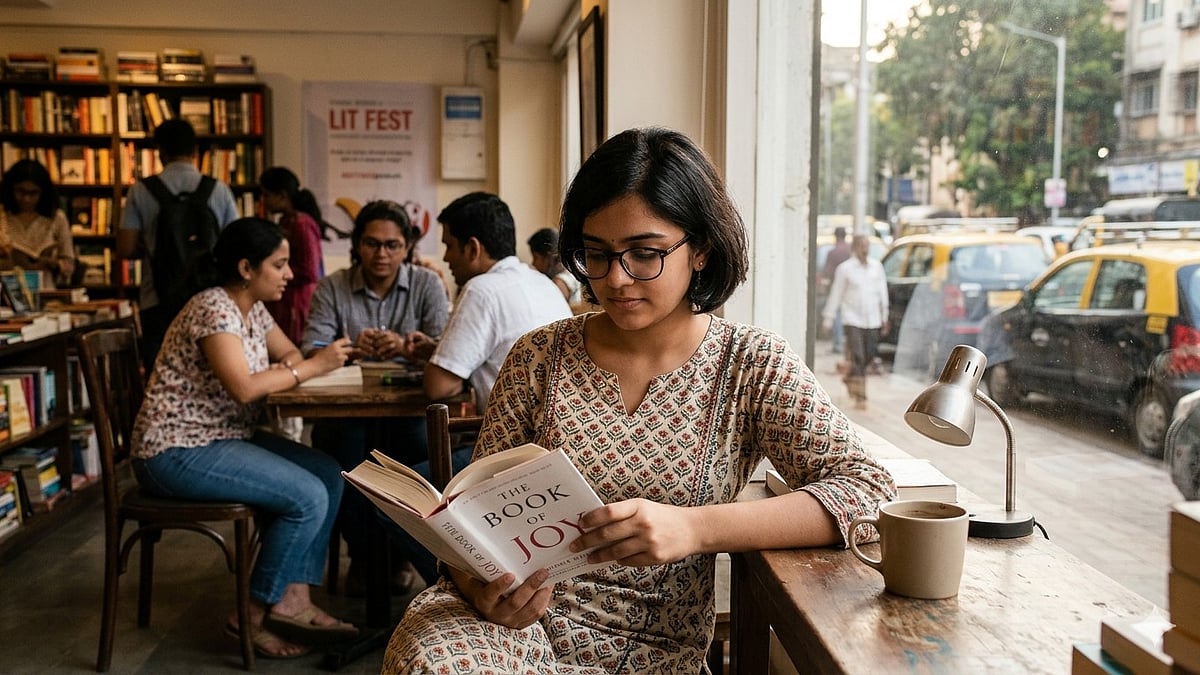
Shah recalls the words of poet W.H. Davies. "'What is this life if, full of care, we have no time to stand and stare.' In the horde, people are just looking for more social media likes, more viewership, so they would go to any extent. Let people find their own elixir through books."
For Sonigra, the episode reflects a worrying shift in society's relationship with literature. "A single photograph can ignite storms of outrage, reducing complex works to simplistic slogans and personal choices to moral battlegrounds. Ultimately, it calls on us to fiercely protect the right to read freely, to think dangerously, and to extend empathy even when a book makes us uncomfortable."
Gupta hopes readers will extend the same openness to books that they do to films and streaming content. "I believe people must be more open-minded about the titles on the covers of books. In an era where violent movies and crime dramas are praised, people should be open-minded towards crime and thriller novels. I believe writers are getting more and more crafty about their titles to catch more audiences."
The outrage surrounding one commuter's reading choice may soon fade from public memory. But the questions it has raised are likely to endure. If readers begin hiding book covers, avoiding certain titles or second-guessing what they carry on a public transport, then the debate is no longer about one book. It is about protecting the freedom to read without explanation or fear. It is a reminder that in the race for viral content, the right to privacy and consent should not become collateral damage.

