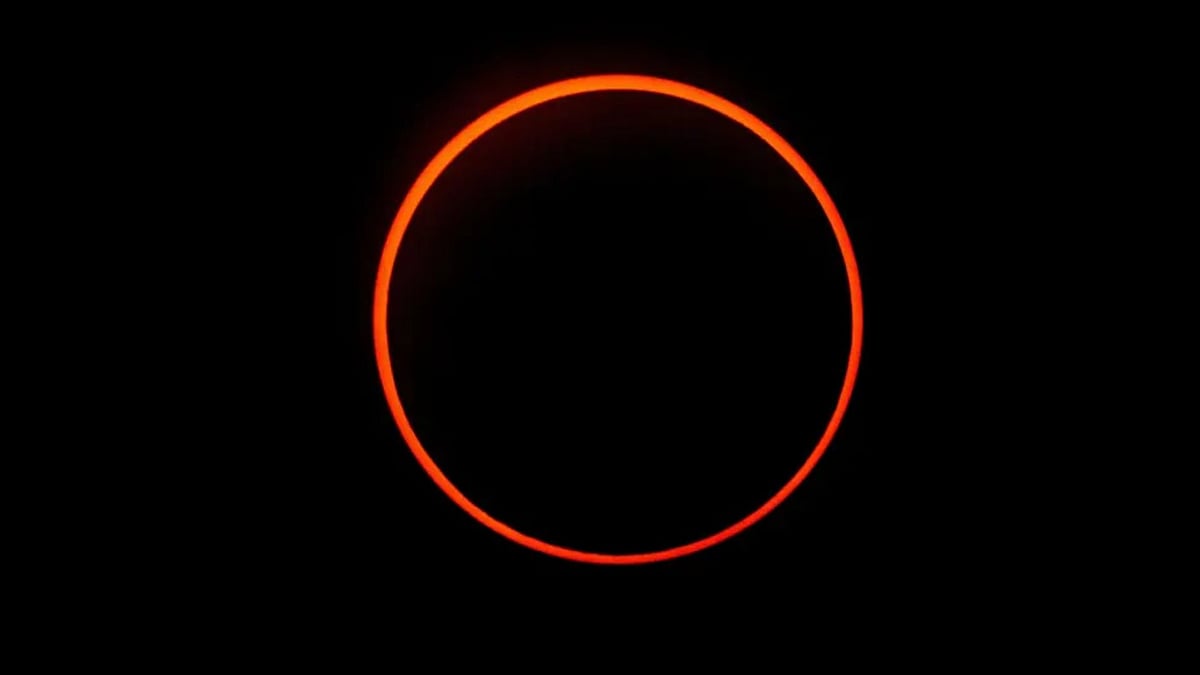
Skywatchers are in for a fascinating celestial moment as the first solar eclipse or Surya Grahan, of 2026 is set to take place on February 17. This time, it will appear as a rare and visually striking annular eclipse, often called the "Ring of Fire." But the big question many in India are asking is, will it be visible here?
When is Surya Grahan 2026? Date & time
The annular solar eclipse will occur on Tuesday, February 17, 2026. According to Indian Standard Time (IST), the eclipse will begin at 3:26 pm and conclude at 7:57 pm, lasting approximately 4 hours and 31 minutes.

Astronomically, a solar eclipse happens when the Moon moves between the Earth and the Sun, partially or fully blocking sunlight. In an annular eclipse, the Moon does not completely cover the Sun. Instead, it leaves a bright outer ring visible around its edges, creating the dramatic halo-like appearance that gives the event its popular nickname.
Interestingly, this year's first eclipse coincides with Phalguna Amavasya (new moon day) as per the Hindu calendar. As per Drik Panchang, the Amavasya tithi begins at 5:34 PM on February 16 and ends at 5:30 PM on February 17. The day holds religious importance, and devotees often observe fasting and prayers.

Will it be visible in India?
Despite the timing being available in IST, the annular solar eclipse will not be visible in India. It will instead be seen from parts of southern Africa, Antarctica, and South America. Countries such as Zimbabwe, Zambia, Namibia, Mozambique, Argentina and Chile fall along the visibility path. You can watch the solar eclipse through the global streaming platform and NASA social media.
Since it won’t be observable from India, the traditional Sutak period associated with eclipses will not be considered valid here.
Want to take a break from the news? Play our games on game.freepressjournal.in
