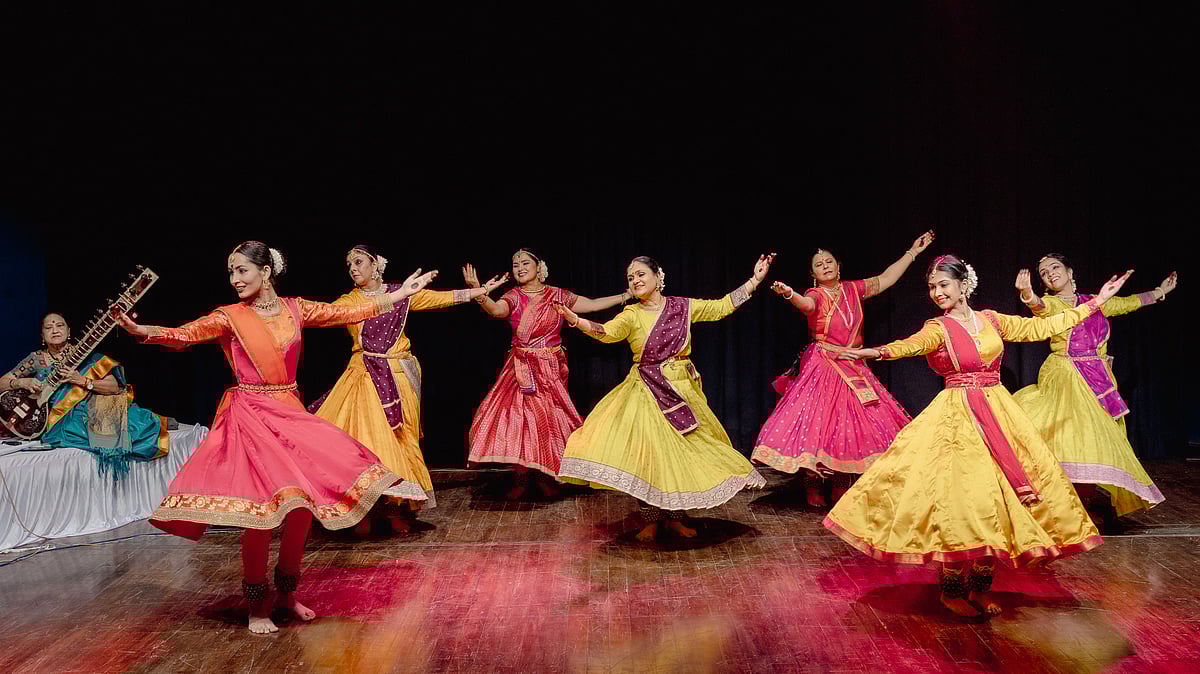
Recently held at Ravindra Natya Mandir, this annual evening continues to serve as a sanctuary for Kathak, specifically the Jankiprasad Gharana of Banaras. Led by Padma Shri Guru Sunayana Hazarilal, the evening is organised to commemorate her late husband and mentor, Guru Pandit Hazarilal. Renowned as the torchbearer, he is credited with rescuing this style from the precipice of extinction in the mid-20th century.
The show opened with Shiv Vandana, a devotional piece with a mix of abhinaya and nritta. It depicted his various forms through steady, statuesque poses. One of Pt. Hazarilal’s key contributions was the reinvention of Kathak abhinaya for the modern stage. He gave us a new vocabulary for body movement (angika abhinaya) and expression. “We give importance to ‘thaat’ in which the dancer tunes their body for the performance. They strike different attitudes with gliding movements of the neck, eyebrows, and wrist. The whole body becomes one with the rhythm,” says Sunayana Hazarilal.
Nritta
The Nritta (pure Kathak) segment highlighted the abstract core of the Banaras lineage, focusing on precision, fast footwork, and some Jugalbandi. “A brilliant performance by Neesha, Aruna, Sheetal, Anuradha, Shloka, Saee, and Swapnal. The performers reflected powerful, energetic movements and subtle expressiveness,” says Pranati Mhatre, a classical singer.
The recital was anchored by a distinguished musical ensemble, featuring Pt. Kalinath Mishra on tabla, Pt. Somnath Mishra providing the vocals, and Alka Gujar on sitar. “One feels happy that the young generation is enthusiastically carrying forward the lineage of Banaras Gharana,” Mhatre adds.
Founded by Pandit Jankiprasad, a Sanskrit scholar, this gharana views Kathak as a form of daily worship that relies on Natwari Bols. “The sound made by feet on the ground,” as Sunayanaji describes it.
Abhinaya
The latter piece, ‘Chalo Sakhi,' centered around Lord Krishna. In this, dancers invited their companions (Sakhis) to join them for Holi festivities. “One moment that stayed with me was the portrayal of Krishna during Holi. The performance captured the tenderness of Krishna’s presence. It was as if the colours and joy of Holi were unfolding right in front of us,” says Maahi Vaidya, actor and dancer. Belonging to the Thumri tradition of Kathak, it conveyed joy and playfulness. “It was a moment that truly lingered with me even after the performance ended,” she shares.
Subtext
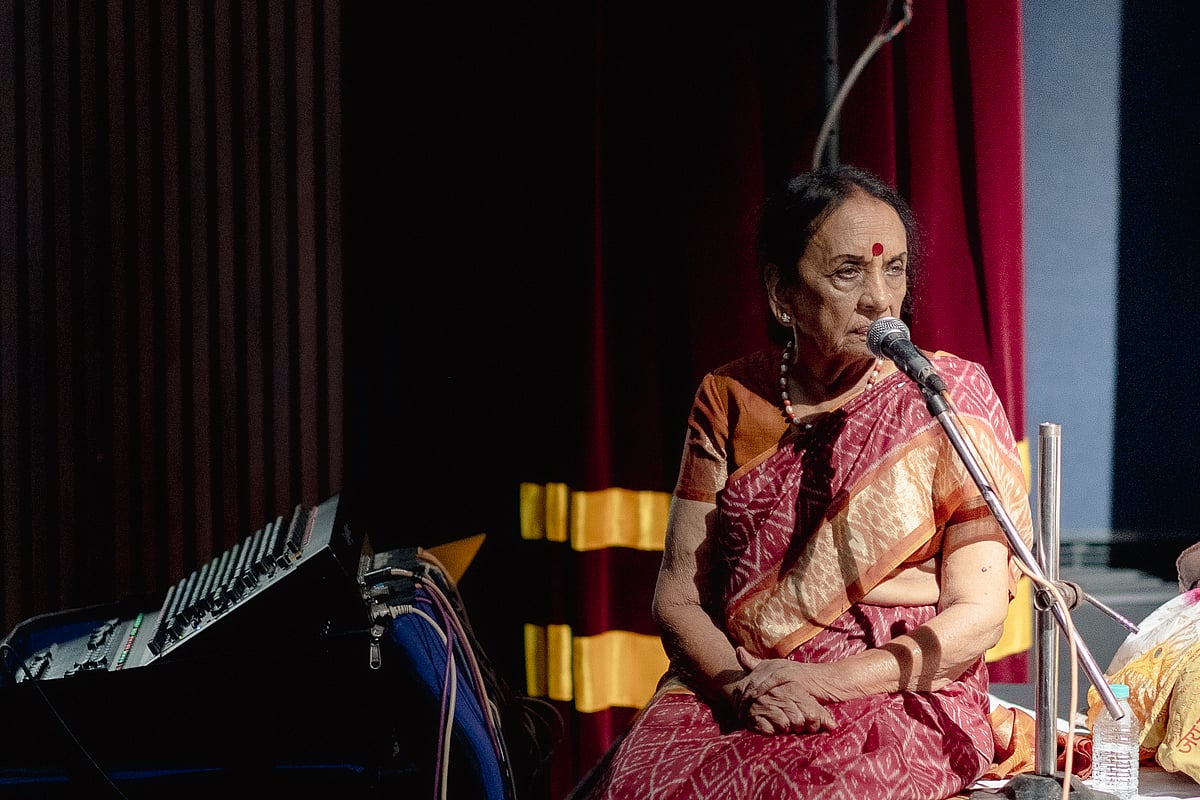
“My husband's guru left India and went to Pakistan in 1947. So at the time of independence, we had no performing artists for our Gharana on stage. Only if we perform will people know [about us],” shares Sunayanaji. When the partition threatened the fragile ecosystem of his lineage, Pandit Hazarilal carefully structured the Barakhadi or foundational rhythms. It essentially teaches a dancer about body movements and how to use different parts of the foot (flat, toe, and heel) to produce distinct sounds. This ensured that the gharana’s development remained untainted by the modern pressures of the era.
Guest Feature
The evening also featured a guest segment by the celebrated Odissi dancer Vidushi Swapnokalpa Dasgupta. The culmination of her performance depicted Goddess Parvati’s homecoming. Dasgupta portrayed Parvati's mother, Menaka. She portrayed the mother eagerly waiting and prepping for her daughter's and grandchildren's arrival. The choreography removed the focus from the characters' divine status. It showed the universal joy of a family reunion. Menaka simply didn’t want her family to go, turning a mythological story into a story of longing. “Each piece brought a different emotion to the stage, and it was wonderful to see how the dancers used expression, rhythm, and storytelling to bring the narratives alive. The energy of the performers and the atmosphere in the auditorium made the entire evening feel very special,” says Maahi.
The Torchbearer
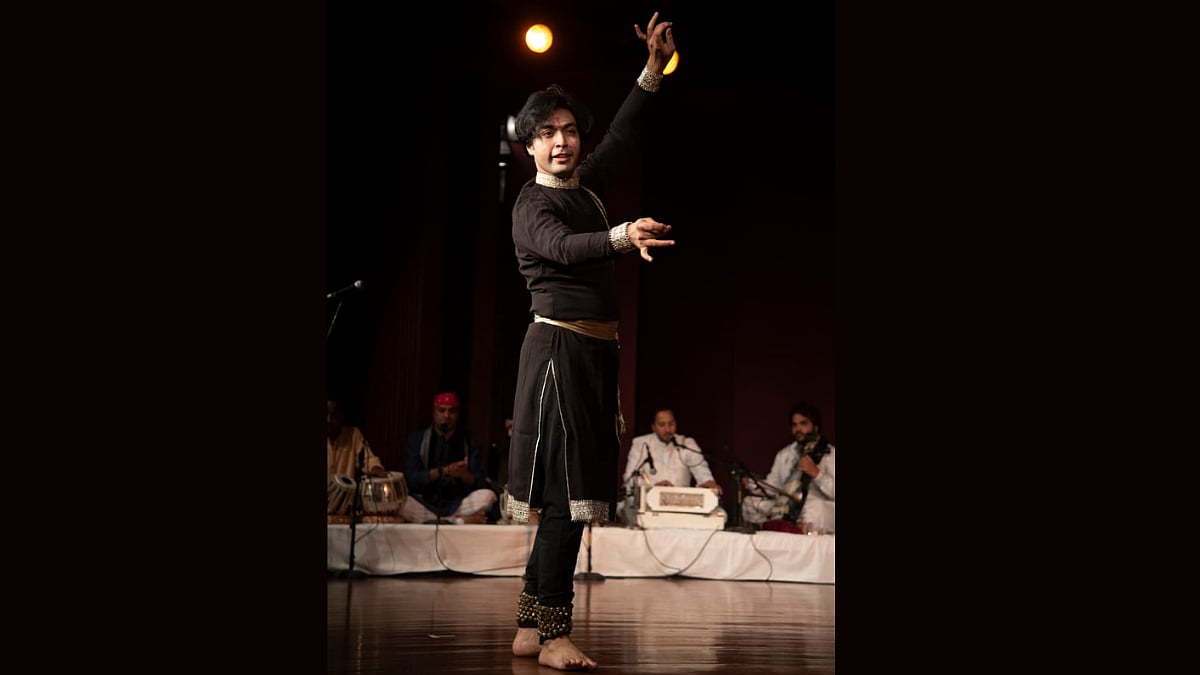
The legacy of Pt. Hazarilal is coloured with grit, defined by a discipline required to hold a severed history together. Sunayanaji always says that the Jankiprasad Gharana has survived for over three hundred years because it is meant to go on. She carries the same grit on stage, one that demands total focus from her disciples. As for the 34th Nritya Samarpan, it was wrapped with a sense of solidarity and warmth.

