
Family memories often stay with us for years, sometimes evolving into stories of their own. For prize-winning poet, fiction writer and essayist Leeya Mehta, her novel Extinction draws inspiration from her childhood in Mumbai and the family folklore that has stayed with her over the years.
Mehta will discuss these influences at Mumbai LitFest 2026, where she is set to launch Extinction and explore how family histories can become a starting point for fiction. Her session, titled ‘Family Secrets’, will take place on October 24, 2026, from 3:30 pm to 4:30 pm at the Little Theatre. The book launch will be followed by a discussion featuring Iffat Nawaz and Leeya Mehta, with Shabnam Minwalla as chair.
Ahead of her appearance, Mehta spoke to The Free Press Journal about the childhood memories and family stories that inspired Extinction, and how they shaped the novel.
What does being part of a literary festival like LitFest Mumbai mean to you as a writer?
It’s an honour and a privilege. It allows me to celebrate my own creative life after the years spent writing a book whose subject matter and structure were an intellectual and emotional challenge.
It is especially meaningful that my book will launch at LitFest Mumbai, at the Little Theatre, where I spent so many hours over the years watching plays. I grew up surrounded by the Mumbai theatre community, the most generous, creative and inspiring group of people. Mumbai is home. The place I grew up in, went to college in, worked for many years in. It is the place generations of my family come from. It is my creative home, and where I became a writer.
What inspired you to write Extinction, and how did the story first take shape? Tell us more about the white tiger element in the story.
My childhood in Mumbai inspired Extinction. I think back to the process of writing this book. It wasn’t the first novel that I wrote. It was the book that I wanted to be published as my first novel. I came to it from the light, because I knew that I wouldn’t be able to come to it from inside the dark, where some of the subject matter in the book needed to go.
And the place of inspiration and light came from imagining my own grandmother’s essence. There is something about being loved and connecting to another human being that is at the centre of belonging. As a child I belonged to my grandmother and she belonged to me. She had a love for poetry and was able to play. I realise in retrospect that the world of children—the child’s imagination and ability to hold reality and fantasy—was something I could investigate as the structure of the book. And my grandmother, even as an adult, had access to this aspect of childhood.
Thus, I wanted to convey some of her essence as a counteracting balance to what was going to be a very difficult process of writing the darker parts of the novel. Thus, I came to the character of Ava first—a woman quite like my grandmother, who could be a vehicle for the imagination and a vehicle for love. At first, I began to sketch a woman and a tiger and write fragments into my sketchbook. I had been reading Jorge Luis Borges for some years so I think he was also in my subconscious. Blake, who was my grandmother’s favourite poet to recite aloud, was there too. Then there were the family stories of the things my own grandmother could make cats do, and her obsession with a white tiger when she was pregnant. When my mother was born with blue eyes, it became family folklore!
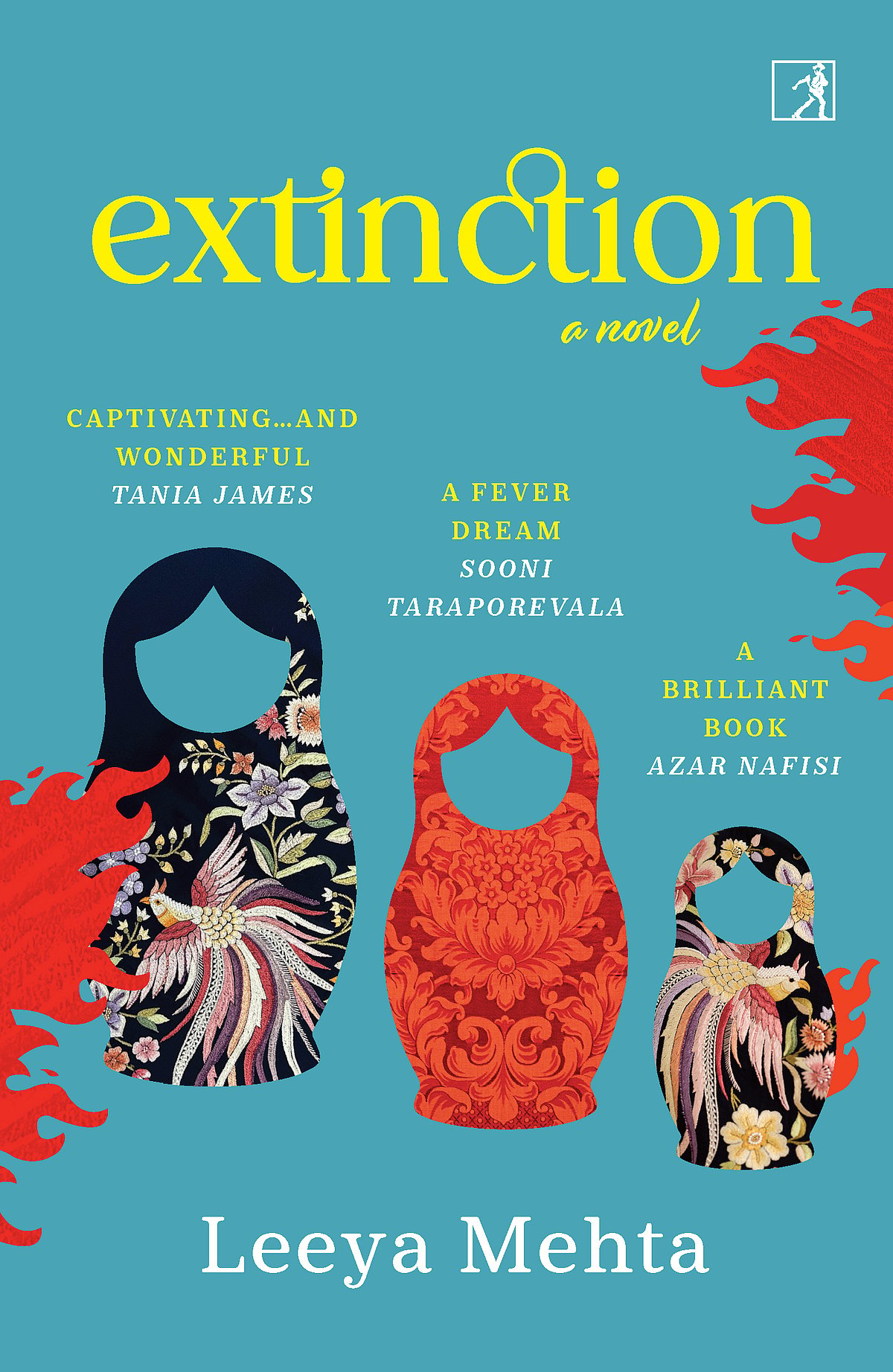
Extinction by Leeya Mehta
How does Extinction differ from your earlier works, the collections of poems, The Towers of Silence, and A Story of the World Before the Fence, in terms of themes and storytelling?
I think there is a difference in process, as well as content. The form of the novel allows for extraordinary creative freedom. But it’s not an easy form to succeed in, and the stamina and self-confidence it requires is not for the faint of heart; it’s climbing Mount Everest in bad weather; you have to make many attempts over many years. If you get to the summit, well, Hurrah! But there really is no guarantee that you will.
On subject matter, I think that the poems and the novel complement each other, and there are overlapping themes of loss and grief, of innocence and experience. For me, as a Parsi moving through the world, there is a deep sense of rootedness in Indian and Parsi culture, a sense of implicit belonging. But as a person of a shrinking diaspora, in constant motion, living a more global life, there is also a sense of loss, as culture becomes more diffused, and language is lost, whether ancestral languages from Persia, or Gujarati, which is one of the languages of my family that we don’t speak as much anymore, being dominated by English and Hindi.
In an increasingly digital world, why do you think in-person literary gatherings still matter?
They matter more than ever! They are our lifeblood. In-person gatherings allow for a multicultural and multigenerational audience, for deepening civil and public life. They are exhilarating and essential. My day job is as a literary curator, community organiser and university professor. I run an international literary centre in the US capital region – in Virginia and Washington DC – named after the American cultural commentator and writer, Alan Cheuse. The audiences in the US love the in-person experience, as do students. They create intimacy, which is a universal human need.
Indian festivals are logistical feats, a model for the world! They are on a different scale compared with the festivals I have attended in the US. In India, the size of the audience, the level of audience engagement, that sense of exhilarating community and discussion, feels unparalleled. There is nothing like a literary festival on an Indian scale, and I really enjoy how it reiterates our culture, our ability to listen and talk, to argue, to inspire, and most of all, how it encourages a global literary culture and local reading culture.
What can readers expect from the launch of Extinction and your session at LitFest Mumbai?
I think they will really relate to these local stories of family, and love. The book is set across twentieth-century India and people will encounter places they know. They can expect a candid conversation about family history – bringing their own experiences to bear and possibly share. Iffat Nawaz and Shabnam Minwalla are both such incredible presenters, and this conversation promises to be full of depth and surprises!
You have received several literary honours, including an Atlanta Review International Publication Award. How have these recognitions shaped your writing journey?
I don’t share my work very widely, so it is nice to see that when I do share it, my work is recognised and celebrated. But the fulfilment of my intention to write is really the most important thing. I love writing. At the core of my journey is the gratitude that I have been able to fulfil this intention. My mother, my husband, my community, they’ve supported me in ways that I can’t even begin to express. So, it’s the writing and my beloved community that is part of the everyday journey.

