
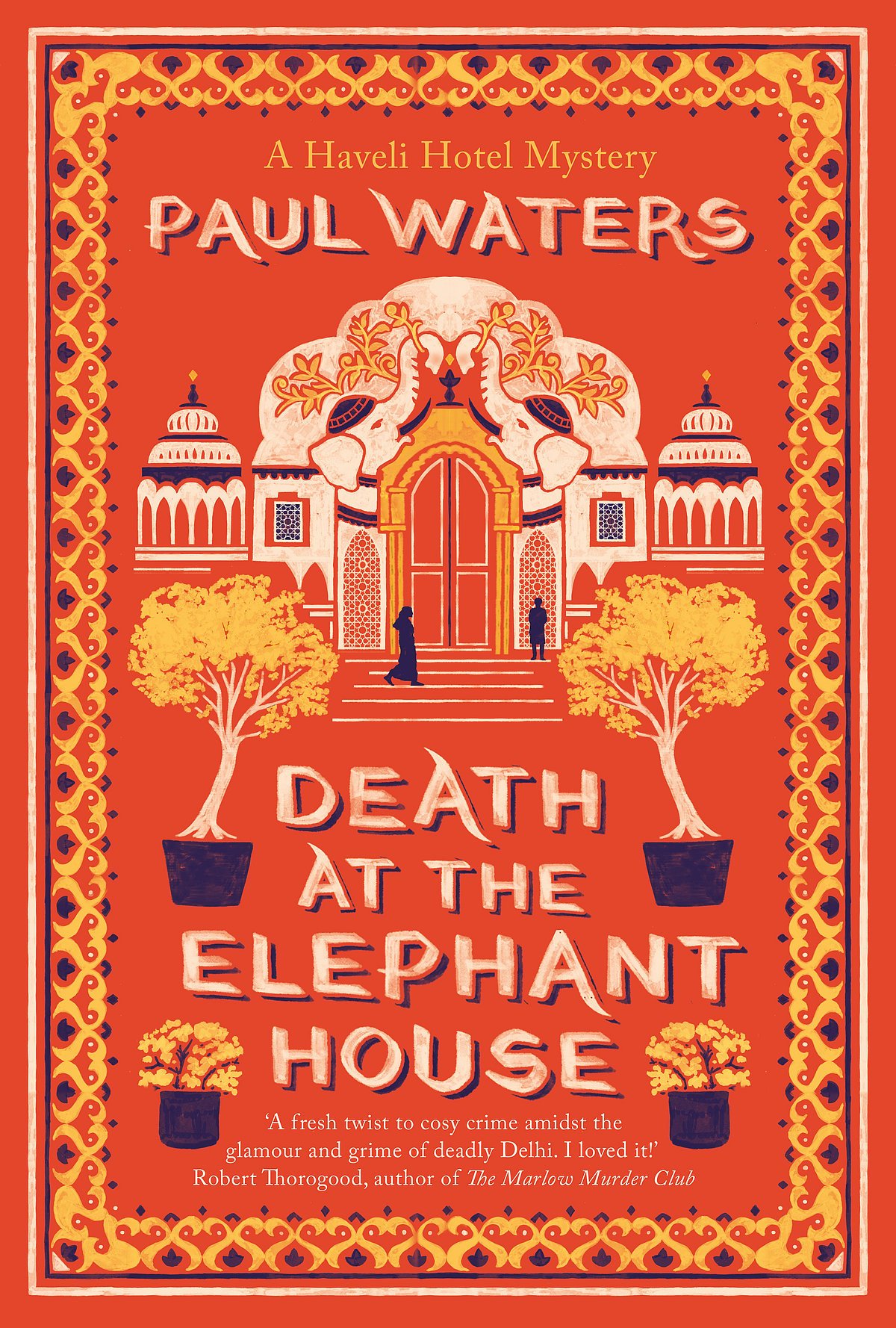
What do a cigarette-stealing elephant, an Irish nun and an Indian hotelier have in common? They are all part of the wonderfully unusual world of author Paul Waters, whose latest crime novel, Death at the Elephant House, brings murder, mystery and an unexpected animal into the mix.
The award-winning BBC producer and podcast presenter is now heading to the City of Dreams for the Mumbai LitFest 2026, where he will discuss his new book, offbeat crime solvers and the enduring appeal of a good murder mystery. And if his own plans for a future novel are anything to go by, literary festivals might be hiding a few fictional bodies of their own!

Paul Waters heads to Mumbai LitFest 2026
Waters will be at the Mumbai LitFest on October 24, 2026, for a session titled ‘The Daggers Are Out!’, marking the launch of his book Death at the Elephant House. Scheduled from 2 pm to 3 pm at the Little Theatre at NCPA, the session will feature Meeti Shroff-Shah, with Kiran Manral as chair, discussing the appeal of offbeat crime solvers.
For the unversed, the novel brings back Sister Agatha Murphy, an Irish nun, and Avtar Mehta, an Indian hotelier, as unlikely partners investigating another mystery. Their story follows Murder in Moonlit Square, the first book in Waters’ Irish-Indian cosy crime series, set in Delhi’s Chandni Chowk and listed at No. 3 on the Indian fiction bestseller list.
And if you're curious to know more about his latest novel, Waters himself has spilled some details about it in an exclusive chat with The Free Press Journal, also revealing how once a reader threated him after being unhappy with the ending.
A cigarette-stealing elephant and the story behind the mystery
Roshni, the cigarette-stealing elephant in Death at the Elephant House, is an unexpected addition to a crime mystery. But her inspiration came from an encounter Waters had while making an arts programme for the BBC World Service.
“I had the pleasure and privilege of watching the artist Abhishek Singh under a giant banyan tree, as he painted a picture of a mystical elephant swimming through the cosmos while I was making an arts programme for the BBC World Service," he adds, saying, "As he painted, he enlightened me about the sensitivity of elephants and their mistreatment at the hands of humans."
Waters stated that he wanted to celebrate these wonderful animals in his story. "While it is true that having an elephant living in your courtyard is unusual, it is not unprecedented. A woman in my hometown Belfast kept an elephant in her back garden during the World War Two blitz. It was safer there than at the zoo. And a notorious street fighter in Belfast used to have a lion in the small backyard of his terraced house," he explains.
Beyond the elephant, the contrasting backgrounds of Sister Agatha and Avtar give the series its distinctive dynamic. Their differences shape how they approach clues, suspects and the mysteries they encounter.
Talking about them, Waters quotes, “They come from such varied cultures and experiences that they see the world differently. But that difference is a strength when it comes to solving mysteries and tracking down killers. Together they spot clues that others would miss. And their shared values of justice, tolerance, care and fairness make them good partners. But they are still getting to know each other and build trust. The relationship is still very new, and they cause each other all sorts of trouble – putting their lives at risk as well as saving them.”
Writing about India when you did not grow up there
Although Waters grew up in Belfast, his Irish-Indian crime series is firmly rooted in Delhi. The idea to set his stories in India came from his wife, Aneysha, who is from the capital, while his aunt Agatha, an Irish nun who taught across India, offered an unexpected personal connection to the city. Discovering that his aunt’s first posting in Pune was at the school where Aneysha’s late mother studied made the connection even more remarkable. “That discovery felt like the universe nudging me to write these books,” says Waters.
For the author, however, a personal connection is only the starting point. Writing about India also means ensuring that the places, people and experiences he brings to the page feel authentic to those who know them best.
“I feel that authors should write about wherever their imaginations lead them, but I also feel a strong duty to write a version of India that feels authentic to Indians. I only write about places that I have been, and I spend a lot of time looking and listening – especially in Chandni Chowk. I talk to so many people, and make sure that Indians read my books before they are published. I write about India with huge affection, but I also want to make my fictional version feel real – so it’s a mixture of light and shade.”
Writing fiction has also allowed him to approach India differently from his years in journalism.
“I can have conversations as a writer that would probably not happen if I was a journalist looking only to expose wrongdoing or a tourist seeking entertainment. The more I learn about India, the more I realise how little I know and how much more I have to learn. It is such a complex, vivid, challenging and exciting place – the perfect setting for satisfying stories," he states, explaining, "And coming from Belfast, I know that Ireland and India have a lot in common – legacies of partition and colonialism, people who grasp life with gusto, and complex challenges that are not served by easy solutions.”
Why murder mysteries keep readers hooked — and one reader’s threat
From classic whodunits to cosy crime, murder mysteries continue to draw readers into worlds where every clue matters and justice may eventually prevail. For Waters, part of the genre’s enduring appeal lies in the reassurance it offers, even when the stories explore the darker sides of human nature.
He says, “The real world can be a pretty awful place at times. Crime fiction does not shy away from this, but it’s more likely that the bad guys will not get away with their crimes. Readers find a lot of comfort in that, as well as entertainment. If only the real world was more like our fictional versions.”
But when readers become deeply invested in a story, their reactions can sometimes be as dramatic as the plot itself. Waters recalls one reader who was so unhappy with the ending of one of his books that he threatened the author. “A reader once threatened me. He warned me that if I did not change the ending of one of my books, he would track me down and punch me in the face.”
Rather than being persuaded to rewrite the ending, Waters saw the reader’s response as proof that the story had struck a nerve. “This had the opposite effect from what he wanted. I loved that this particular reader had such a strong reaction to what I’d written and counted it as a great success. I made no changes, but did avoid that punchy critic in future.”
Mumbai LitFest and his next murder mystery
For Waters, who is heading to a literary festival, it offers an opportunity to exchange ideas beyond the solitary process of writing. His next novel will also be set at one, making his Mumbai visit useful research.
“Literary festivals like the Mumbai Lit Live Festival are so important in an era where people are often alienated from each other. I treasure the opportunity to talk with people face to face, and discuss and disagree and be persuaded about new ideas. Being an author is inevitably a solitary pursuit at times, so these gatherings help keep us sane," he explains, hinting, "Also, my next book will be set during a literary festival, so my time in the Mumbai Lit Live Festival will be excellent research on which authors to kill and which one will be the murderer. In a fictional sense, of course.”
At the Mumbai LitFest, Waters will discuss Death at the Elephant House and the appeal of unconventional crime solvers. And with another mystery already in the works, his next set of fictional suspects may be closer to the literary world than readers expect.

