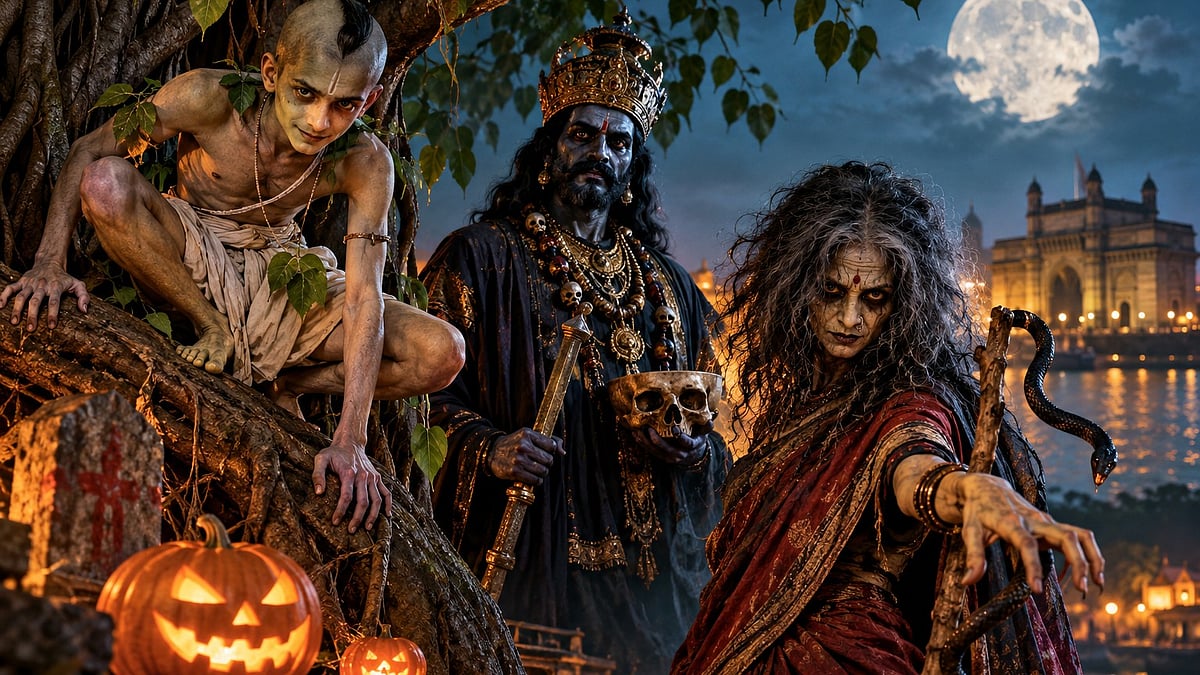
Halloween falls on Saturday, and the city's costume shelves are full of witches, zombies and vampires. Mumbai, though, never needed to import its ghosts. The Konkan coast and the Marathi villages that shaped the city have long had their own: a boy who lives in a peepal tree, a ghost-king who patrols at night and a witch whose cane turns into a snake. Folk-horror films such as Munjya and Tumbbad brought a few of these figures back into conversation, and young Indians have started to bring them to Halloween. HorrorCon India, a horror and Halloween festival, grew from about 5,000 visitors in 2024 to nearly 20,000 in 2025.
The city has a long paper trail of its spirits. A British civil servant's collection, Folk Lore Notes, Vol. II: Konkan, was printed at the British India Press in Mazgaon, Bombay, in 1915. Here are the spirits worth knowing before Saturday.
Boy on peepal tree
The name comes from a coming-of-age rite. During the thread ceremony, a boy wears a girdle of munja grass around the waist, and he is called Munjya once he puts it on. According to folklore in Maharashtra and on the Konkan coast, munjyas are the ghosts of boys who died after this ceremony but before marriage, and they live in peepal trees.
He is less of a monster than a moody neighbour. Most munjyas do no harm, but they may hit back at anyone who defiles their tree, pelting offenders with stones or causing accidents. There may be a practical root to the fear. Peepal trees release significant amounts of carbon dioxide after nightfall, and fear of the munjya keeps people from sitting under them after sunset.
Divay Agarwal, founder of HorrorCon India and creator of the horror channel Khooni Monday, says such tales are where the appeal begins. "Most of us grew up hearing stories about a haunted house in the neighbourhood, a spirit associated with a peepal tree or a ghost story passed down by grandparents," he says.
Halloween look: a shaved head with a tuft, a white dhoti (wrap worn around the waist), a sacred thread and a few leaves in your hair.
Ghost king
Most of India knows the vetal from the Vikram and Betaal tales, where a spirit hangs from a tree and quizzes a king with riddles. He has already turned up at Halloween parties. Shoaib Malik, a regular partygoer, noticed the change last October. "Most people had dressed up as characters from Indian folklore, like Manjulika, chudail (witch), Tenali Rama and betaal," he says.
In the Konkan, he wears a crown. Vetal is king of ghosts, and the Konkan is ruled by him and his ghosts. Yet locals see him as a protector. In Maharashtra's coastal Konkan region, he is better known as the folk deity Vetoba, and tradition holds that he moves through the village at night and keeps watch over his devotees' property.
His best-known home is the Vetoba temple at Aravali, about 15 km from Vengurla on the way to Redi in Sindhudurg. The idol stands over nine feet tall and is made from five kinds of metal. Devotees bring him an unusual gift: leather chappals (sandals). Locals say the soles wear out within a few days because of his vigorous patrols.
Halloween look: dark robes, a skull bowl, a wooden sword and, of course, a well-worn pair of Kolhapuris.
Witch with a cane
If the munjya sulks and the vetal protects, the chetkin is the one grandmothers warned girls about. According to the book Ghosts, Monsters and Demons of India, chetkin is a Marathi word usually translated as witch or sorceress. She walks with a cane that she can turn into a black krait at will, and she may possess people, especially young girls, and make them cackle madly.
Folk witches are already a hit online. Anamika Saini, 23, an optometry student and horror make-up creator from Lucknow, built her Bengali witch look for about ₹300 to ₹400, sculpting the ears and a bone neckpiece from air-dry clay. "Navratri was on, so everyone was creating Bengali eye make-up looks. It is also the month of Halloween, so people started mixing the two, and it became a trend," she says.
Halloween look: an old nine-yard sari, loose grey hair, a walking stick and a rubber snake to swap in mid-party.

Also on the guest list
The cheda is said to guard buried treasure, and many villages on the Konkan coast have a cheda stone where the first taste of the morning's milk is offered. Skip the offering, and he may stop the cows from giving milk.
Why they still haunt us
These figures were never simple villains. Each spirit carries a rule: respect the tree, honour the guardian, make the offering. That moral thread runs through every grandmother's version of these tales, and young partygoers now carry it into their costumes. Mahek Chacha, 26, a management trainee from Mumbai, has worn Lois Lane, Misa Amane and Sukuna to past parties, but her dream costume comes from home. "I embrace my culture every day. If I had a character I would love to dress up as, it's Tripti Dimri's chudail from Bulbbul," she says.
Agarwal sees no conflict between the two worlds. "They can dress up as a vampire one day and Manjulika the next, and both feel equally relevant," he says. This Halloween, the boy in the peepal tree might just get the bigger welcome.

