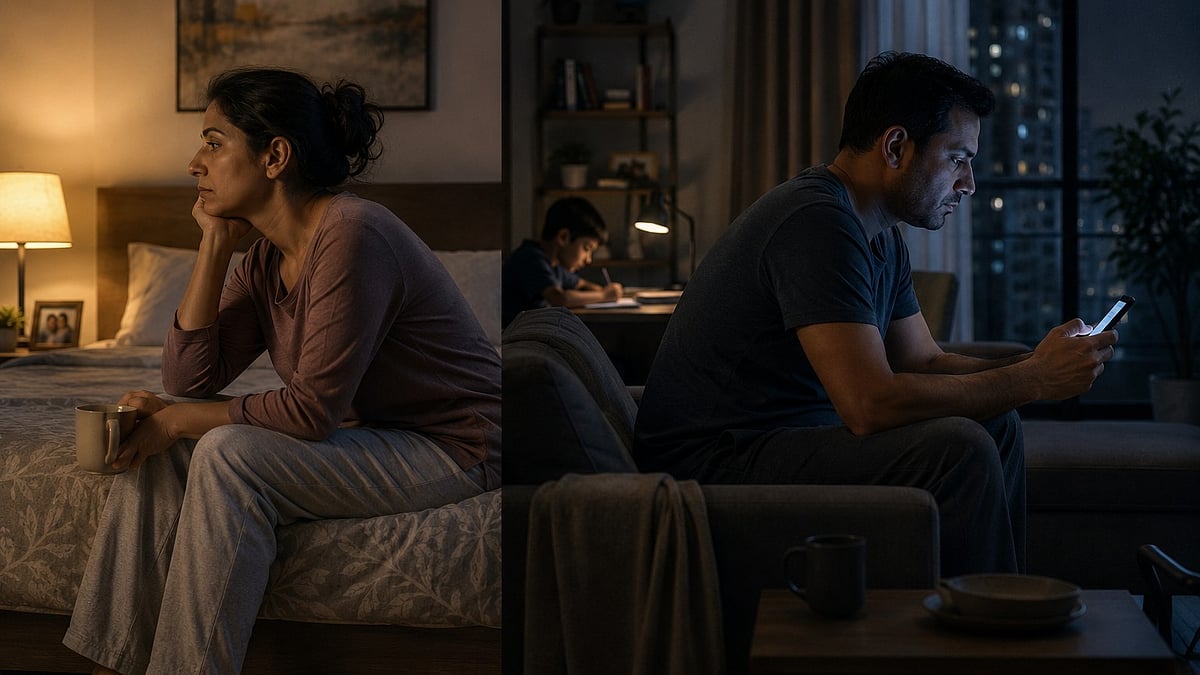
You share a home, a bed, children, and responsibilities at home; yet, each evening, you disappear into separate silences. Somewhere along the way, the thread of genuine connection has broken. There are moments of aloneness in every relationship, but when that aloneness transforms into loneliness – something invisible, unnamed yet very tangible – it enters the territory of what therapists and relationship counsellors call Parallel Life Syndrome. Your relationship has moved into the ‘parallel zone’ where there are no longer emotional outbursts, raging arguments or tearful making up; just two people who have drifted away living under the same roof, almost like roommates. You start following the ‘live and let live’ policy with minimal interactions.
“It is a relationship where two people live alongside each other but no longer truly connect. Their lives have quietly drifted apart, there is no ‘we’ moment here. Daily routines rarely overlap, conversations feel minimal or absent, and emotional closeness fades into the background. They function side by side, not together. That is how a shared life slowly becomes two parallel ones over the years,” says Shivani Misri Sadhoo, Certified Marriage Counsellor & Founder of Saarthi Counselling Services.
What makes this situation so insidious is that it rarely announces itself. There is no defining moment of realisation, just a quiet seeping in of detachment from each other. The gestures of connection that once felt essential quietly fall away. There is no tension, no emotion, just a kind of practiced indifference. Couple often fall into this as a way of escaping from trials of daily life, be it parenthood, career demands and the stress of managing home.
Psychologists note that many couples in this pattern don't even recognise parallel life syndrome as a problem at first. “The absence of open conflict often feels like stability. Accord is mistaken for happiness. It is only when one partner or both begin to feel a persistent sadness and loneliness that the reality of their parallel lives become undeniable,” explains Dr Sujatha Koshy, Educational & Emotional Wellbeing Psychologist & Trainer at India Counselling Services.
Slow disappearing act
Parallel life syndrome does not discriminate by age, background, or the intensity of a couple's original love story. It is seen in newly married couples paralysed by the demands of building a life together, in mid-life partners who outsourced their connection to parenting and now find themselves strangers with an empty nest, and in long-married couples who simply never developed the vocabulary for sustained emotional intimacy. One often feels trapped between too invested to leave, too disconnected to rebuild. The relationship functions on autopilot, where warmth, empathy, and intimacy quietly fade without a dramatic breakup.
“It started with ignoring little conversations, showing irritability at any request for intimacy or sharing the events of the day with the simple excuse of being tired. Slowly but steadily, we have grown distant, while apparently together but living very separate lives. I was not comfortable with the idea in the beginning, but for the sake of keeping peace within the family, I have accepted the change,” said Donna B, a Bangalore based content writer, who has been married for over 20 years. Her partner often seen to be a friendly, affable person in social surroundings, always rushing out to help others, has consistently ignored her for years now, she claims.
She claims that she feels lonely and sad, and does have periods when she breaks down, but the negative response from her spouse forces her to go back into her shell and restore the appearance of normalcy in their relationship. “I always end up being the one throwing a ‘tantrum’ and the disagreements impact the teenaged children at home. So, I swallow my hurt and go on living the emotionally distant, lonely life,” she adds.
Talking about the crippling effect of parallel life syndrome, Simran Raina Sharin, Relationship & Couples Therapist, Founder beMore Wellness says, “Loneliness inside a marriage can be more devastating than being lonely alone, because it is invisible, unnamed, and carries the weight of a promise unfulfilled. No one decides to live parallel lives. It happens in the accumulated silences between two people who stopped reaching for each other."
Aarshi Roy, an entrepreneur, who was married for nearly 15 years started to notice the change in her spouse’s behaviour as their son started to grow up. “As I got busy with managing my son’s schedule, my entrepreneurial venture, I started to notice a marked change in my ex-spouse. Even when I wanted to share my thoughts at the end of the day, he would ignore me. I found that it was me who was constantly trying to pull him into a conversation, while he was happy living in his own space. I was extremely lonely and it was like I was living with a stranger under the same roof,” she adds. After living in this parallel life setup, Roy decided to leave her husband, and moved out with her son. She says, she is happier now, feels less lonely, and has a more successful career and social life.
It’s not just women, even men tend to share similar experience. Shatadru Bhattacharya, a Dubai-based marketing professional explains that his relationship with his newly married wife started to deteriorate after just 6 months because of their career demands and the inability to live together for longer period of time. “Being in separate cities meant we met occasionally and we were friendly enough, yet I felt that the connection that we had when we were dating was lost. We even attended family gatherings and social events together but returned to our respective homes at night. It was like we were married, and we weren’t. It went on for a while, but our parallel lifestyle was taking a toll on me. I wanted more from the relationship, but we weren’t able to move forward” he adds. Eventually, they decided to move on and end their short marriage.
The signs
Experts say that life transitions and uneven distribution of responsibility between couples can act as accelerant in creating a parallel life situation within the relationship. The change is never drastic but happens slowly over a period where the couple learn to accept this distance. The slow withdrawal becomes a permanent separation while sharing same space if no deliberate effort is made to revive the relationship – the gap simply calcifies.
Some of the signs that show that you are living a parallel life include a persistent sense of loneliness, lack of meaningful conversation that delve deeper into emotion, lack of physical and emotional intimacy, being friendly without any real connection, no longer sharing any interests or future plans and hiding the full truth of the relationship from friends and family, finally pretending that everything is fine with a smile that never reaches the eyes.
Mental health toll
Research consistently shows that the quality of our closest relationships is one of the strongest predictors of mental and physical health. When that relationship becomes a source not of comfort, but of quiet desolation, the effects ripple through every dimension of a person's wellbeing. “The psychological impact of living in a parallel life relationship can be severe, especially if the relationship earlier was a more connected one. The loneliness that arises from such a situation is highly detrimental and stressful for a person,” says Dr Koshy. This chronic loneliness that emerges from this problem is very damaging for an individual, adding to stress and anxiety. In some cases, this can come out as angry outbursts, passive aggressiveness and explosive resentment, which can leave the person feeling exhausted and guilty.

The feeling of being unseen by one's own partner carries a major psychological weight and takes a toll on self-worth as well. Anxiety, in the person more invested in the relationship, is another problem that crops up when couples supress underlying issues to avoid confrontation and keep all the interactions only transactional. The fear of being seen as demanding or unreasonable can eat away at the person, often making them irritable or distant. “When the person who chose you stops being with you in the small, daily acts of attention and care, you tend to internalise the disconnection and take it as a personal verdict of not being good enough. Depression, anxiety, and a pervasive emotional numbness are common consequences. Some even feel a loss of identity, mostly in severe cases,” explains Raina Sharin.
Reviving the relationship
It may not be easy, but with little effort, couples can go back to being together in the real sense. The first and the most courageous act is to simply accept the fact that the two of you have been living separate lives. Saying it aloud to your partner as an observation can help break the pattern. Experts advise starting slow by doing small things together. While, it may seem strange in the beginning, but sharing micro-rituals together can help heal the relationship. Dedicating some ‘we-time’ for coffee dates or even watching a movie at home can help rebuild some of the lost connection. Finally, communication – it is the cornerstone of every relationship. Making an effort to talk to each other on non-essential things, sharing a joke, or discussing a book, can go a long way.

