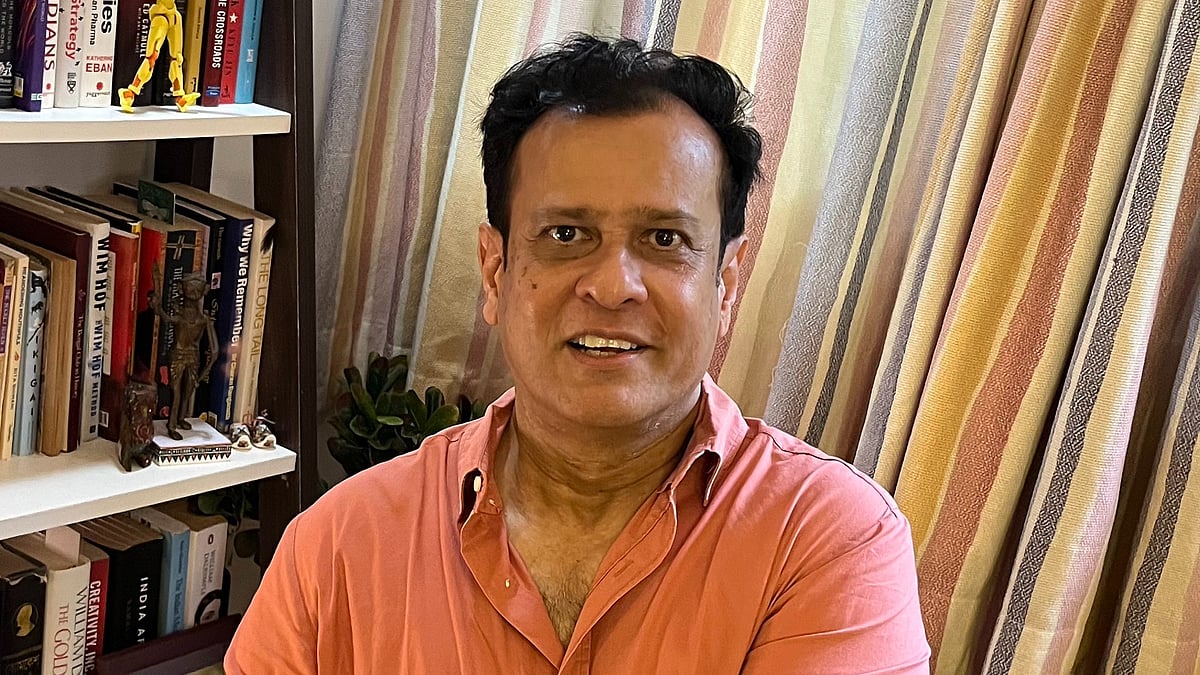
After being inducted into the NASA Hall of Fame, Dr Bedabrata Pain stayed away from research only for a short time before taking over reins of RED. A Kolkatta boy who grew up in religious atmosphere slowly moved away from the rituals only to remember the fragrance of the flowers and spirit of the festival.
Excerpts from the interview:
What did Durga Puja mean to you as a child and what does it mean to you today?
Durga Puja is not one event – but a vicissitude of activities and emotions – a spell that began with Mahalaya and ended with Kali puja. In my childhood, before the urban heat island had its way, the period will be heralded by the emergence of strands of white “kash” flowers., mesmerizing shades of autumn clouds on a clear sky, and a nipping zephyr that made you reach for the “kantha” (a soft thin decorative quintessential Bengali quilt). And you wake up at 4 am to the sounds Mahalaya – a 90 minute live program of songs and “stotra” aired by all india radio - huddled up under the “moshari” (mosquito net), drifting in and out of half-slumber, and watching colors return to the skies. This was the beginning of the Durga Puja period – a symbolic return of the mother with her kids to her parents’ home.
For many Bengalis like my dad, this was also the time travel. In fact, probably even now, some parts of Himalayas, October is called the Bengali month. So, one of the indelible childhood associations of the Durga Puja time is with the romance of train-travel and fragments of coal getting lodged in your eyes. Not that it prevented me from craning my head and looking out the window.
Durga puja, for Bengalis, it was a social gathering – devoid of ritualism or considerations or caste, religions or whatever other divisions. If such elements existed, they remained firmly in the background – in fleeting ways. Everything goes as long as it was “nirmal anand” – with food – from sweets (diabetes, that’s the other person’s problem) to meat – as a mainstay.
Today, when I hear ugly and shrill voices being raised in Bengal about prohibiting meat and forcing down rituals in manacles, I find it more than disturbing. These seem to be voices that want to destroy an unique Bengali ethos – a culture of non-conformism and being anti-establishment, and a certain disregard for social stigmas and barriers, while taking all kinds of diversity in its stride.
A most memorable scene - gut-wrenching scene and rife with Bengali motifs - from the iconic “Pather Panchali” is when Harihar (the father) returns home for Durga Puja with all the new clothes and gifts to find his daughter Durga dead.
I hope Bengalis resist the epilogue of that being written out today.
Does the scientist in you question the sanity of the festival? If you had to explain the human need for festivals and spirituality from a scientific perspective, how would you explain it?
When one utters the word scientist, it conjures up a weird picture – of somebody sitting aloof from humanity, dealing only with numbers, narrow logic, number crunching and solving some equations – disconnected from broader questions of life and living. This is a caricature of what science is – a notion conjured up in many ways by the logical positivists of the early 20th century.
But the scientific method is not such a narrow thing. It is an approach, an outlook for formulating and tackling problems and delving deeper beyond the surface ripples. It is not a cut and dried thing either. It’s something that moulds to the problem at hand.
So, when applied to the social sciences, it is not hard to make sense of human lives or why certain cultural forms exist or persist. After all, human beings are products of a certain economic-social-political conditions over time. It gives birth to their set of ideas, their habits, their outlooks.
The other day I saw a hilarious meme that said “where is my Oscar for acting like everything is fine?” Indeed, in an insane world, when you carry on in conditions of meaninglessness and alienation, when you live in conditions of enforced sanity if only to be alive and stay afloat – are festivals a sign of insanity or restoration of sanity?
Do you believe in the fact that spiritual energies can be explained by Quantum Physics?
Nothing bugs me more when scientific terms like energy, field, frequency, resonance, dimensionality and many other scientific terms are invoked to give credence untenable beliefs and vacuous mysticism, quite often at the hands a charlatan, trying to use the authority of science for personal gains.
In physics, energy has a very precise definition – a capacity to do work or cause a change. it is connected with physical processes – either with external or internal motion (e.g. rest energy) or the presence of a field (which is also a precise term).
But then what is spiritual energy? it can mean just about anything – its vagueness its biggest ally - conveniently morphing to suit the narrative needs of the moment. Just think of the array of things that get implied - vitality, intention, presence, an invisible spiritual substance and many others - all equally vacuous! So when someone speaks of “raising your energy,” “clearing stagnant energy” or “sending healing energy”, either, one is clueless, or one is using scientific-sounding vocabulary and authority of science to fool the gullible.
And there’s no dearth of authoritative and scientific-sounding phraseology such as auric fields, high-vibration people, low-frequency emotions, raising your vibration, align with your higher self, align with the universe – just to name a few of vacuous mumbo-jumbo.
In the 20th century, Quantum Physics (well, Quantum Electro Dynamics) rose as one the most successful theory in terms of prediction. That epithet came from its ability to accurately predict anomalous magnetic moment of particle to 12 to 13 places of decimal (differing only in a part per trillion) – an astonishing feat. (Of course, it has its spectacular failures as well – such the prediction of vaccum zero energy, but that’s another story.)
Yet, conceptually, it has remained genuinely strange, and utterly counter-intuitive and utterly befuddling. As the scientist Richard Feynman stated, “if you think you understand quantum mechanics, you don’t understand quantum mechanics”. Certainly, the instrumentalist Bohr-Heisenberg orthodox interpretations of quantum physics only took the quantum weirdness to dizzying levels.
No wonder, it provided a most fertile ground for every fly-by-the-night mystic and spirituality peddler to exploit. Statements such as “in the quantum field of infinite possibility, your observation collapses the quantum field into the reality you choose” evoke the seductive authority of science, but are nothing but bird-brained hogwash. They are perfect examples of nonsense masquerading as profundity – quite a common occurrence these days, not just with the spiritual fraudsters but many post-modern thinkers as well.
What is spirituality to you?
In the hands of philosophical idealists, spirituality usually refers to something beyond rationality, something that transcends the physical world and/or the self into some other “dimensions of existence or intuition”. Or perhaps, the universe itself participates in the divine (the idea of immanentism). Or perhaps a mystical unity where boundaries of self and the world blur. Or perhaps, where pansychism – where a disembodied impersonal universal consciousness that permeates the world or is the fundamental reality from which everything emerges.
For me, these are all assertions – which, almost by the very construct of it, nobody can prove. If such notions provide solace to somebody, I have no quarrel with it, but I think the world can well do without recondite notions.
I seek spirituality in this world – in the world of human interactions, in their inexorable drives to make this world a better place to live – a place for fulfullment of material and psychological needs, and a place to unfurl repressed creativities.
It is in the indomitable human spirit of never giving up, or resisting against injustice and the reprehensible; it is in the profound empathy about suffering that forms an indelible bond amongst us, it is in the dreaming of a new world that can be created and that is possible – it is in these places that I find spirituality.
It is the rubble of Palestine, it is in fightbacks against ICE, it is in the efforts to rein in the billionaires to make an affordable life, it is in the lines of youth on hunger strike in Jantar-Mantar, it is in the resistance of the farmers, it is in the poetry and art that invariably get created in every movement for change – it is there that i find spirituality. The world, I believe, needs this kind spirituality in their veins in droves.
Can the feeling of being spiritually connected be explained through neuroscience?
Setting aside, spirituality for the moment, understanding consciousness is one the last fronters of exploration. There are those over centuries and today who try to give consciousness an ontology of its own – unconnected with the material world or brain processes. But in the 20th century neuroscience has begun exploring the question of consciousness in a serious way – both by associating brain processes with elements of consciousness, as well as exploring deep scientific and philosophical concepts.
There are scientists that conjecture quantum mechanical origins of consciousness – but nothing testable has really emerged.
But this is how science proceeds – through trials and errors, by getting stuck in blind alleys, by clarifying concepts. We may not solve the hard problem of consciousness, but i am not sure if that’s a problem worth solving.
Is there a scientific explanation for why religious faith can provide people with a sense of purpose, hope and emotional strength?
I remember in an insightful book called the “Capital” – a story about urbanity of Delhi, the author Rana Dasgupta makes an interesting point that the religious fervor of the rich – carried out with wanton pomp and ostentation – has more to do with protection of wealth than praying for more. Deep down the uber-rich feels do not feel that they earned their wealth through their efforts, and they are more worried about losing it.
At the same time, religion is a very personal matter. As they say, it is in moments of distress that we remember God. But then this is world where distress is order of things, not the exception. Who is to judge how people summon their inner strength in pervasive conditions of vulnerability and insecurity?
And then there are those who prey on vulnerability of people to spread hate, to sow seeds of division, to create diversion, to create strawman enemies – all to secure their hold on power. Examples are rife in this world.
But the significance of religious faith to a vast majority of people that have been denied human dignity can never be forgotten. For most folks of left/liberal persuasion, Marx’s quote about religion as “the opium of the masses” has a become a matter of cliché. Yet, if one reads the entire passage, one sees the role religious faith plays in people’s lives – and perhaps the more vulnerable a people are, the more grows the clamor for religion.
Here's the incisive passage from the introduction to the “Critique of Hegel’s Philosophy of Right” by Karl Marx.
“Religious suffering is, at one and the same time, the expression of real suffering and a protest against real suffering. Religion is the sigh of the oppressed, the heart of a heartless world, and the soul of soulless conditions. It is the opium of the people. … The criticism of religion is, therefore, in embryo, the criticism of that vale of tears of which religion is the halo.”
I think words are superfluous after that.

