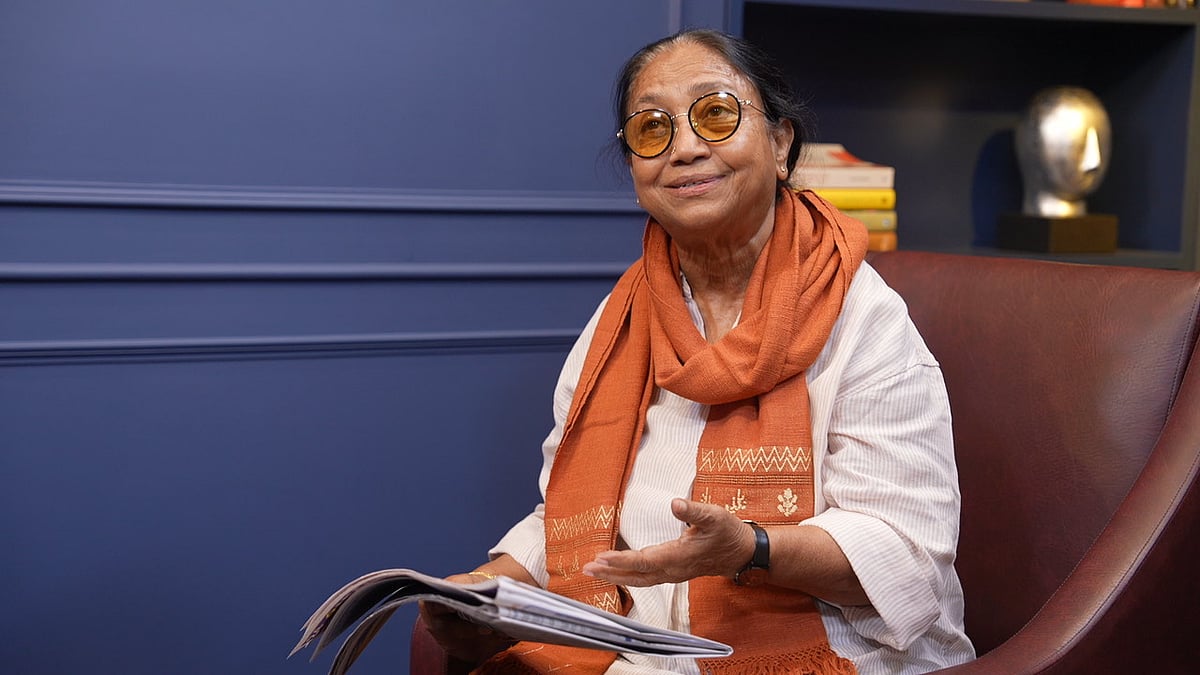
Banu Mushtaq does not romanticise the act of writing. For her, it has always been closer to confrontation, with power, prejudice and authority. When Heart Lamp, English translation of a selection of her short stories, won the 2025 International Booker Prize, it brought global attention to a body of work forged over four decades, but the moral centre of her writing remains resolutely local.
“It is a troubled time we’re living in”, the Kannada author says, referring to growing instances of hate speech and the demonisation of the Muslim community.
“At this fractured time, if you don’t talk, if you don’t shout, if you don’t echo the words and cries of our fellow beings, it is an unpardonable thing,” she says, about the role of writers during times of crisis.
At the core of her writing is a conviction: “Personal is political.”
In her world, the most ordinary acts acquire political heft from their contexts, from acts of omission and commission.
Her characters may suffer injustice, but it is their resistance that defines them. “That resistance itself is politicalised.”
That insistence on resistance is not accidental. Mushtaq came of age as a writer during Karnataka’s Bandaya (rebellion) literary movement of the 1970s and 80s, when literature was inseparable from grassroots activism.
Writers marched with farmers, Dalits and women’s groups, wrote pamphlets, shouted slogans and faced arrest. “Writers never stayed away from the people. They were with the people. We raised our voice along with them,” she recalls. Her stories, she says simply, came from there. “It was people’s power.”
Written between 1990 and 2023, Heart Lamp’s 12 stories chronicle the lives of women and girls in patriarchal communities in southern India. Translated from Kannada by Deepa Bhasthi, the stories offered “something genuinely new” for English readers, according to Max Porter, author and chair of the International Booker Prize 2025 jury. “This was the book the judges really loved, right from our first reading,” Porter said.
Mushtaq, who is also a lawyer, has been a women’s rights activist and an anti-caste activist. She is the second Indian author to win the International Booker, after Geetanjali Shree won it for the English translation of her book in 2022. Heart Lamp is the first collection of short stories to be awarded the Booker prize, considered the world’s most influential award for translated fiction.
Her own position within literature was precarious from the beginning, on account of her identity. “Muslim? Muslims are demonised. Woman? A woman is condemned, cornered,” she says. “These were all negative identities.” As a Muslim woman writing in Kannada, rather than Urdu, she encountered suspicion from multiple quarters.
Questions of legitimacy followed her everywhere—who she was writing for, what cultural references she could claim, if she was permitted to write about Hindu epic characters, or characters from the Islamic world.
“There were only boundaries, boundaries, boundaries,” she says. She turned to contemporary life as a pragmatic writer’s move, but paradoxically, those characters would prove to be universal, deeply political.
Even then, the assumptions about women’s writing remained reductive, and women writers were belittled. It was presumed that women could write “only about the ingredients in her kitchen”.
It was not only the religious patriarchs who questioned her right to write. “The entire system asked questions. They never demanded an explanation. I was not given a chance to explain what I meant. Those people, who could not understand literature, who could not understand what I was saying, who could not understand the importance of my words, they were the judges there, and they penalised me continuously.”
Navigating this terrain over a writing career spanning decades required constant calculation, and Mushtaq often felt that she was in a war.
“I have got two swords, one in each hand; I am fighting with the patriarchy, and with the right-wing people,” she says.
The pressures she faces are not only external; they shape the prose itself. “I cannot write a full sentence without self-censoring,” she says.
Despite it all, stories matter, says the writer who has published six short story collections over four decades, with a seventh currently in preparation. Readers’ reactions have persuaded her of this.
A self-described feminist man once told her he recognised his masked bigotry after reading her work. One woman reader from Pakistan asked if Mushtaq had somehow video-recorded incidents in her family, so resonant the stories were. Another reader confessed he could only read her stories in fragments, because they demanded empathy and understanding.

For Mushtaq, this is precisely how literature works. “When… the reader starts reading it, the story doesn’t end there. It starts growing in the mind and heart of the reader,” she says. That growth, inward, gradual, unpredictable, is where change may begin.
The Booker moment itself, she admits, felt surreal. Compounded by lost luggage, missing medications and overwhelming expectations back home, when she finally heard her name announced, she struggled to believe it.
In a memorable acceptance speech, she said the moment felt like “a thousand fireflies lighting up a single sky—brief, brilliant and utterly collective”. In a divided world, literature was one of the last sacred spaces where humans can live inside each other’s minds, she said.
She imbues her stories with that same hope. The stories of women’s lives, reproductive rights, faith, caste, power and oppression were “life-affirming stories”, according to the Booker judges.
Mushtaq herself says her female characters may often be poor or illiterate, but never passive. “They have their own character, their own way of fighting back. Somewhere they compromise, somewhere they hit back, and somewhere they laugh with irony.”

