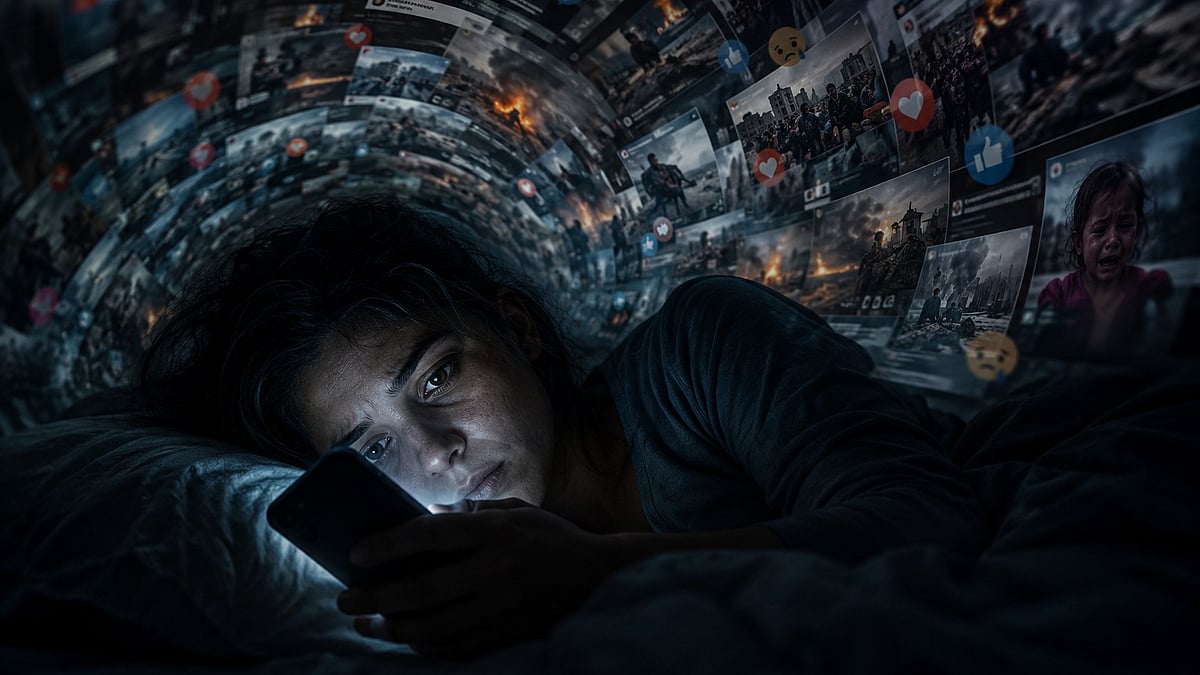
You open social media to check one notification and, before you know it, you're scrolling through stories about crises, scandals, and disasters. You feel stressed and mentally drained, yet you keep going. This habit, known as doomscrolling, refers to consuming large amounts of negative or distressing content online, often long after it stops being enjoyable. While it can leave us feeling anxious and exhausted, our brains are surprisingly wired to keep scrolling.
Here are four reasons why your brain hates doomscrolling but still struggles to stop.
Brain treats negative news like survival information: Thousands of years ago, paying attention to threats helped humans survive, so the brain evolved to prioritise negative information. That instinct still exists today. Stories about disasters, crime, conflict, and uncertainty grab our attention because the brain views them as important signals. The challenge is that social media delivers an endless stream of such content, making us feel like we constantly need to stay informed.
Dr. Sachin Adukia, international award-winning Neurologist and IIT-Bombay research collaborator, says, “Doomscrolling taps into our brain’s instinct to notice threats and seek new information. Negative news grabs attention because the brain prioritises potential dangers, while endless updates keep us searching for more. Together, this makes doomscrolling difficult to stop, even when it leaves us feeling stressed or emotionally drained.”
Algorithms know you can't look away: Social media platforms are designed to keep users engaged for as long as possible. Their algorithms quickly learn what captures attention and often promote emotionally charged content because people tend to spend more time interacting with it. Negative news, shocking headlines, and controversial topics often trigger stronger emotional reactions than positive stories. As a result, the more time you spend looking at distressing content, the more similar content the platform is likely to show you. This creates a cycle where the brain becomes surrounded by negativity, even when it would prefer a break.
Infinite scrolling creates a dopamine loop: Many people associate dopamine with pleasure, but it is more closely linked to anticipation and reward-seeking. Every swipe brings the possibility of finding something surprising, important, or emotionally engaging, and that unpredictability keeps us scrolling. Much like a slot machine, the brain keeps chasing the possibility that the next post might be worth it, making it difficult to stop even when the content is leaving us feeling worse.
“Negative content grabs our attention, and social media algorithms keep feeding us more of it. Even when doomscrolling leaves us feeling anxious or exhausted, it’s hard to stop because there’s always one more update to check. I think short-form content has made this worse by training us to constantly seek instant stimulation. Breaking the habit starts with being more mindful about what we consume online,” says Dharam Panchamiya, a 24-year-old Gen Z user.
Stressful content becomes strangely addictive: One of the biggest paradoxes of doomscrolling is that people often consume content that actively increases their stress levels. Part of the reason is that the brain seeks certainty during uncertain times. When people feel anxious, they often look for more information in an attempt to feel prepared and in control. The problem is that endless scrolling rarely provides closure. Instead, it delivers more updates, more worries, and more reasons to keep searching. As a result, people become trapped in a cycle where they seek information to reduce anxiety but end up increasing it instead.
Ekta Dharia, Clinical Psychologist and Psychotherapist, says, “Doomscrolling is hard to stop because our brains naturally pay more attention to negative news than positive news. When we feel stressed or worried, we often seek answers or reassurance online, but end up finding more upsetting content instead. This can create a cycle where anxiety leads to more scrolling, leaving us mentally exhausted and emotionally drained.”

How to break the cycle
The good news is that small changes can help break the doomscrolling cycle. Switching your phone to grey-scale mode, limiting screen time, turning off unnecessary notifications, and creating phone-free moments during the day can reduce overstimulation and give your brain a chance to reset.
Doomscrolling is not a lack of willpower. It happens because ancient survival instincts are colliding with modern technology designed to hold our attention. Understanding why we are drawn to negative content is the first step towards building healthier digital habits and knowing when it's time to put the phone down.

