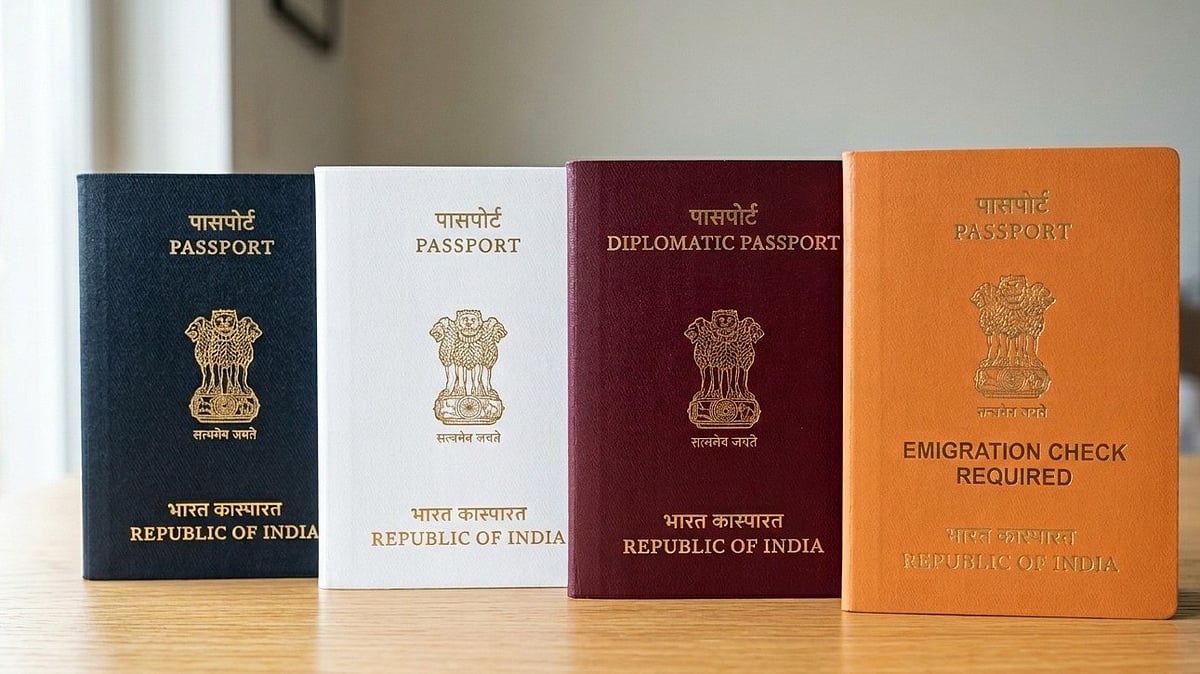
A passport is more than just a travel document — it is an identity card for the world. In India, passports are not one-size-fits-all. Depending on the traveller’s purpose, profession, and official status, the Government of India issues passports in different colours and categories. While most people are familiar with the standard blue passport, there are lesser-known variants designed for diplomats, government officials, and specific employment-related travel requirements.
Here’s a closer look at the different types of passports in India and what each one signifies:
Blue
The blue passport is the standard passport issued to ordinary Indian citizens. It is the one most people carry for international travel, whether for vacations, higher education, work assignments, or family visits abroad.
The Ministry of External Affairs issues this passport, which is valid for 10 years for adults and for 5 years or until the holder turns 18—for minors.
White
The white passport is not commonly seen because it is issued strictly to individuals travelling abroad on official government duty. Reserved for officers representing the Indian government in an official capacity, this category is granted exclusively to government officials.
Unlike ordinary passports, the white passport clearly identifies its holder as someone undertaking a state-related assignment. This distinction often helps streamline immigration procedures and ensures due recognition of the traveller’s official status while overseas.
Maroon
The maroon passport, also known as the diplomatic passport, is issued to Indian diplomats, high-ranking government officials, and diplomatic couriers.
This category comes with certain privileges during international travel. Diplomatic passport holders may receive easier visa processing, dedicated immigration counters, and diplomatic immunity in some circumstances, depending on international agreements.
However, diplomatic passports are not issued for personal convenience. They are strictly linked to the holder’s official role and responsibilities. Once an official assignment ends, the passport may need to be surrendered.
Orange: ECR status
The ‘orange passport’ in India was proposed for citizens with Emigration Check Required (ECR) status typically those with less than a 10th-grade education as a measure to protect them from exploitation abroad. However, in January 2018, the Ministry of External Affairs decided against issuing separate orange-coloured passports. While the colour distinction was scrapped, the ECR status continues. Such individuals are issued the standard blue passport, but without the last page, which earlier contained address and guardian details.
Why these distinctions matter
Passport colours are not chosen randomly. They help foreign authorities quickly identify the traveller’s role and the purpose of travel. Immigration systems worldwide rely on visual cues for faster verification.
For India, these colour distinctions also create a clear separation between ordinary citizens, official delegations, and diplomatic representatives.
As global travel evolves, passports are becoming smarter, more secure, and digitally integrated paving the way for the next generation of travel documents.
Know more about e-passports
Embedded chip stores biometric & personal data
Makes passport harder to forge or tamper
Speeds up immigration clearance
Compatible with global e-gate systems
Damage to chip can make passport unusable
Gradual rollout; older passports remain valid until expiry
Uses Radio Frequency Identification (RFID) technology
Powerful passports
The latest Henley Passport Index ranks 199 passports worldwide, measuring how many destinations travellers can enter visa-free or with visa-on-arrival. Here's a breakdown of the latest passport rankings and what they tell us about global travel freedom:
Asia leads
The 2026 index shows Asian countries firmly at the top.
This highlights how strong diplomacy & international ties are shaping travel access.
Top 3 passports
Singapore – Ranked No. 1, with access to over 190 destinations without a prior visa.
Japan – Shares second place, offering exceptional global mobility.
South Korea – Also in second place, matching Japan in travel freedom.
Why Singapore stands out
Reflects long-standing global partnerships and strong international engagement.
Shifting global balance
Europe still performs strongly, but Asia now dominates the very top spots.
This marks a clear shift in global travel influence over recent years.

What these rankings mean
Passport strength goes beyond travel convenience.
It reflects diplomacy, trust between nations, and global cooperation.
Overall, the 2026 Henley Passport Index shows a world where mobility is increasingly shaped by relationships between countries rather than geography alone.

