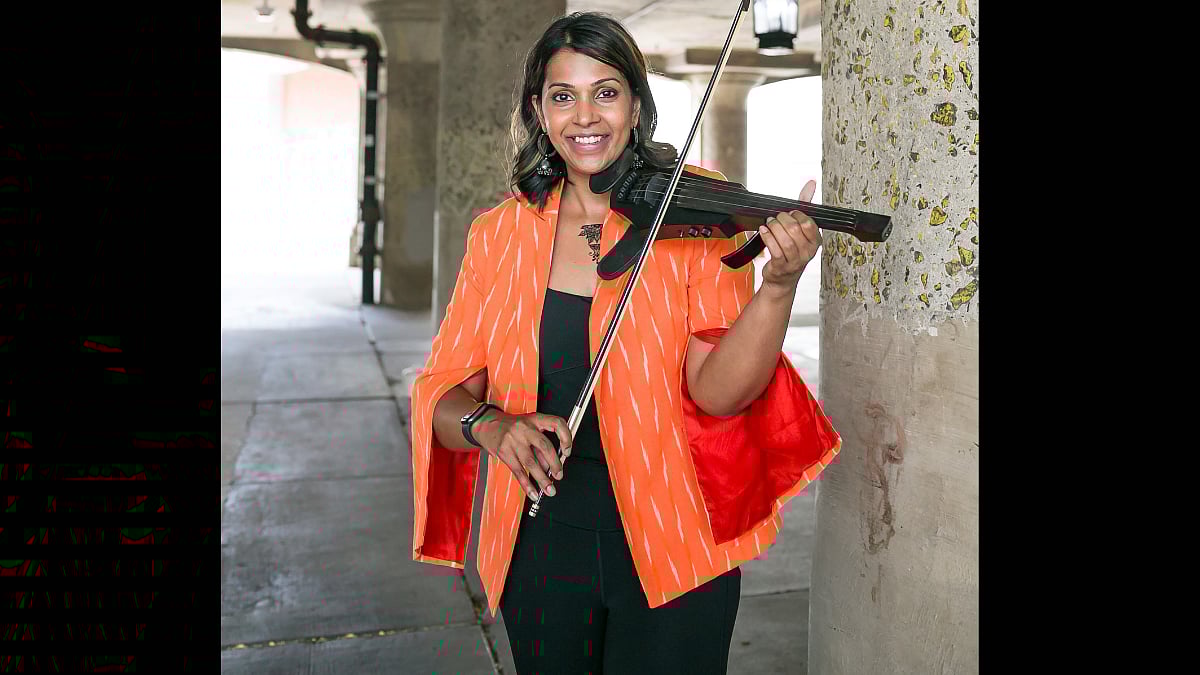
As a violinist, vocalist and composer, Chennai-born Harini Raghavan aka Rini has made a mark ever since she graduated from the Berklee College of Music, Boston, in 2015. She’s created a distinctive style of Indian Jazztronica, which fuses Carnatic raags with modern textures and cinematic arrangements.
Now based in New Jersey, Rini has just completed the Ragaverse India Tour 2026 covering Goa, Bengaluru and Chennai. The events were curated by Quriosity, and she was joined by American guitarist Alec Goldfarb, Gurgaon drummer Ranajoy Das and Luxembourg-based bassist Achal Murthy. A core member of the Berklee Indian Ensemble, Rini is a recipient of the 2023 New Jersey State Council on the Arts Fellowship, and has released the albums Echoes Of The Ghats and Blue Carpet Sessions Vol 1. In an interview, she talks about her journey.
Excerpts from the interview:
When did you start learning the violin?
When I was around five years old, first from my grandmother and then from a guru in Chennai. I took formal Carnatic lessons from many gurus including Ganesh and Kumaresh for violin and Chitravina Ganesh for vocals. I learnt violin for around 10 years and vocals for around 15 years in Chennai.
Who were your inspirations?
My grandmother first. She used to sing really well and compose her own songs. We always had Carnatic music playing on the cassette player — a lot of M.S. Subbulakshmi’s songs like Bhaja Govindam and Bhavayami. My main influences were MS for vocals and my teacher Ganesh for violin.
When did you get exposed to other forms of music? Which artistes did you like?
Growing up in Chennai, I got exposed mostly through film music and indie music. A.R. Rahman’s songs had so many incredible elements in them and I loved bands like Euphoria, Strings and other ones that MTV used to showcase then. I loved how they made folk music contemporary and blended classical music with western elements. The 1990s bands like Spice Girls and Backstreet Boys were also big in Chennai, and from Michael Jackson, one got to hear some harmonies and pop grooves. In the 2000s I got to listen to amazing producers like Imogen Heap, who was a big inspiration to write and produce my own music. I loved Radiohead and post-rock band Sigur Ros for their amazing timbres and ambient music. So there was a lot of variety.
When did you move to the US?
I got into Berklee in 2012, and moved to Boston then. After graduating from Berklee in 2015, I moved to New York and now I live in New Jersey.
How did the stint at Berklee change your approach to music?
It was amazing to see and hear so many different kinds of musicians. Listening to them bring a little bit of jazz and improvisations into their ethnic music inspired me to do the same with mine. It really opened up the possibilities of directions I could take in blending Carnatic music with other genres and create compositions that aren’t boxed into one or the other.
Could you tell us about your album Echoes of the Ghats and the track Mango Showers.
Echoes of the Ghats was an album I produced with songs I had written during the pandemic and had tracks about all the highs and lows we all went through collectively as humans across the globe.
Mango Showers is a track I wrote about the pre-monsoon showers in Kerala that brings the mango season. The track also encompassed my very first India tour and all that we experienced meeting people there.
You’ve recorded popular Carnatic tunes like Raghuvamsa Sudha (in ragam Kadhana Kuthuhalam) and Tellsi Rama (in Poornachandrika). How did you work on the fresh arrangements?
I wanted to keep the soul of these compositions intact and work around them to embellish them with contemporary chords and layers that made them feel they had a more futuristic platform that showcased their depth.
Could you tell us about your collaboration with kanjira player Swaminathan Selvaganesh on the track Cadence of The Stars?
I met Swami in New York and had already collaborated with him before on my arrangement of Bhavayami. I really wanted to feature him on an original song and I reached out to him in April 2025. I wanted to write an electro-Carnatic space journey tune and the sonic presence of the kanjira definitely elevated the composition. Swami played it very tastefully within the arrangement and his solo improvisations were amazing.
What are you working on these days?
I am working on new music featuring some New York-based artistes as well as some new music collaborations with Indian artistes that I met on this tour and planned meetings with. I also tour with other projects in the US like American Patchwork Quartet and Sunny Jain’s Wild Wild East.
What are your hobbies and interests besides music?
I love anime! My favourite one is one of the longest running ones called One Piece. I also love K-Drama and their soundtracks. I love languages, and am aspiring to make my Spanish better and learn Korean and Japanese.
How often have you performed in Mumbai and what has been your experience?
I have played three times in Mumbai — at the Taj for a private event with the Berklee Indian Ensemble in 2018, at AntiSocial in 2023 and at NMACC in 2024. All the times, the experience was great. There are unfortunately no shows this year, but we are working on lining up a performance for next year.

