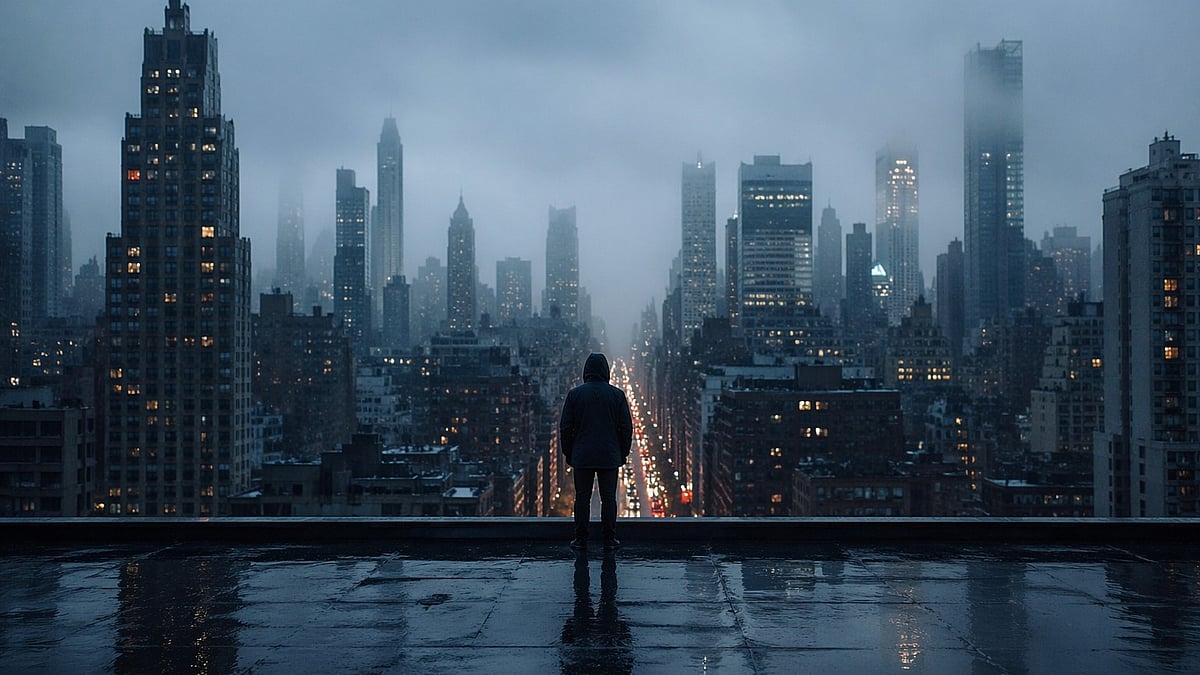
Musician Satinder Sartaaj’s viral song ‘Jaiye Sajna’ speaks of loneliness, emotional drift, and a life unmoored. In the comments, thousands of people are asking the same bewildered question: “Why am I crying listening to this?”
“The answer”, says Dr. Itisha Nagar, a clinical psychotherapist based in Noida, “lies in the ebbs and flows of urban society. There is a shared, underlying sense of loneliness that people across age groups are experiencing today".
"Everyone is looking for someone to talk to at the end of the day; something that used to happen naturally in earlier phases of life."
It has a name: “urban loneliness”. A psychological condition of city life in the 21st century that needs urgent discourse. It is not simply the absence of people but the very absence of meaningful connection, despite living amid millions of people.
Gunjan Sharma (33) puts it plainly. "Despite having a family, a cuddly dog, and so many friends, you just feel something is missing," says the communications professional who moved from Delhi to Mumbai. "It's not about being physically alone, but more about feeling emotionally disconnected or misunderstood in that moment."
Aditee Mitra writes on her blog on Medium, “Many personal stories echo this affective disconnect. People moving to cities for work feel lost among strangers. The effect is subtle — sneaking into dark evenings alone, talking nonstop — without anyone really listening. In the city one can live among people and still be alone.”
Aisha Imamuddin, who relocated to Bangalore from Chennai a year and a half ago, echoes this. She has colleagues, visits friends and goes to the mall when the walls close in. Yet there are nights when the heaviness of it all has her writing her feelings down in a journal, or crying for hours.
This is the paradox living in the heart of urban centres, when a city offers proximity without connection, and crowds without the belongingness of a community.
“The causes are structural, not personal”, says Dr. Nagar, “which is precisely why individual willpower rarely fixes the problem”. Urbanisation has fundamentally altered the texture of daily relationships. "Cities are spaces of mistrust," she says. "Anonymity reduces accountability, and people automatically become more guarded." This mistrust, in a way, is adaptive—it protects you in a fast-paced urban environment. But in the long run, it reinforces loneliness.
Migration patterns compound this, when one arrives without a ready social circle. Lavinia D'Souza, an analyst who has lived in Leeds for a decade, notes that friendships forged through work are hard to sustain once people leave. "You can't just casually ask to catch up on weekends," she says. "Plans often need to be made months in advance, everyone has a life and commitments". The spontaneity that characterises close friendship becomes logistically impossible.
For older adults, it gets worse. Those who have watched their children move abroad and their social circles thin out through illness or death can spend days in large homes with almost no meaningful human contact. Loneliness has no preferred age.
Dr. Nagar draws a direct line between urban loneliness and a larger socio-economic and political environment — the ambient stress of economic uncertainty, global instability, and the relentless pressure to keep performing regardless. "The most basic human need in such a context is to have someone to talk to," she says. "People are not looking for solutions, just someone to listen to them. But increasingly, they're unable to find that."
An insidious aspect of urban loneliness is how effectively it silences itself. The social expectation to be active and surrounded by friends means that admitting loneliness carries the stigma of failure. People hide it, and in doing so, deepen it.
"The first step towards a solution is acknowledging, collectively, that loneliness is widespread," says Dr. Nagar. Therapy has a role, she adds, but a limited one — it works at the individual level, but loneliness is fundamentally a structural problem.
Solace in Community
The solutions being tried are, appropriately, communal. Baithaks, poetry circles, supper clubs, wellness groups — informal spaces where people gather around shared interests rather than professional obligation. Astuti Singh, a hospitality professional living in Bangkok, has built her social life around exactly this. Hailing from a defense background, Singh says she stays resilient more often than not when feeling lonely. “I cave, but I also actively try to go out attending events, pursuing wellness programmes and joining classes of my interests.”
D’Souza says, “I’m still happy to make plans, but as people get older, everyone has so much going on that it becomes harder to follow through.”
Do these spaces work? Not always, and not immediately. But they create the chance to meet another person in the same room. "It's unlikely there is no one in the world you can relate to, but you have to keep showing up", says Dr. Nagar. The answer, urban designers increasingly argue, may lie not in grand interventions but in the conscious choreography of everyday spaces— parks, libraries, community gardens, fine-grained streetscapes—designed not merely for movement, but for belonging. In a city of millions, that remains, somehow, the hardest thing to do.

