
Suhas Inamdar’s The Legacy is an engaging corporate drama that examines the fault lines between inheritance and merit, wealth and values, and personal ambition and familial responsibility, with its tagline being "True Legacy Is Earned, Not Inherited". Set in the competitive world of Indian business, the novel uses a divided corporate empire to ask a fundamental question: does a legacy belong automatically to those who inherit it, or to those who prove themselves worthy of carrying it forward?
At the centre of the story is Vikram Malhotra, a formidable businessman who transforms the Malhotra Group of Companies into a flourishing empire. His death, however, exposes the fragility concealed beneath its success. His sons, Dharam and Parth, divide the business and pursue separate paths. What should have been the continuation of their father’s achievement instead becomes a struggle shaped by rivalry, ego and competing visions.
Into this fractured world enters Karan, Vikram’s illegitimate son, born from a relationship that preceded his marriage. Unlike Dharam and Parth, Karan has no recognised place within the Malhotra family and no unquestioned claim to its wealth. He must build his own business and establish an identity independent of his father’s name. Ironically, it is this outsider who understands the meaning of Vikram Malhotra’s legacy more clearly than the lawful heirs. Karan begins making calculated business moves intended to reunite the estranged brothers and preserve what their father created.
This reversal is the novel’s strongest idea. Dharam and Parth possess the inheritance but struggle to preserve its spirit; Karan is denied the inheritance yet emerges as its most committed guardian. Through this contrast, Inamdar distinguishes material succession from moral succession. Property, shares and positions may pass through bloodlines, but vision, discipline and responsibility have to be earned.
Karan is consequently the novel’s most compelling character. His circumstances could easily have reduced him to a resentful challenger seeking recognition or revenge. Instead, his independent rise gives him dignity and agency. His efforts to bring his brothers together reveal that he is motivated by something larger than personal gain. Yet his actions are not free of complexity: he operates through corporate strategy, making his intentions unfold gradually. This lends tension to a story driven as much by business manoeuvreing as by emotional conflict.
Dharam and Parth represent different responses to inherited privilege. Their separation shows how quickly a founder’s unified vision can splinter when the next generation treats ownership as entitlement. The corporate contest between them also mirrors their unresolved emotional distance. Inamdar effectively demonstrates that boardroom battles are seldom about money alone; beneath them lie insecurity, pride, jealousy and the desire for approval.
The novel is most persuasive when it connects these intimate conflicts with the larger pressures of corporate life. Business becomes more than a backdrop: it is the arena in which the characters’ loyalties and principles are tested. Decisions involving expansion, control and competition acquire a moral dimension because they determine whether Vikram’s enterprise will endure or collapse.
At times, however, the book’s message is stated too directly. Its emphasis on values, reconciliation and responsible leadership occasionally makes the narrative feel instructional. Some conflicts could have benefited from greater moral ambiguity, particularly if the brothers’ opposing positions had been explored with more psychological depth. Readers accustomed to darker corporate thrillers may also find the novel’s ethical framework relatively idealistic.
Nevertheless, its accessibility is part of its appeal. Inamdar writes with a clear sense of purpose and keeps the human relationships at the heart of the corporate drama. The story remains approachable even when it deals with questions of succession, strategy and organisational control.

Ultimately, The Legacy is not merely about who controls the Malhotra empire. It is about what deserves to survive after its creator is gone. By placing an unacknowledged son at the centre of the family’s possible reconciliation, Inamdar delivers an effective reminder that birth may confer privilege, but character determines worth. Thoughtful and emotionally grounded, the novel offers an absorbing reflection on family, leadership and the difficult work of turning inheritance into a meaningful legacy.
Incidentally, do the names and some of the story elements sound familiar? You're right, it's all too reminiscent of the Mahabharata, that ultimate thriller. We've seen the modern film recreation of the classic story in Shyam Benegal's Kalyug, and Inamdar's novel does it justice in its own way, too.
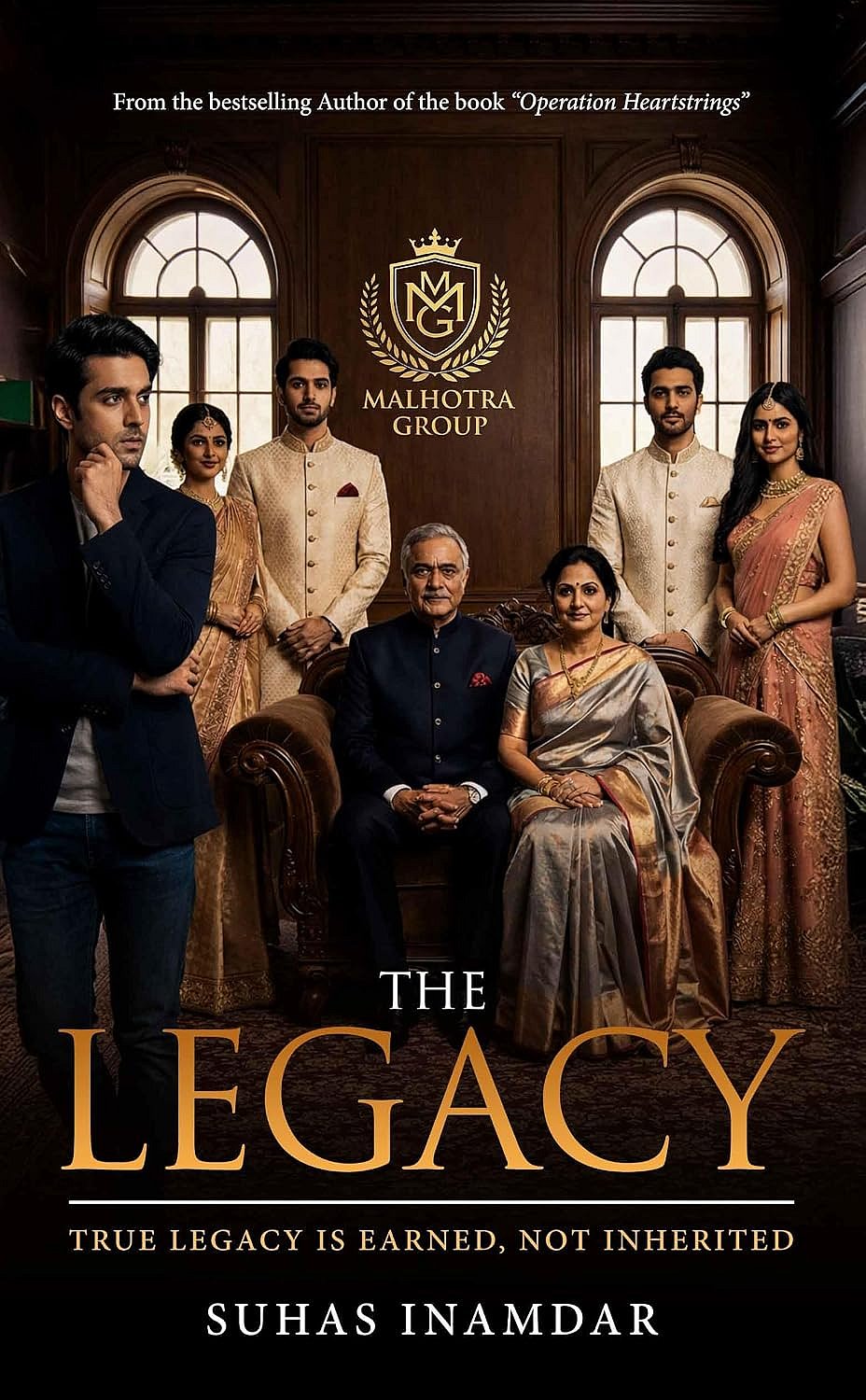
Book: The Legacy: True Legacy Is Earned, Not Inherited by Suhas Inamdar
Publisher: White Falcon Publishing
Price: Rs 325
Pages: 240

