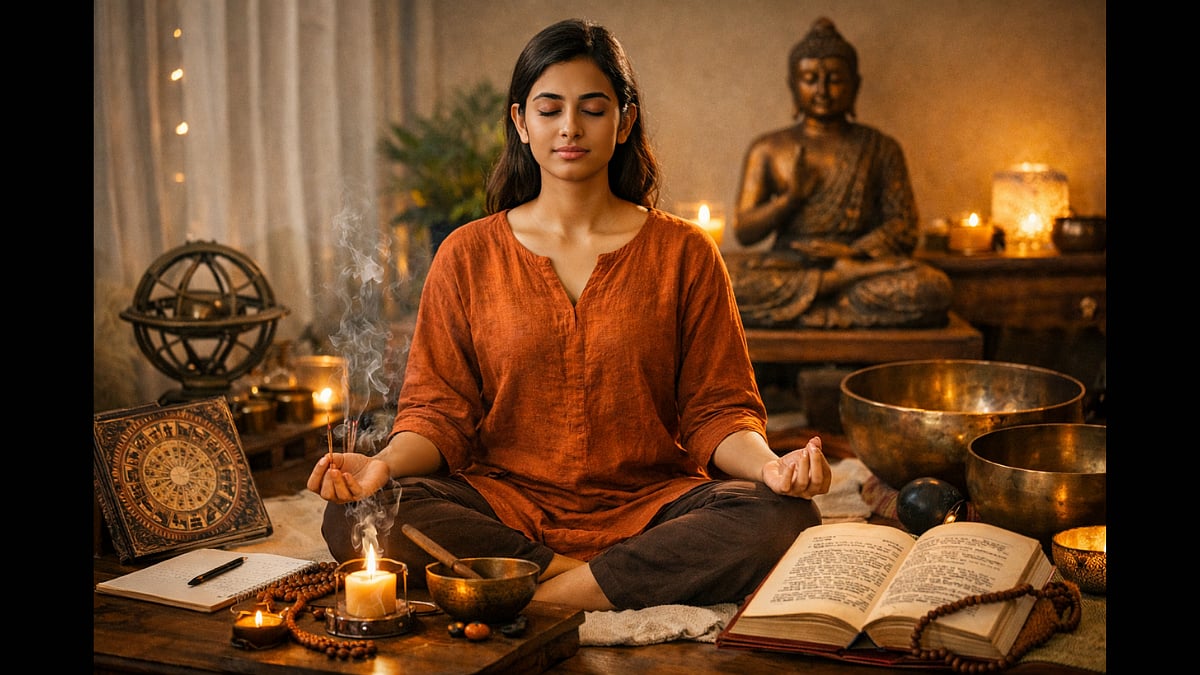
By the third week of January, the noise of New Year resolutions softens. What remains is quieter and more revealing. In this emotional after-January space, a deeper shift in spiritual curiosity is becoming visible — not as a public declaration, but as a private return inward.
Across homes, phones, bookshelves and quiet corners, spirituality is being practised with less display and more discipline. Meditation is personal. Scriptures are intimate. Astrology is reflective. Sound healing is experiential. The sacred is no longer staged; it is lived.
This inward shift is also reflected in industry data. A 2025 Grand View Research report valued the global spiritual wellness apps market at approximately USD 2.16 billion in 2024, projecting a CAGR of over 14% till 2033. India is among the fastest-growing contributors, driven largely by young urban users adopting meditation, mindfulness and reflective tools for daily personal use rather than institutional learning.
A quiet change in how we search for meaning
“What we are witnessing is a quiet but marked change in how people look for meaning,” says Vikram Labhe, Founder & CEO of Melohaa. He believes the inward turn comes from a desire to understand rather than perform. “Life today is noisy and curated, full of comparisons that leave little space for honest self-reflection. Increasingly, people find the clearest insights when they carve out time alone with their thoughts and practices.”
According to him, meditation, scripture study, philosophy and astrology are now being used as practical tools to navigate life’s tangled moments. Astrology, in particular, is being reinterpreted. “Many now study their natal charts to spot repeating behaviour patterns or follow planetary movements to prepare for likely challenges and openings,” he explains. “There is a quiet bravery in doing this work without applause or immediate approval.”
This shift, he adds, reflects a more personal relationship with knowledge itself. People set their own pace, return to ideas when needed, and try different practices without pressure. “Private spiritual exploration has become a practical kind of resilience,” he says — a way to meet uncertainty with steadiness and grounded purpose.
The private discipline of belief
“I’ve felt my relationship with spirituality shift deeply this year,” says Ankit Raj Kashyap, an actor and entrepreneur. “It’s no longer about seeking spaces outside; it’s about going inward.”
For him, meditation has become an act of honesty rather than performance. Scripture reading, once structured, now feels emotionally intimate. “The real work is internal. Growth happens when no one is watching,” he says, adding that spirituality for him now means discipline, solitude and complete honesty with himself.
This preference for privacy is mirrored in market trends. A 2025 BonaFide Research report estimates the Indian online meditation and mindfulness market will cross USD 660 million by 2029, fuelled by rising stress awareness, hybrid work culture and a growing preference for home-based self-practice. Users are increasingly choosing short, private daily sessions over long retreat-style programs.
From guidance to inner authority
Himalayan Siddhaa Akshar, yoga and spiritual leader and founder of Akshar Yoga Kendraa, sees this inward movement as a natural phase of spiritual maturity. He explains that people often begin their journey in guided environments — through group learning, mentors and structured practices — where trust and direction are established. Over time, attention naturally shifts inward.
“When curiosity matures, silence, daily practice and self-reflection become more purposeful than external distractions,” he says. Spirituality, he adds, stops being bound by time or place and becomes part of everyday life, supporting emotional balance, mindful decision-making and inner stability.
A 2026 Future Market Insights report on India’s yoga and meditation services industry projects the sector to nearly double in value by 2035, highlighting how spiritual practices are increasingly merging with everyday wellness routines, emotional health and productivity habits.
Scriptures that speak back
For Shantanu Pednekar, a 24-year-old PR professional based in Mumbai, spirituality today feels conversational rather than ceremonial. “It’s no longer only about visiting places or following organised practices,” he says. “It’s about an inner shift — a self-call where you pause, reflect, and reconnect with yourself.”
Reading the Bhagavad Gita and Mahabharata has become, for him, a way of understanding his own emotions and decisions. “You start relating the stories and ideas to your own experiences, challenges and choices,” he explains. Modern interpretations rooted in Vedic wisdom, he adds, have made these teachings easier to apply in contemporary life.
Astrology as introspection
Astrology too is being redefined. Snehal Marchande, Founder & Creative Head at Chanakya PR, believes spirituality is shifting from being “loud, public, or performative” to becoming “private, self-reflective, and contemplative.”
“This inward turn reflects a generation that is emotionally aware, mentally fatigued, and seeking meaning beyond algorithms, hustle culture and constant validation,” she says. Cultural trend reports from 2025 also note that younger users are moving away from purely predictive astrology towards natal chart studies, planetary cycles and psychological interpretations as tools for self-understanding.
Sound healing: returning to the first sense
Among the practices gaining renewed relevance is sound healing — a meditative experience rooted in vibration. Using frequencies from singing bowls, gongs and the human voice, sound healing slows brainwaves and invites meditative states without effort.

There is also a biological intimacy to sound. The ear is one of the earliest sense organs to develop in the womb, which may explain why vibration feels grounding and emotionally resonant. In a digitally overstimulated age, sound becomes a bridge back to the present.
As Ami Doshi, founder of Jeevalaya, says simply: “Surrender to sound and just flow.” A 2025 Straits Research report valued the global sound therapy and sound healing market at over USD 2.8 billion, attributing its growth to interest in non-verbal, sensory-based wellness practices for emotional regulation.
Not a retreat, a realignment
This inward movement is not about withdrawal from society. It is about engaging with life from a steadier centre. People are not rejecting ambition, progress or relationships — they are simply refusing to let their inner world be governed by constant noise.
By the time January settles into itself, perhaps the most meaningful spiritual resolution is not about becoming someone new — but about returning to who one truly is.

