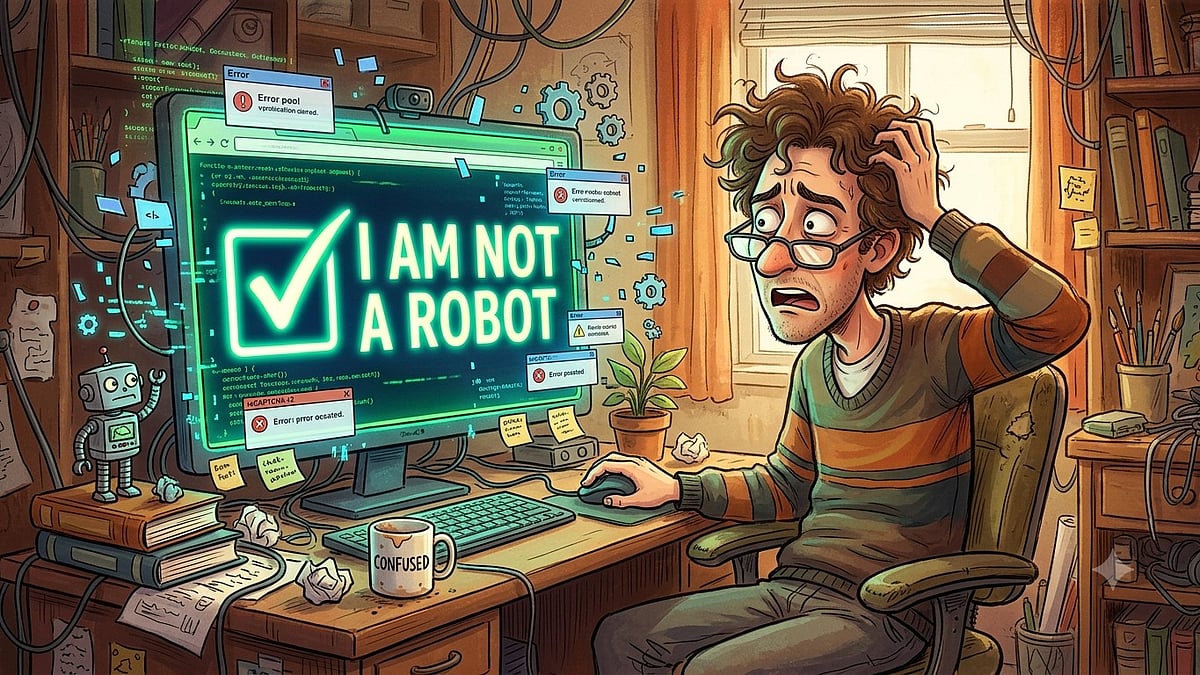
It feels pretty ironic that a computer program demands you prove you’re a human by checking a box that says "I am not a robot."
The reason it asks this—and the reason it already seems to "know"—comes down to how modern CAPTCHA systems (most notably Google's reCAPTCHA v2 and v3) operate behind the scenes.
Here is what is actually happening when you click that little box:
It’s not about the click
The checkbox itself isn’t a test of your ability to click a square. It’s a behavioral tracking bait. Before, during, and after you move your mouse cursor toward that checkbox, the CAPTCHA script is analyzing subtle human signals:
Mouse movement trajectory: Humans move their mouse in slight curves, with tiny tremors, natural acceleration, and variable speeds. Bots usually move in perfectly straight, mathematical lines or teleport instantly to the coordinates of the box.
Timing & Micro-delays: A human takes a split second to perceive the box, move the cursor, and click. Bots do this in microseconds.
Screen resolution and rendering: The system checks how your web browser renders the page elements down to the pixel.
Digital footprint
When you arrive at a website, your browser carries a lightweight digital footprint. ReCAPTCHA evaluates:
Are you logged into a Google account?
What is your IP address history?
Have you recently navigated other websites normally?
Do you have standard cookies and browser extensions?
If your browser history and mouse movement look completely natural, the system assigns you a high "human score." It lets you through with a simple single click because it was already 99% confident you were human before you even hovered over the box.
Why have the box at all?
If it already knows, why make you click?
The Trigger Moment: Clicking the box creates a specific timestamp and action where the script collects all the accumulated movement data and browser signals to make its final evaluation.
Bot Deterrent: It forces automated scripts to load and execute JavaScript, interact with page elements, and mimic complex user behaviors—making automated spam attacks vastly more expensive and computationally difficult for bad actors.

What happens when it isn't sure?
If you are using a VPN, a privacy-focused browser, moving your mouse too mechanically, or browsing anonymously, your confidence score drops. That’s when the reCAPTCHA triggers the secondary test—forcing you to identify traffic lights, crosswalks, or fire hydrants to clear up the uncertainty.

