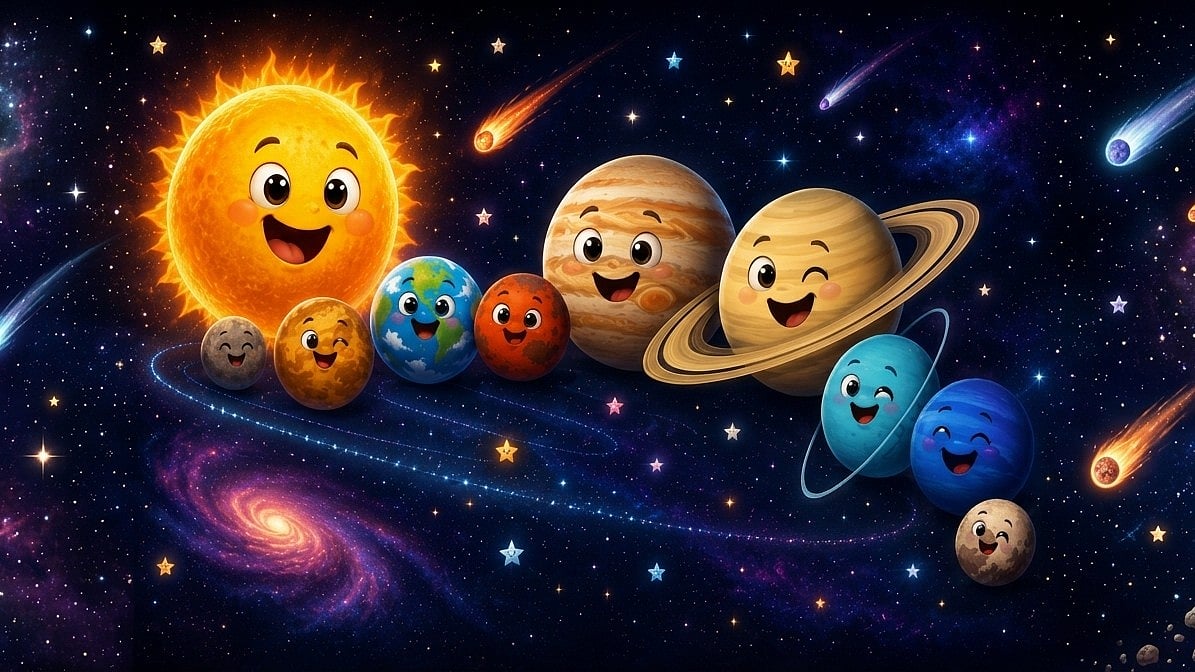
Planets are round because of gravity.
When an object in space gets large enough, its own gravity pulls material evenly toward its center. Over time, gravity smooths out mountains, bumps, and irregular shapes, creating a sphere — the shape where everything is as close to the center as possible.
A sphere is the most stable shape under strong gravity. Smaller objects, like many asteroids, don’t have enough gravity to pull themselves into a round shape, so they stay lumpy or potato-shaped.
Most planets are actually slightly squashed spheres called “oblate spheroids” because they spin. The spinning causes the equator to bulge outward a bit.
For example:
Earth is slightly wider around the equator than from pole to pole.
Saturn is even more squashed because it spins very fast.
A simple way to think about it:
Small object → weak gravity → irregular shape
Large object → strong gravity → round shape
Scientists call the point where gravity becomes strong enough to make an object round “hydrostatic equilibrium.”

