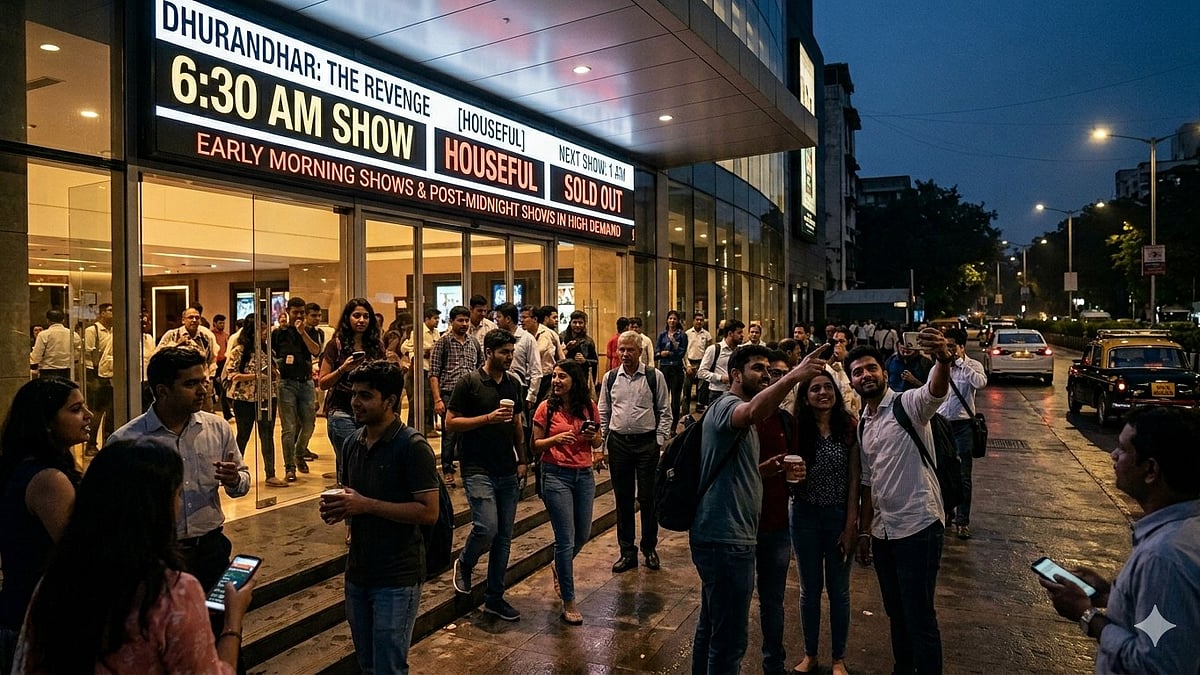
At first, it surprised me to open BookMyShow and see 6:30 am and 1 am shows of Dhurandhar: The Revenge. But as I looked further, I realised those shows were actually houseful. To add to my amusement, I also realised that people I know are actually going to watch these movies, and it has nothing to do with the generation they belong to. That’s when I understood that this is now a common phenomenon. Perhaps I’m the only one fast asleep by 11, still holding on to the idea that mornings are meant for coffee, not cinema. The rest of the world is widely active at this hour.
But what’s unfolding across cinema halls right now is not just a scheduling experiment; it’s a behavioural shift. The idea of “prime time” in movie-going is quietly dissolving. Shows that once sat at the margins of exhibition, 6:30 AM screenings or post-midnight slots, are now not only viable, but, in many cases, sold out.
The recent run of Dhurandhar: The Revenge has made this impossible to ignore. Across multiple theatres, shows began as early as 6:30 in the morning and extended well past midnight, with audiences stepping out as late as 4 AM. What is striking is not the novelty of these timings, but the consistency of turnout. These were not sparse, experimental screenings; they were, repeatedly, full houses.
Not a one-film phenomenon
This pattern, however, is not isolated to one film. Over the past year, high-buzz releases like Chhaava and Border 2 have triggered similar exhibition strategies, with theatres adding early morning and even 2–3 AM shows to accommodate demand. The phenomenon also echoes older fan-driven traditions, most notably the early morning screenings of Rajinikanth films, where the act of watching the film at an unusual hour was as important as the film itself.
The difference now is scale. What was once reserved for hardcore fandom has expanded into a broader, more diverse audience behaviour, cutting across cities, industries, and age groups.
Trade logic
Trade voices remain clear that the foundation of this trend is economic. Taran Adarsh says, “It happens with films where there is high demand.” The logic, he suggests, is straightforward: if audiences are willing, theatres will extend show timings to accommodate them.
Senior journalist and trade analyst Amod Mehra adds a more behavioural layer to this shift. “Even when there is no public transport, people are coming. This is happening in Mumbai… not so much in places like Punjab or Delhi. Maharashtra is safer,” he notes, pointing to how geography influences turnout. At the same time, he emphasises the psychological appeal: “There’s a kick you get out of doing something different… people are enjoying it, showing off a little, posting about it.”
Filmmaker Subodh Khanolkar situates this within a film’s release cycle. “There are two sides… the demand has to be huge, otherwise theatres won’t do this,” he explains. Recalling similar patterns during the release of his film Dashavatar, distributed by Zee Studios, he adds, “It’s a business thing… when there is pre-buzz and demand, they try to squeeze in extra shows. But it won’t happen with every film.”
He also points to the cultural layer that underpins this behaviour. “Like with Rajinikanth films, people take pride in watching early shows… that same feeling is there now.”
For exhibitors, these shows are not just about accommodating audiences but maximising screen utilisation during peak release windows, where every additional show directly translates into revenue.
Access and FOMO
What truly drives this trend, however, is the audience and the urgency with which they are choosing to watch.
“I went for the late-night show… walking out at 4 in the morning was wild,” says Pallu Singh, a PR professional. “Not getting proper sleep wasn’t ideal, but it somehow felt worth it.” For her, the decision was shaped by both excitement and immediacy. “There was no way I wanted to risk spoilers popping up the next day… first-day, late-night felt like the only real option.”
That sense of urgency is echoed by Shama Hurkat, 23, from Mumbai, who opted for an early morning show. “The ticket prices were quite high, and I didn’t want to wait… there was also a bit of FOMO involved,” she says. What surprised her most, however, was the turnout. “Despite the odd hour, the theatre was full.”
For others, availability becomes the deciding factor. Delhi-based professional Lovely Singh recalls, “Most of the earlier shows were already full and this was the only slot available. Also, there was a lot of buzz around the film, which made me want to watch it as soon as possible rather than wait.” Even then, the experience reflected something larger. “Even at such a late hour, the theatre was full… a mix of young viewers, groups of friends, and working professionals.”
Lifestyle choice
Beyond urgency and access, there is a more experiential layer shaping these choices, one that has less to do with the film itself and more with the environment around it.
“Late-night shows just fascinate me… there’s something different about the vibe,” says Shilpi Biswas, 27. For her, the experience extends beyond the screen. “After the movie, I usually head out for a long early-morning drive and end it with tapri ki chai. It just hits differently at that hour.”
Weekend dynamics further reinforce this trend. “I watched a Friday late-night show which was houseful… Saturday mornings are relaxed,” says Khushboo Bhawnani Alag, who also highlights a practical reason. “Since it was an A-rated film, kids cannot be brought along… what better 4-hour slot than their sleep time?”
There is also a social dimension to these choices. “We usually go at night shows to have similar young crowd… it’s fun with the same age group people, you make some noise, laugh at similar jokes,” says Nainy Vijayvargiya, recalling her experience at a packed late-night screening in Mumbai.
The thrill
Among younger audiences, the appeal often lies in spontaneity and shared experience. “We bunked college and went with a bunch of friends… had crazy fun, it was an experience to remember,” says Piyush Kapur, 20.
For others, it is about fandom and pride. “I went for a 7:30 am show because I am a big Ranveer Singh fan and wanted to watch the first day first show… loved the experience,” says Kartik Aggarwal, 25. He took his father along, and surprisingly, he also enjoyed the experience as much as this Gen Z did.
These motivations, whether driven by fandom, FOMO, pricing, or pure thrill, are varied, but they converge in one key way: the timing itself becomes part of the story.

More than just a showtime
What emerges from across these voices, audiences, trade analysts, and filmmakers is a clear pattern. These odd-hour screenings are not anomalies; they are a response to a changing audience mindset.
Cinema-going today is no longer confined to convenience. It is increasingly shaped by immediacy, experience, and the desire to participate in a moment at its peak. Whether it is a 6:30 AM show driven by affordability or a 3:30 AM exit fuelled by hype, the act of watching has expanded beyond the screen.
Well, which show did you watch? Are you also part of the “thrill” group, or do you prefer your disciplined lifestyle over anything, like me?

